

The Wallenberg DNA at the Heart of EQT



Christian Sinding, EQT’s CEO from 2019 to 2025, explains how the investment firm has incorporated the influence of Sweden’s Wallenberg family from its earliest days – and how that’s allowed EQT to become a “why not?” company.
- Christian Sinding, EQT’s CEO from 2019 to 2025, explains how the investment firm has incorporated the influence of Sweden’s Wallenberg family from its earliest days – and how that’s allowed EQT to become a “why not?” company.
It was in Stockholm where everything began.
The Swedish capital was where André Oscar Wallenberg, a man who had already lived many lives as a sailor, a politician and a journalist, established the Stockholms Enskilda Bank in 1856.
With it, he also laid the financial foundations for the Wallenberg family dynasty, which would go on to be involved in banking, industrials, philanthropy and investing.
In 1876, the city’s glamorous Hotell Rydberg hosted a celebration of the bank’s 20th anniversary. Making a speech, A.O. Wallenberg set out his philosophy, which prized hard work, renewal and investing in the future.
“All capital is nothing but completed work,” he told the assembled grandees. “But that completed work is a support for the work that shall yet be done.”
Well over a century later, Stockholm would also provide the backdrop for the formation of a new venture that would embody this same spirit: EQT. Dining together at an Old Town restaurant, Conni Jonsson, head of corporate finance at Investor AB, the Wallenbergs’ investment firm; Claes Dahlbäck, Investor AB’s CEO; Griff Sexton; and John Hepburn discussed launching a private equity firm with Wallenberg DNA. A few months later, in 1994, Jonsson brought EQT into existence.
“EQT was founded in the spirit of the Wallenberg family, which is really all about building businesses for the long term,” says Christian Sinding, who served as chief executive of EQT until May 2025 and now chairs the EQT Council.
A long-term strategy
Some of those investments have been very long-term indeed. When Astra, a Swedish pharmaceuticals company, ran into financial trouble in the 1920s, Jacob “Juju” Wallenberg was among the consortium of investors who bought the company. A century later, Wallenberg family investment vehicles still hold a stake in the company, nowadays known by its post-merger name of AstraZeneca.
But the Wallenberg approach is not just to buy and wait. The family’s guiding principle is responsible ownership. This can include getting actively involved in company decisions and being willing to adopt the latest technologies. After all, data from PwC shows that “agile and purpose-driven” family-owned firms grow revenue faster than their peers.
Purpose-driven' family businesses are more pro-active
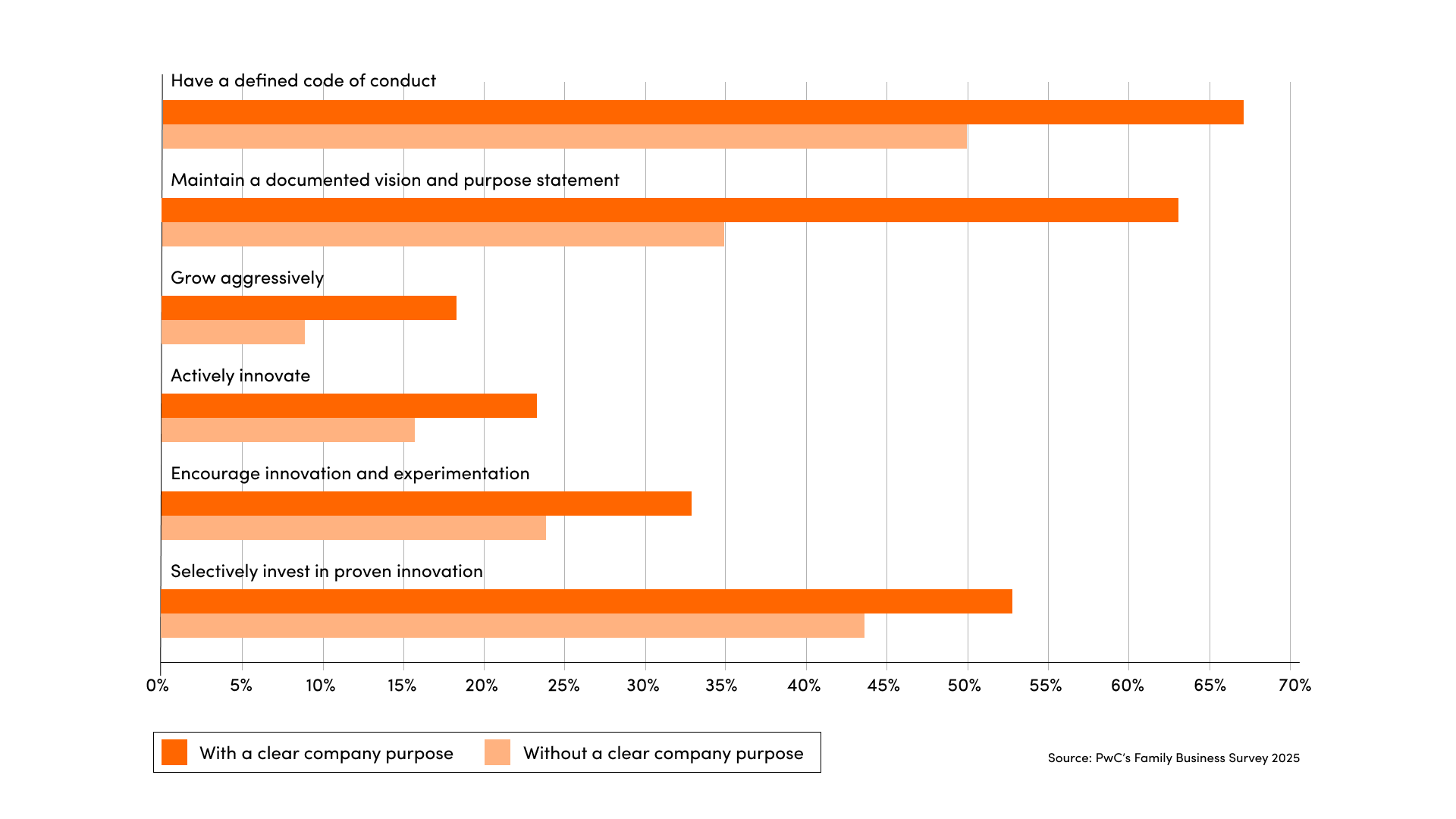
Family-owned businesses with a 'clear purpose' report a greater likelihood of pursuing actions that fuel sustainable performance, PwC says
In the words of Marcus Wallenberg Sr, who was responsible for the founding or reorganization of several hugely important Swedish businesses in his lifetime: “No business is so bad that it cannot be put back on its feet with the right leadership, but no business is so good that it cannot be destroyed by a bad leader.”
The EQT difference: Why not?
Sinding, who joined EQT in 1998, says that from its earliest days the private equity arm of the Wallenberg universe saw opportunities to stand out. “Buyouts were developing all over the world, but with a very financial approach,” he says. “There was a possibility for us to enter the market with a much more industrial approach, with a long-term ownership approach. Basically trying to be the best owner of companies.” In other words, a very Wallenberg approach.
At the same time, EQT had to be adaptable as the global landscape shifted. As Sinding puts it, there was an opportunity to combine “long-term family thinking with the private equity toolset”.
Despite scepticism from some observers about whether the firm could make a mark outside of the Nordics, EQT began expanding overseas in 1999 with the opening of a Munich office. Today, it has offices in more than 25 countries across four continents. This global expansion is just one example of EQT seeking out new opportunities at every stage of its growth.
“In my mind, EQT is a ‘why not?’ company,” Sinding says.
From taking the leap of setting up a new firm in the 1990s, to expanding across Europe and beyond in the 2000s, to becoming a public company at the end of the 2010s, there is a willingness to embrace change in the name of excellence.
“We are a growth-oriented company,” Sinding says. “And we’re really going for gold.”
Values in practice
Subscribing to those principles is one thing, but how do they work in practice?
It comes down to being an investor who thinks about “more than capital”, says Sinding. Driving growth with responsibility at the core means engaging with a portfolio company’s stakeholders, from management to the unions and employees to government.
Here, the Wallenberg connection can be useful on a practical level too, allowing EQT to leverage a global network in its efforts to support leadership teams.
But responsible ownership also means thinking carefully about when to become an owner in the first place. “We want to be able to look ourselves in the eye and say, ‘do we want to own and develop this company in this industry?’” explains Sinding.
This approach isn’t just a way to be principled, in EQT’s view it can also lead to better business decisions. Sinding recalls the boom in cannabis companies during the late 2010s as one example. Despite the hype, EQT declined opportunities in the space, a decision that looked rather wise in retrospect, after the industry bubble popped.
Looking forward
The Wallenberg philosophy is not simply one of continuity. Over the generations, the family business has constantly expanded into new territories and sectors, responding to the shifting world. EQT has done the same.
“We always need to evolve and change,” says Sinding. Right now, the priority is adapting to AI, something EQT has been anticipating for a while and building strategies to match. Whether that’s through helping portfolio companies to upgrade their systems or taking stakes in companies that will be critical to the next phase of AI growth, like data center provider EdgeConneX or humanoid robotics company 1x, it’s a challenge that all parts of the business are rising to.
Marcus “Dodde” Wallenberg, the son of Marcus Sr, once wrote: “To move from the old to what is about to come is the only tradition worth keeping”. We think he’d approve.

ThinQ by EQT: A publication where private markets meet open minds. Join the conversation – [email protected]
MoreInsights








Exclusive News and Insights Every Month
Sign up to subscribe to the EQT newsletter.