

How Private Capital Is Helping to Overcome AI’s Power Problem

Power grids can’t keep pace with the AI boom. Investors are stepping in to bridge the gap.
- As demand for electricity surges due to AI, the U.S. grid faces growing strain.
As artificial intelligence use skyrockets, so does its thirst for energy.
Existing power grids and the buildout of new transmission lines simply can’t keep up. Data centers’ demand for energy is forecast to explode by 175% by the end of the decade, the equivalent of adding another top 10 power-consuming nation, according to Goldman Sachs. Meanwhile, connecting new power projects can take up to five to eight years.
“The industry was left flat-footed,” says Ben Levitt, associate director of North America Power & Renewables Research at S&P Global Energy.
Surging demand, fueled by AI, has led to severe mismatches between where power is needed and where capacity exists. PJM, the wholesale power market stretching from Chicago to New Jersey, faces the greatest data center demand growth of any region. Yet it has placed few orders for new large gas turbines needed to meet that demand, due to price caps and long interconnection waits.
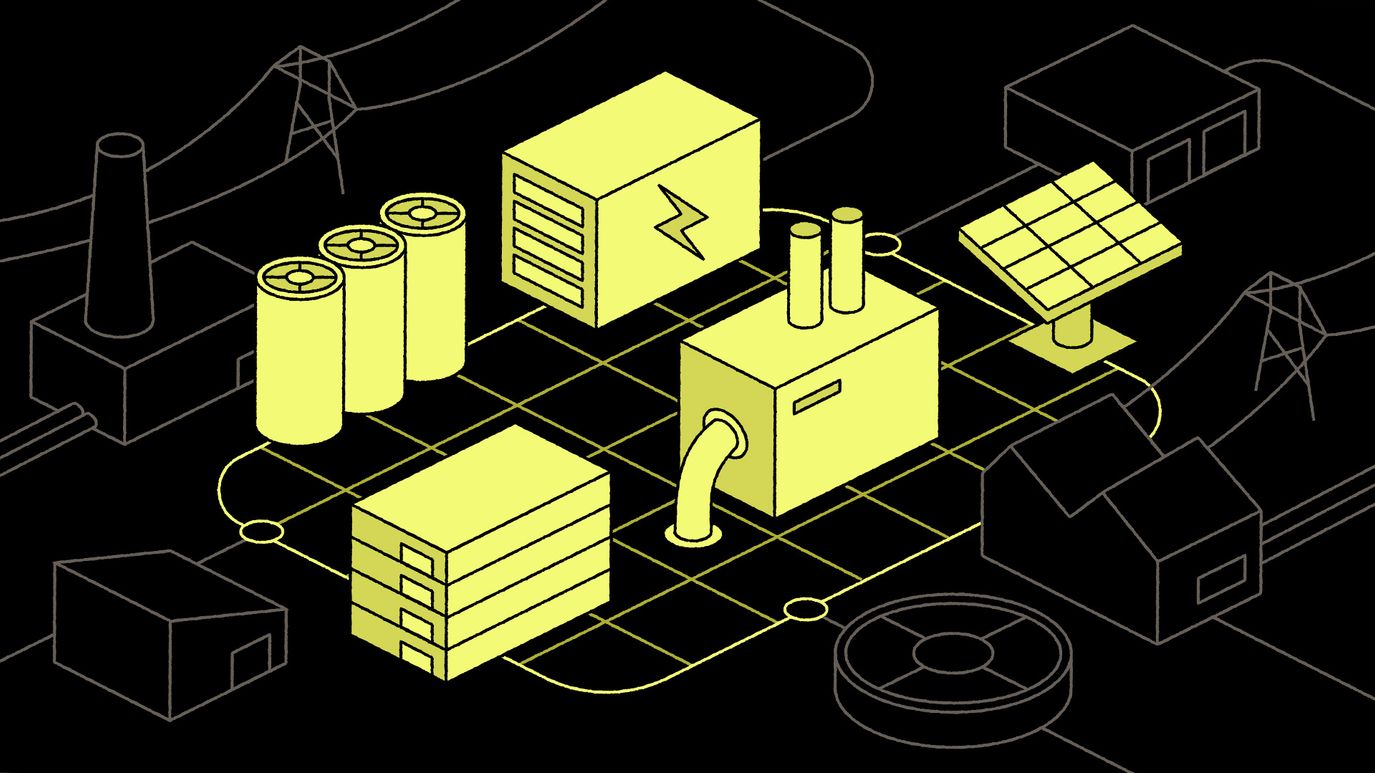
While the power crunch is raising the risk of shortages over the next two years, it’s also creating an opportunity for investors. Data center developers and energy companies, backed by private capital, are focusing on hybrid or off-grid projects to generate electricity, relying on renewable energy, natural gas, microgrids, battery storage, and nuclear power.
On-site power
Global power consumption is rising at the fastest pace in more than a decade. The problem is that traditional utilities were built for decades of relatively flat demand. In the years prior to the AI boom, utilities had actually been closing older plants, since there was more than enough capacity.
The appetite for energy took the industry by surprise, at a time when it takes longer to add supply, says Rob Gramlich, president of Grid Strategies, a consulting firm. “It is much harder to permit and build anything and to get all the equipment needed with today’s constrained supply chain,” he says.
U.S. grids have about 70 gigawatts of spare generating capacity during peak periods, but data centers alone will need roughly 85 gigawatts of additional power by 2030, according to S&P. Most of the demand is concentrated in already-strained regions, such as the mid-Atlantic and Texas.
With the grid unable to deliver power fast enough, data center developers have faced growing calls to bring their own. Big technology companies earlier this month pledged to bear the cost of new electricity generation to power their facilities amid concerns over rising energy costs.
A growing share of data center operators are producing electricity on-site rather than drawing it from the grid. S&P estimates on-site capacity will rise to roughly 30 gigawatts by 2030, meeting about a quarter of new data center power needs.
One roof
This is an area where private capital is playing a crucial role. While regulated utilities must navigate lengthy approval processes, private infrastructure investors can potentially move faster and structure deals more creatively. Private capital is “the oil that keeps the machine going,” says Matthew Kestenbaum, managing director at EQT.
EQT has built a portfolio ranging from energy projects to data centers. Those holdings include EdgeConneX, which develops data centers for hyperscale customers, and Scale Microgrids, which designs, builds, and operates on-site power systems, incorporating solar, batteries, gas generators, and fuel cells. Cypress Creek, Zelestra and OX2 develop renewable energy projects, while Zayo provides communications infrastructure.
Working with its portfolio companies, EQT can provide expertise and capital to help develop a large-scale energy project and put a data center next to it, then market the integrated solution to major AI companies and provide connectivity.
“We’re able to break down barriers and drive collaboration across our different companies to think about what more integrated solutions look like,” Kestenbaum says. “A lot of people only have one piece of the puzzle. But we can bring all those together and put capital behind it.”
Backup power
What the industry calls "behind-the-meter" capacity is expected to surge over the next five to seven years, then ebb as loads migrate back to the grid. But that doesn’t mean these assets will go to waste. “These aren’t going to be stranded assets,” says Levitt of S&P.
Data centers still need backup power, a role traditionally filled by diesel generators. Regulators are starting to require data centers and other large consumers to use their on-site technologies to help alleviate stress and strengthen the broader grid by adding capacity.
“You’re always going to need grid capacity,” Kestenbaum says. “You’re always going to need behind-the-meter capacity. They’re not mutually exclusive.”
The scale of the challenge is global, and even conservative demand forecasts far exceed anything the power industry has dealt with in decades. Whether the system can keep pace remains an open question. But increasingly, private capital is part of the answer.

ThinQ by EQT: A publication where private markets meet open minds. Join the conversation – [email protected]
MoreInsights






Exclusive News and Insights Every Month
Sign up to subscribe to the EQT newsletter.