

How a Three-Horse Sleigh Inspired EQT’s Governance Model
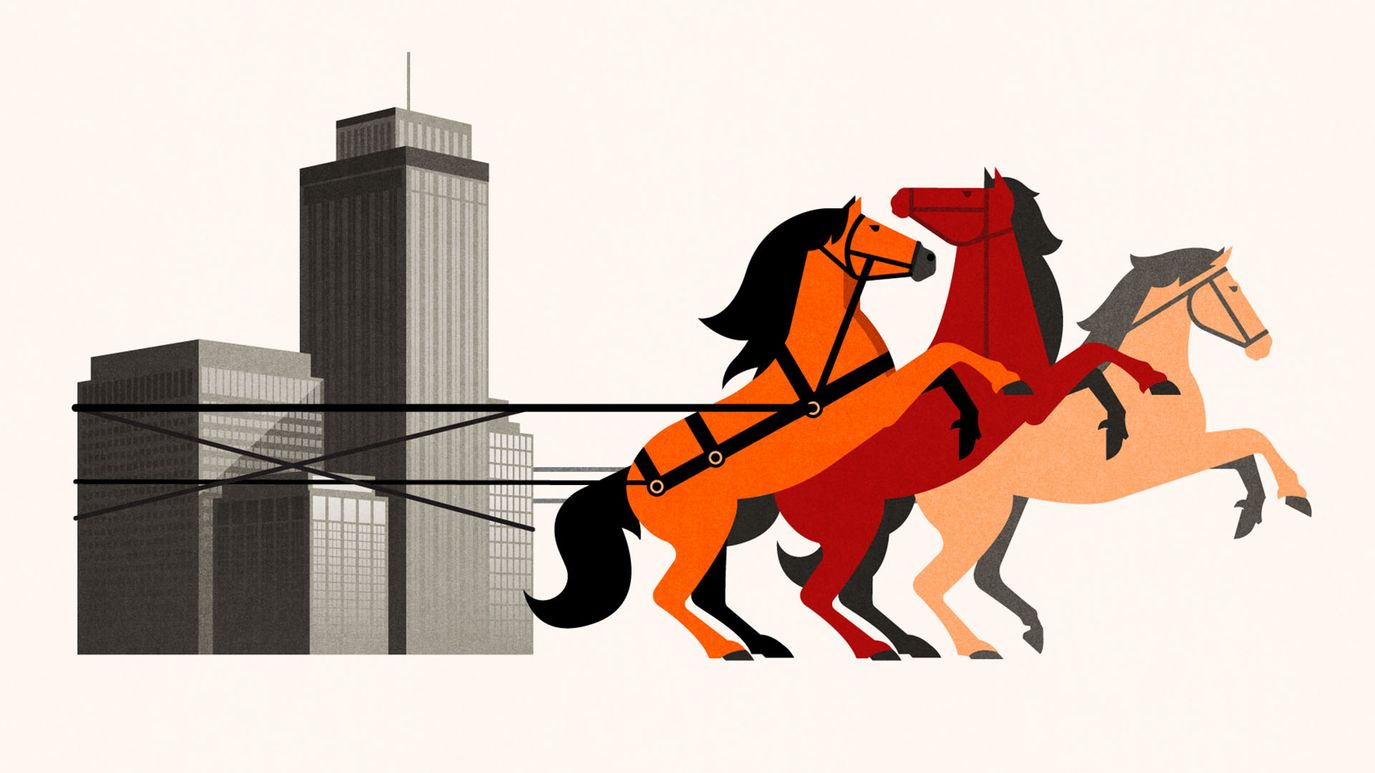

The Troika has been at the heart of EQT’s investment approach since the firm’s beginning. The three-member group is designed to keep portfolio companies on track.
- The EQT Troika is part of every EQT-controlled company and comprises the firm’s CEO, Chair and senior EQT representatives.
“Quite simple” is how Bettina Siempelkamp, Head of Global Network Talent for EQT, describes the Troika: “It’s a group of three and they support and challenge each other.”
Found at all EQT-controlled companies, those three are the Chairperson, the CEO, and the EQT deal partner, all of whom meet regularly to discuss the running of the business. It is not a decision-making authority, nor a substitute for the board, says Siempelkamp, but a “power triangle” of open, informal, and entrepreneurial cooperation.
Ever since its foundation, this deceptively simple idea has been a crucial pillar in the EQT Governance Model, supporting companies throughout EQT’s stewardship with the goal of future-proofing them for the long term.
The word ‘Troika’ refers to a sleigh pulled by three horses. EQT’s Troika isn’t so different: designed to guide and support the value-creation investment plan for every EQT investment, with all three members pulling in the same direction. Very occasionally, in some deals, the Troika expands to four members.
No two Troikas are the same, but the seriousness with which each is taken is consistent across the EQT portfolio. While company boards typically meet five to six times a year, the Troika, at least at the beginning of EQT’s investment period, usually meets weekly, with at least one physical meeting a month.
These catch-ups are a forum for an open exchange of ideas, criticisms, questions, and plans, and can be used to dive into particular topics in more detail than would be appropriate for a board meeting. The frequency is designed to foster as strong a relationship as possible.
Speaking to ThinQ in 2024, Gunnar Asp, a chairperson of numerous EQT companies, put it this way: “The Troika model was new to me but proved to be an excellent governance framework, allowing for strategic but non-pressured decision-making. It fostered an environment where CEOs could operate with confidence and informed discretion.”
Powered by a network of advisers
Part of what makes the Troika such an essential tool is EQT’s industrial advisor network, which comprises more than 600 industry experts, entrepreneurs and executives. It is from here that EQT typically sources not just the Chair but the majority of the board.
The roots of the network – and the Troika – can be traced back to EQT’s genesis. In 1993, Conni Jonsson was working for the Wallenberg family’s industrial holding company, Investor AB, when he was given a mandate to establish EQT, a private equity company rooted in the family’s traditions of responsible ownership. Following the launch of EQT’s first fund the following year, the Wallenbergs told Jonsson that he could tap up anybody in their vast network for advice on any new acquisitions.
Today, it’s an industry-wide practice, but back then, Jonsson immediately realised that the input of, as Siempelkamp puts it, “someone who’s been there and done it from an operational point of view” gave EQT a considerable edge.
Since then, the industrial advisors network has become a core strand of EQT’s DNA. Advisors now support through the entire investment process, from providing strategic advice on deal sourcing to joining – and chairing – the boards of portfolio companies.
Building a Troika
Earlier this year, Jonsson told a room of EQT Chairs: “When we established [the] Troika, that was because, as a CEO, I felt I had no one to talk to.” Bringing in an experienced Chair to work closely with the CEO remedies this, says Siempelkamp, as they become, “the challenger, the cheerleader, the best friend, the translator, the coach,” whatever the CEO needs them to be in the moment.
Finding someone who can occupy all those roles is not a task Siempelkamp and her team take lightly. “Hunting for the Chair is as important and as complex as hunting for a deal,” she says. As well as being an informal advisor to the CEO, the Chair “ultimately decides on whether the CEO should be in that position.” That’s a crucial analysis, as estimates suggest that between 20 and 50 percent of CEOs at private equity-backed firms are replaced within the first two years.
EQT typically begins searching for the Chair before a deal is even complete, bringing them in at the due diligence phase, or sometimes even earlier. “It’s a very good test of whether this is going to work,” says Siempelkamp.
“We build the board in a way that maps it onto the plan – so if we’re executing a large M&A strategy, there should be someone on the board who’s done that, or if it’s a huge go-to-market effort in a software business, then there should be a proven go-to-market expert on the board,” says Siempelkamp.
In addition, EQT boards often have a dedicated Audit Chair, a digital expert, and a sustainability champion. Additionally, each member of the board and management is expected to invest in the business. “In that way, we ensure that everyone has entrepreneurial skin in the game,” says Siempelkamp.
Successful board building considers more than pure sector expertise – it’s about matching personalities and finding skill sets that complement each other. More recently, this has been supported by Troika Jumpstart, an overnight off-site during which members align on goals, management strategies and self-improvement approaches.
As with the entire Troika forum, Siempelkamp explains, “It’s not that they need to be best friends, right? That’s not the point, but they need to lift each other up.”
In doing so, the company is expected to go in the same direction.

ThinQ by EQT: A publication where private markets meet open minds. Join the conversation – [email protected]
MoreInsights







Exclusive News and Insights Every Month
Sign up to subscribe to the EQT newsletter.