

Attention Is Just the Start: Seizing Europe’s Strategic Tech Opportunity



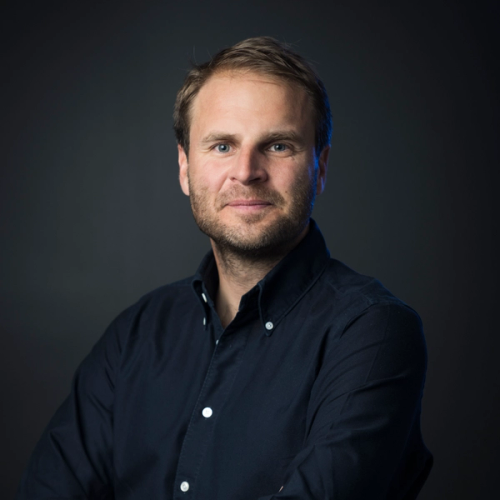



In a new white paper, EQT's Victor Englesson, Ted Persson, Robert Sternberg and Sandra Malmberg argue that Europe can build the next generation of global tech champions.
- Building the next global tech champions in Europe is possible and achievable. Europe can make scaling easier by simplifying and unifying rules, creating an ambitious 28th regime, and making public procurement more innovation-friendly. Europe must also encourage late-stage capital and corporate partners to work together to support scale-ups, through initiatives like offtake agreements and milestone-based financing.
Long before AI and large language models (LLM) became synonymous with Silicon Valley, Europe was shaping the ideas that would make them possible.
In 2017, leading AI researcher Jakob Uszkoreit co-authored “Attention Is All You Need,” a seminal paper that introduced the Transformer architecture underpinning most modern LLMs, like the AI tool ChatGPT. Jakob’s father, Hans Uszkoreit, was himself an early, accomplished computer science scholar. His career began against the backdrop of the Cold War, fleeing his native East Germany after 15 months imprisonment for protesting the Soviet invasion of Czechoslovakia. Landing in Berlin, Hans studied computer science and linguistics, and went on to work at an AI lab at the SRI research institute in California, before returning to Germany with his family.
Jakob continued in his father’s tradition, completing a Masters in Computer Science and Mathematics from TU Berlin in 2007. But instead of going on to pursue a PhD in Germany, Jakob in 2006 accepted an internship offer at Google. Uszkoreit would stay at the American search giant for over 13 years, during which time he made foundational contributions to the modern field of AI, culminating in “Attention Is All You Need.”
It is striking that of the eight named authors of the paper, Uszkoreit is not the only European contributor. In fact five of the eight hold European citizenship. Look across the highest echelons of global technology, and you will find many more examples of Europeans in charge, from Yann LeCun (long-time leader of the FAIR lab at Meta) and Demis Hassabis (co-founder and CEO of Google DeepMind), to younger leaders like Jakub Pachocki (chief scientist at OpenAI, where he works alongside Łukasz Kaiser, another of the European “Attention Is All You Need” co-authors).
Europe has high standards of living, liberal democracy and world-leading education across the continent; its contributions to the modern knowledge economy are a product of these strong foundations.
Yet, Europe has struggled to capture even a fraction of the value created by its citizens since the turn of the millennium. Technology investment in Europe has lagged the U.S. since 2010, and this gap has widened in recent years.
European R&D spending is lagging the U.S.
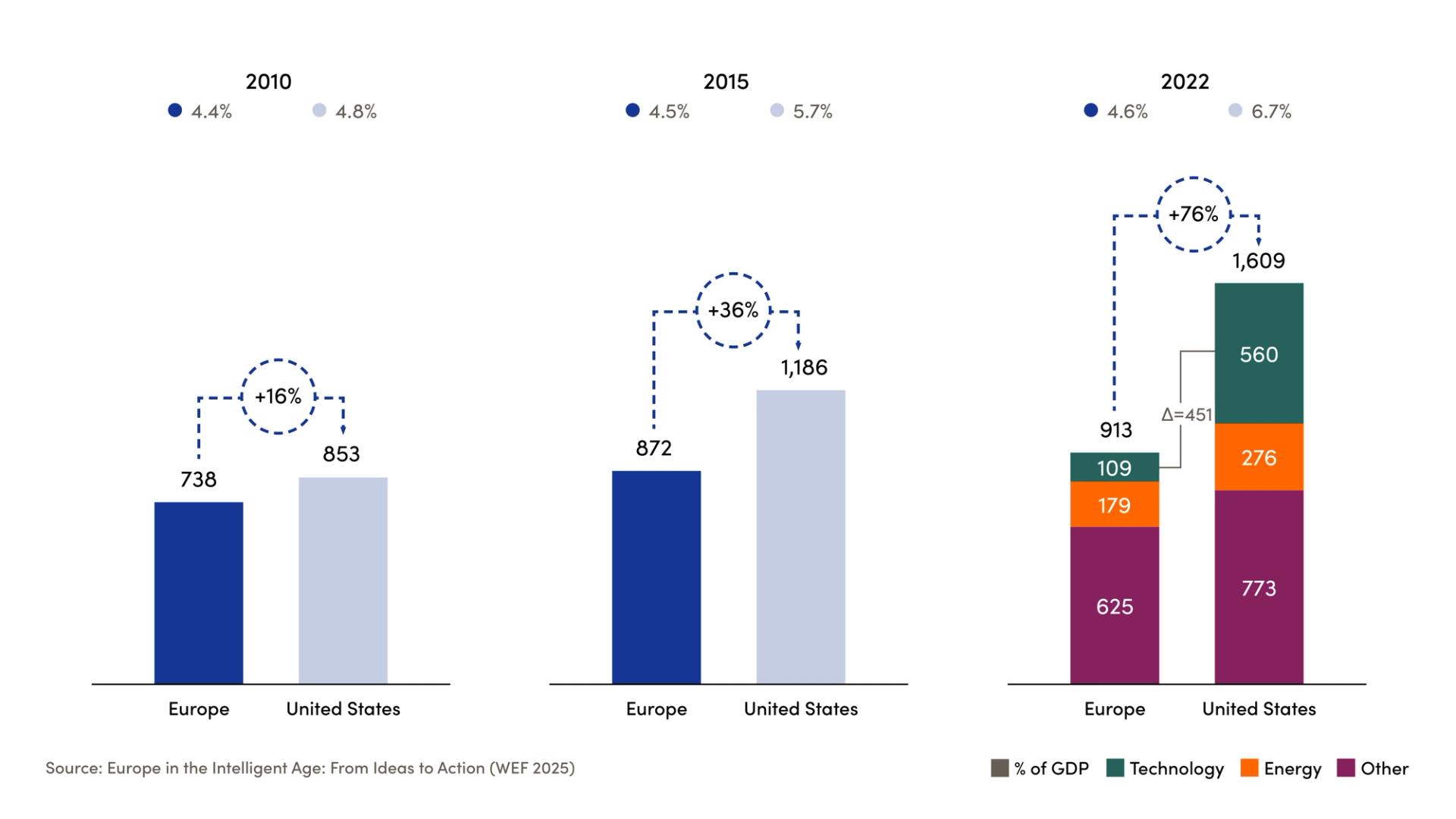
2010-2022 captial expenditure and R&D spend of European and U.S. corporates with revenue greater than $1bn/€1bn in 2022 prices
Europe’s large firms spend roughly half as much on R&D as a share of revenue as U.S. companies and grow only two-thirds as fast, with a return on capital four points lower (2015-2022). As a consequence, Europe has created virtually no global tech champions to challenge American titans like the MAG-7, or China’s Alibaba, Huawei, and Xiaomi. In fact, the EU has created just 14 companies from scratch in the past 50 years with a public valuation exceeding $10bn; in that time, America has created 241. Recent breakthroughs in Generative AI have thus far not changed this pattern, with Europe investing just ~7 percent of U.S. investment levels in Generative AI during 2023 ($1.7bn in Europe vs $23bn in the U.S.)
This has profound consequences for both Europe’s growth and productivity, with real disposable income in the EU growing by around half that of the U.S. since 2000. And as economic power and warfare become ever more technology-dependent, technological capacity will increasingly underpin – or inhibit – sovereign influence. To quote the 2024 report on EU competitiveness from former European Central Bank president Mario Draghi: “This is an existential challenge.”
Despite these headwinds, there is reason for optimism. Europe’s large, well-educated population, leading research institutes and strong industrial base are deeply entrenched advantages. The problems are fixable, and both public and private actors in Europe are beginning to act with urgency.
Generative AI, in particular, is a timely catalyst to translate this new momentum into concrete change. More so than in other recent technology platform shifts, leading AI companies are producing deep technical innovations. These emerging champions are pioneering new frontiers in computer science, semiconductor design and energy generation – what has sometimes been categorized as “deep tech.” And they are applying these advances to industries which have been slower to digitize, like healthcare and industrial robotics, where Europe already competes well on the global stage.
Pulling these strengths together, Europe has the opportunity to build a robust, globally competitive tech economy with European values at its core. One centered on deep, technical research, public and private partnerships, and equitable access to value creation across the European continent. In the sections below, we outline some of the areas where Europe is uniquely positioned to win, as well as how policymakers and corporate partners can support this ambition.
Europe’s edge
Europe is already producing a large and growing cohort of promising companies across the most strategic technology sectors of the next decade, including AI, robotics and energy. We identify over 650 scale-up companies today (for simplicity, defined in this paper as raising a Series C or later in private financing), addressing over €675bn in total end markets today. The number of scale-ups is expected to grow by more than 2.5x to around 1,900 by 2030.
This strategic tech pipeline includes hundreds of emerging future unicorns, alongside breakouts which have already achieved multi-billion-euro valuations, like Black Forest Labs in Germany and Lovable in Sweden.
Identifying promising sectors for European growth
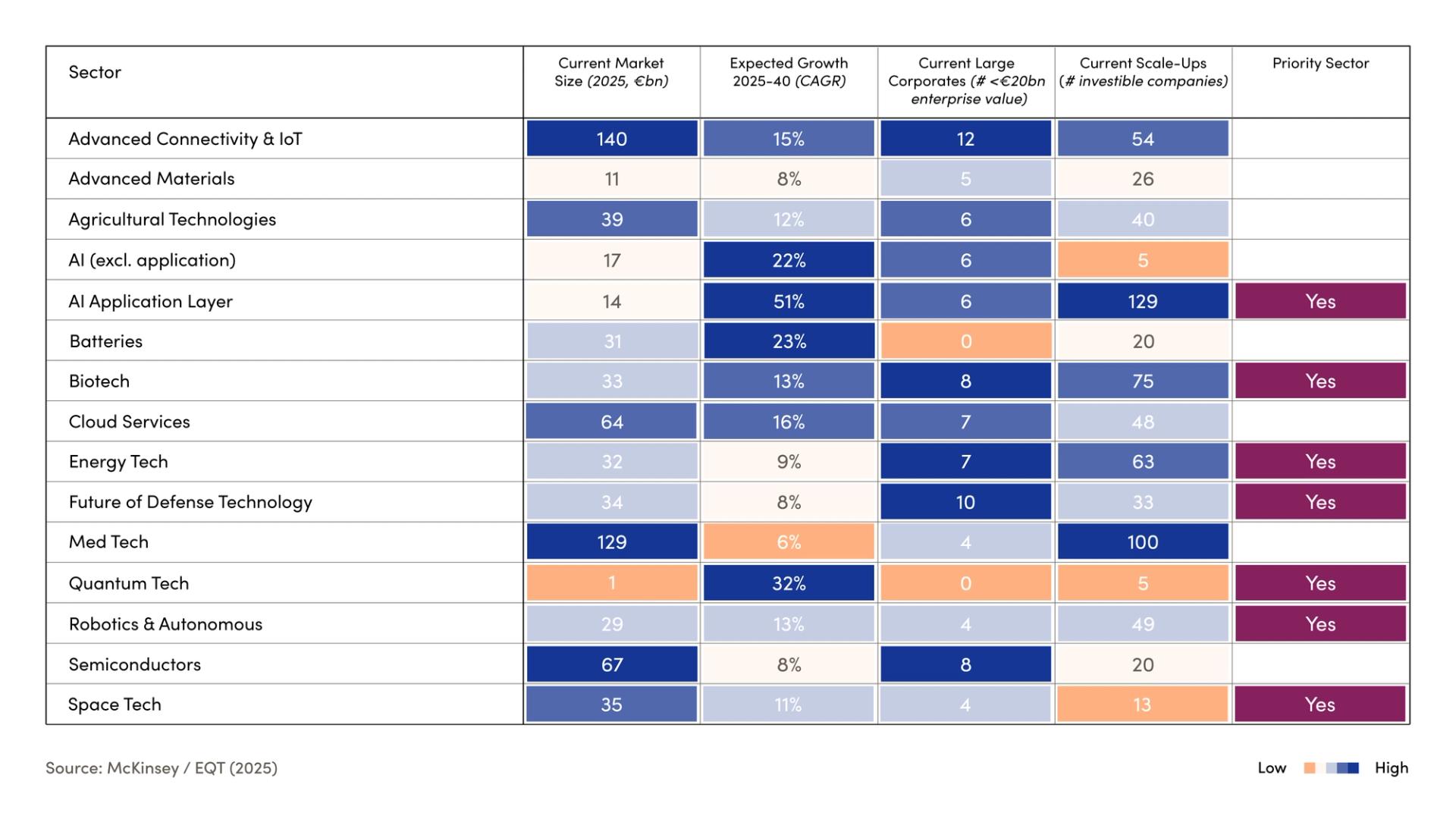
We see the most promising opportunities in sectors which have the following two attributes:
- Transferable learnings and talent pool from current European industry (“Right to win” sectors): The best European technology opportunities will tap into the continent’s existing industrial strengths, which are different to those of the U.S. or China. This includes strong suits in both technology (e.g. application software, fintech) and other sectors (pharma, industrials & robotics, renewable energy etc).
- Geopolitical importance (“Can’t lose” sectors): Europe faces pressure to develop sovereign capabilities in certain critical technology sectors. These include energy, biotechnology and defense. We see these sectors as best-positioned for public-private partnership in the coming years, aligned with the EU’s competitiveness and sovereignty agenda.
With this framework in mind, we have identified the following sectors as particularly promising. Importantly, these are not the only sectors in which we believe Europe is likely to produce technology champions over the next decade – these markets evolve quickly.
AI application layer: Europe has a thriving ecosystem of applied AI companies, with several valued at $5-10bn in private markets. Europe has for decades produced leading software companies across business and consumer end markets. It also has a strong base of enterprise buyers across both horizontal IT use cases and industry-specific verticals. This sector alone has over 100 emerging unicorns in the pipeline.
Biotech: Europe benefits from deep scientific excellence rooted in traditional healthcare and pharmaceutical industries and is well positioned to combine this expertise with AI innovation. This has led to a robust innovation pipeline across both established and emerging treatment approaches, including biologics, small molecules, RNA-based medicines, antibody-drug conjugates, radioligand therapies, as well as gene and cell therapies. Together, this creates a clear opportunity to retain, build and scale more of these companies within Europe.
Dual-use defense and space: Defense spending commitments are up across the continent, and NATO members are now targeting 5 percent of GDP by 2035 up from 2 percent before the invasion of Ukraine. Europe’s existing defense incumbents have grown their order books meaningfully since 2021, but new technology-led entrants are needed in areas like autonomous systems, threat intelligence and space.
Energy technology: Europe has technological strength in fusion, carbon capture, utilization & storage (CCUS), nuclear and grid technologies, driven by longstanding leadership in technologies for reducing carbon emissions, which are adopted globally. Europe now also has a strategic and economic imperative to accelerate clean energy production to grow the continent’s energy supply, and decouple European output from fossil fuel prices. European companies face energy costs today which are 2-3x that of their U.S. peers. We see more than 50 potential unicorns in the pipeline in this sector.
Current and next-gen leading European companies
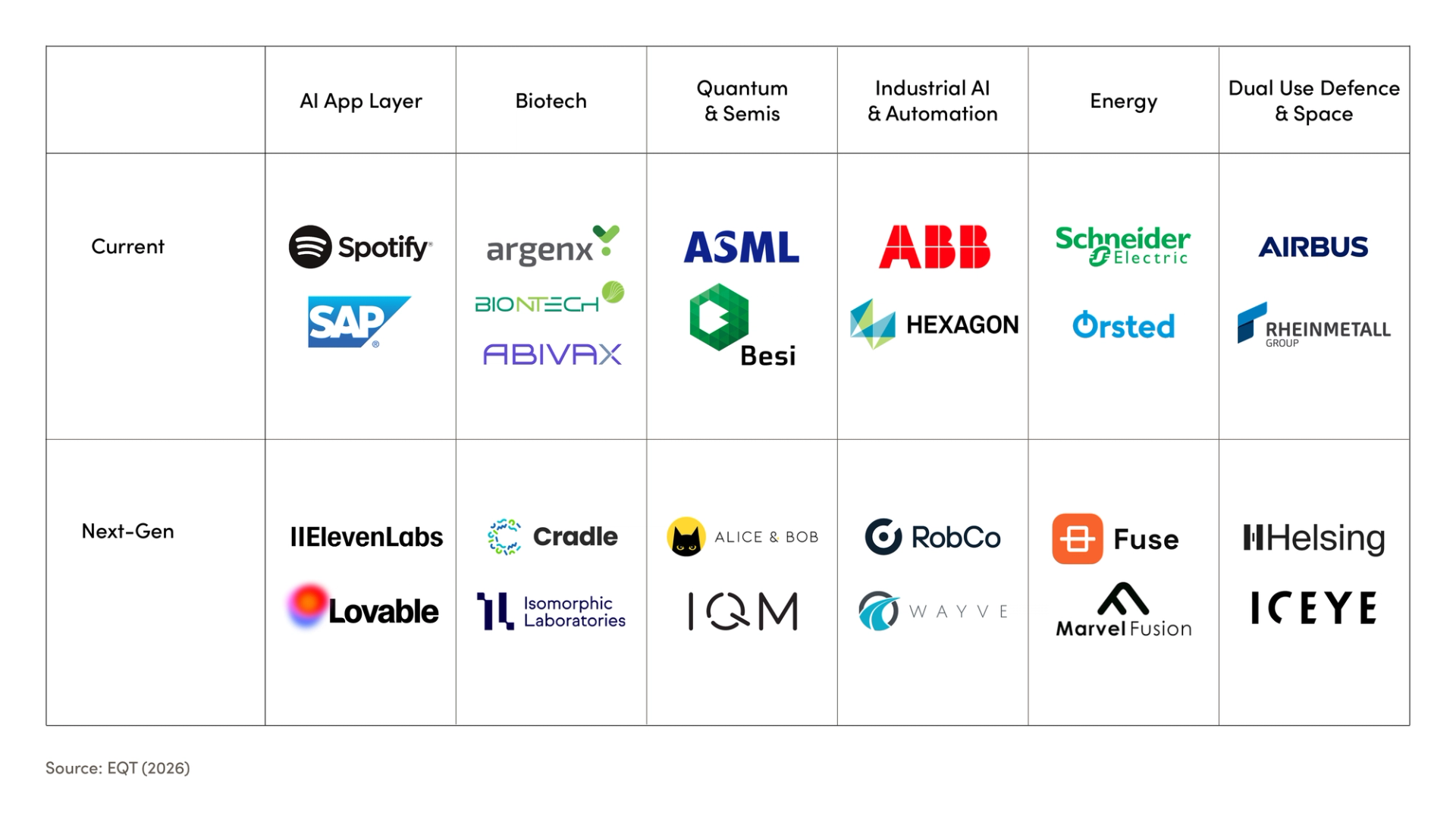
Note: Illustrative examples, not a comprehensive list
Industrial AI and automation: Europe is a longstanding leader in production of robotics, vehicles and industrial products like chemicals. We need to translate that knowledge and now lead the way in automation technologies.
Quantum and semiconductor technologies: Europe has world-class computing research clusters in The Netherlands, Germany and France, and incumbent strength in power electronics, lithography and materials development. Emerging compute architectures - such as quantum systems and specialized AI chips - remain early or unproven. Yet they hold the potential for profound impact and could enable certain classes of complex computational workloads to be executed with dramatically lower energy intensity than today.
What it will take to scale in Europe
Europe has long excelled at producing innovative technologists and companies, for all the reasons discussed above. And the early stage venture capital ecosystem in Europe is as robust as it has ever been, with deal volume up more than four times in the past decade.
The challenge is that many of Europe’s most promising companies leave as they achieve meaningful scale. Between 2008 and 2021, close to 30 percent of the unicorns founded in Europe relocated their headquarters abroad, with the vast majority moving to the U.S.
More domestic scale-up capital can help curb this trend. There are far fewer European funds which can credibly lead a €100m financing round than can lead a €10m round. U.S. funds fill this gap, but this capital often comes with an expectation to move to North America. More capital is only part of the answer; the other is making Europe a more attractive home for scaled technology companies, which will require engagement from ecosystem stakeholders like policymakers, and large corporate partners.
Policy
Broad efforts to simplify and harmonize fragmented EU markets will go a long way towards enabling businesses to scale in Europe, in technology and beyond, and we support such efforts. The IMF recently estimated that intra-EU trade barriers create the equivalent of a 44 percent tariff average for goods (three times that between U.S. states) and 110 percent for services. Europe should also explore liberalizing policies around land use and construction permitting, to accelerate strategic industrial activity in areas like energy, manufacturing and defense.
As has long been shown, for example in Enrico Letta's "Much more than a market" report (2024), Europe's single market is a globally unique asset to attract and scale technology companies - provided we leverage this market strategically and tackle its persistent weaknesses. In our view, this requires three main types of actions - several of which have already been identified by the EU institutions and are in the process of being implemented:
- An ambitious “28th regime”: A pan-European corporate entity is crucial to build and scale in Europe and to attract and retain the right talent. The 28th regime should be established through a directly applicable regulation, rather than a directive, ensuring legal certainty, uniformity and speed of adoption. The framework should build on the principles articulated in the EU-Inc initiative, notably a digital-first, standardized corporate structure designed for high-growth companies. This includes standardized EU-wide employee stock option plans, a central EU-level registry that is fully digital and in English and standardized investment documentation to reduce friction in cross-border fundraising. Crucially, it should not impose limits to the size and scope of the companies that can benefit, ensuring a seamless transition from start-up to scale-up and beyond.
- Pan-European industrial collaboration: In strategic technology areas like energy, space and defense, Europe should align procurement initiatives and standards, alongside boosting funding for these unified programs. As one example, Europe currently spends just €12bn annually on space, around 11 percent the global total, and does not yet have a scaled alternative to SpaceX’s commercial launch offering. Initiatives such as the proposed EU Space Act can also support pan-European collaboration by creating a Single Market for space activities and bringing much needed harmonization across national approaches – although it must not increase the compliance burden for start-ups and scale-ups.
- Public procurement as a catalyst: Expand funding paths and reduce procurement timelines for innovative European scale-ups in strategic technologies in areas like energy, semiconductors or quantum. The EU can also look to parallel agency or sandbox programs, like the U.S. Army’s Janus program for nuclear reactor development.
Scale-up capital & corporate partnerships
While Europe has made substantial progress over the last decade in attracting early-stage risk capital, funding gaps occur further down the scaling journey. Even in proven, capital-light sectors like software and consumer internet, there are few European capital partners with the funds to support €100m+ equity checks. As a consequence, many scale-ups turn to American venture capital and private equity sources. But leading American platforms offer more than just capital:
- They support expansion to the U.S. market, which is structurally larger and more growth-oriented than Europe today.
- They offer a global perspective, given the common investing mandate across North America and Europe. This contrasts with many European funds, whose experience outside of Europe – and thus, firsthand knowledge of many technology “best practices” from North America – is limited.
- They have relationships with other U.S. startups/scale-ups and forward-looking U.S. corporates, who tend to be helpful early commercial partners for new products.
It is thus important to emphasize: Europe does not just lack scale-up capital. It lacks value-add capital for growth-stage companies.
Stronger public-private cooperation and new corporate partnerships will be key to addressing these challenges, and many good initiatives are already underway, such as the European Tech Champions Initiative and the European Commission’s proposed Scale-up Europe Fund (SEF). Initiatives like these can play a critical role in supporting Europe’s scale-up ecosystem and in building the tech champions of the future.
However, it is important to emphasize that initiatives like SEF should offer more than just capital. To be truly transformative, they should function as “anchor” capital surrounded by a network of additional capital sources, offtake partners and talent ecosystems.
This need is particularly acute for companies building in capital-intense “deep tech” fields. These companies can typically fund early stage R&D with standard equity financing, but need to assemble more bespoke mixtureses of grant, debt and milestone-based equity financing at the repeatable commercialization stage. This challenge drives the so-called “valley of death” in deep tech.
Bridging the commercialization gap
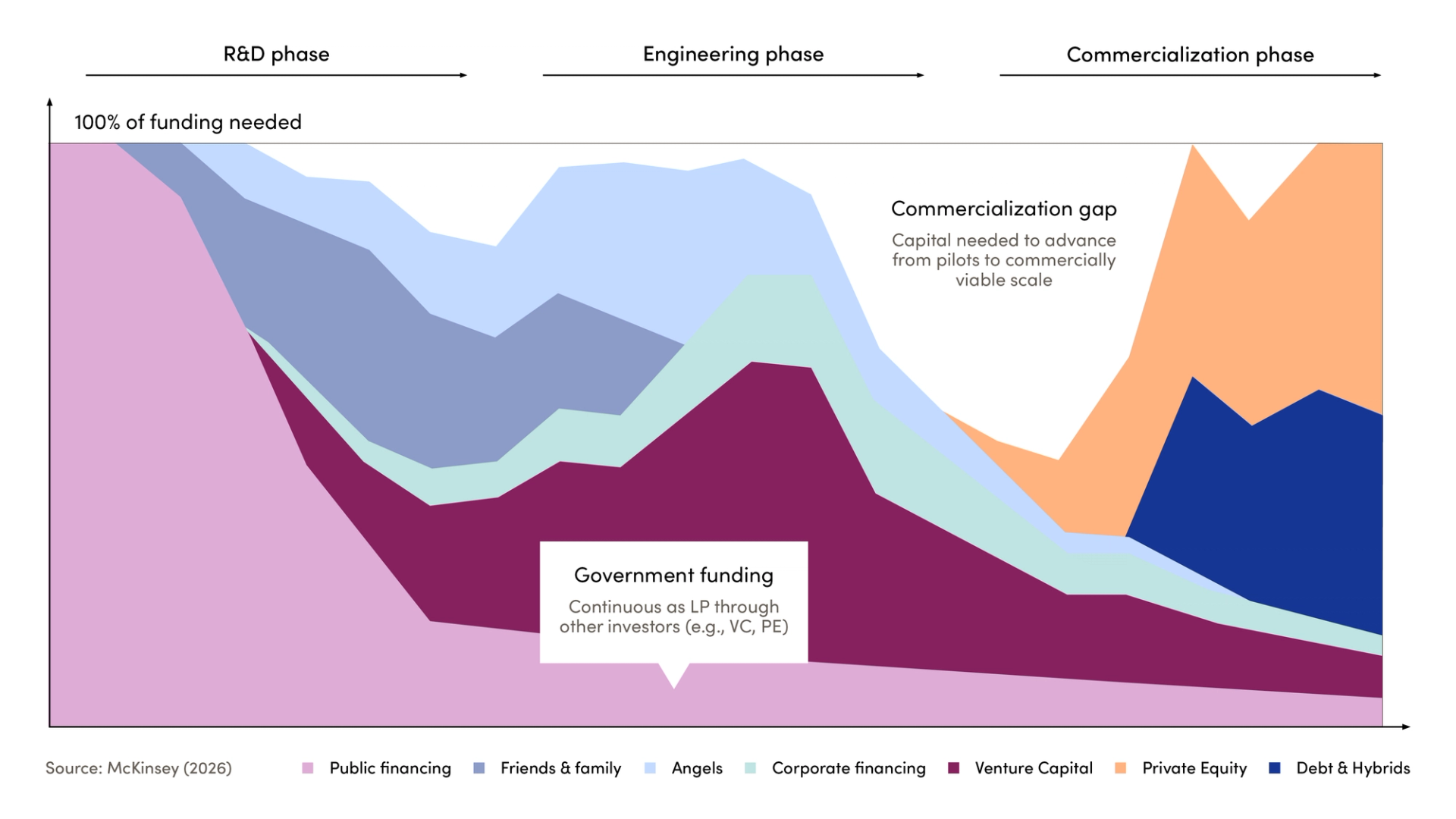
Indicative financing available relative to amount needed
It is by providing meaningful (€100m+) equity checks alongside an orchestrated set of incremental venture capital, bank partner financing, state grants and offtake partners that initiatives like the SEF can help close this gap. This is the level of ambition we need to help make Europe’s scale-up capital competitive against global alternatives.
A brief history of tech ecosystems
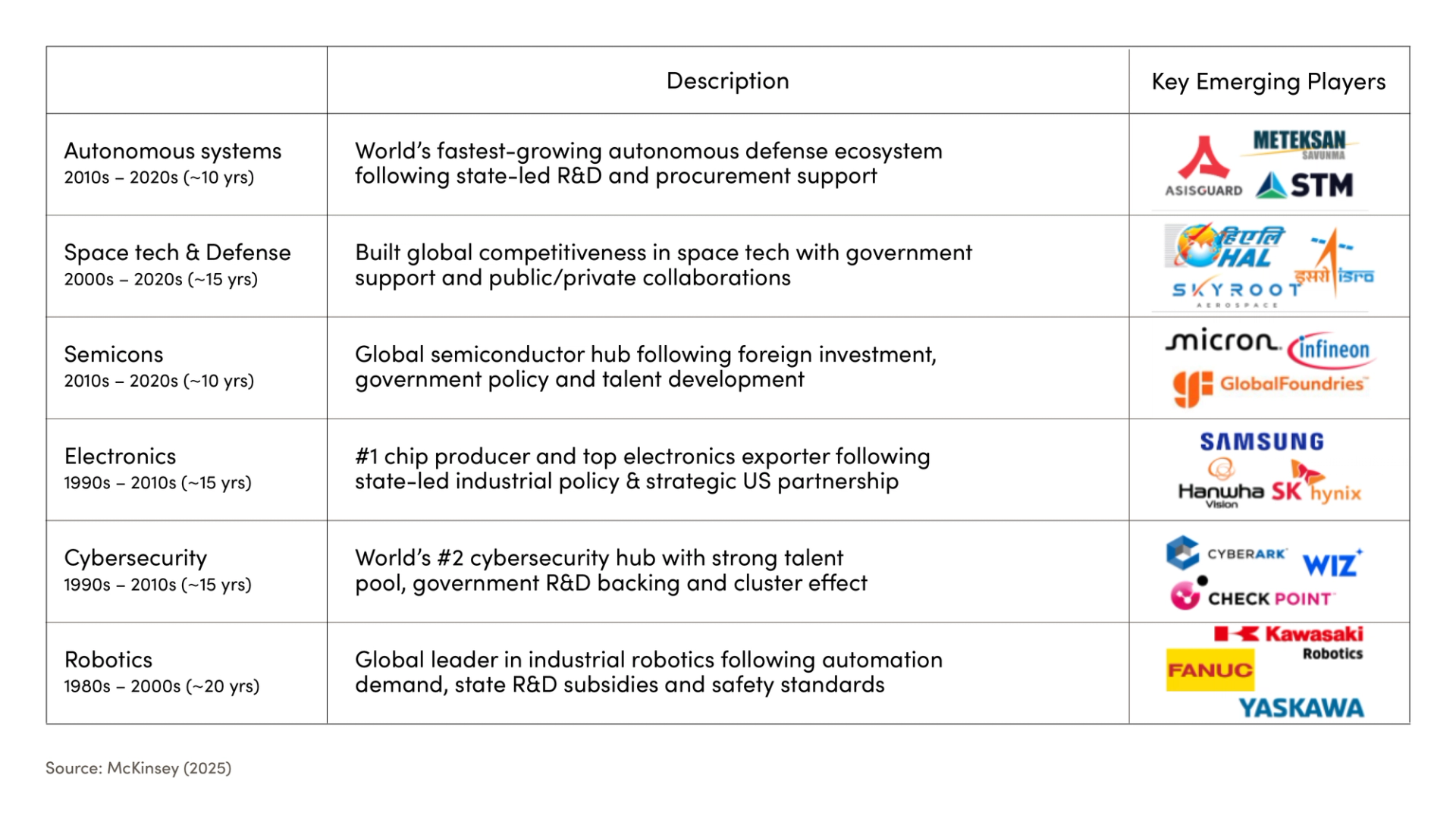
It is important to underline that there are global precedents for this type of public private partnership-led innovation. As one example, Israel’s cybersecurity industry has long been supported by government initiatives. These range from the Yozma Program, which incentivized foreign venture capital in the 1990s, to the IDF’s Unit 8200, which to this day produces many of the country’s cybersecurity startup leaders. These ecosystems don’t develop overnight, but once they do, they tend to be highly durable and self-reinforcing.
The road forward
This spring, thousands of talented technologists across Europe’s leading engineering schools will face the same choice Jakob Uszkoreit did two decades ago. Europe has a window of opportunity to convince this new generation to build tomorrow’s Alphabet, Nvidia or OpenAI on this continent, but it will not last for long. Europe must act with urgency, bringing together public and private stakeholders, to chart a new course.
(Download this white paper as a PDF .)
Disclaimer: This white paper is provided for general information purposes only. Nothing on this article constitutes or is intended to constitute an offer to sell or a solicitation of an offer to buy any interest in any investment vehicle managed by EQT or any company in which EQT or its affiliates have invested,or an advertisement of, or an offer to provide, any investment management or advisory product or service. We are not soliciting any action based on this report.
Victor Englesson is a Partner and Head of Early Stage Technology at EQT, where he leads the firm’s early-stage technology investing across Ventures and Growth. He also serves as Head of EQT’s Global Technology Sector Team, reflecting EQT’s long-term commitment to technology as a core driver of growth and competitiveness. Based in Stockholm, Victor’s work spans across Europe and the U.S., and he is deeply involved in EQT’s ambition to support the next generation of global technology leaders. Victor joined EQT Partners in 2010 and was based in the firm’s New York office from 2015 to 2016. He is a member of the EQT Growth Partners Investment Committee. Victor holds an M.Sc. in Industrial Engineering and Management from the Royal Institute of Technology in Stockholm. Prior to joining EQT, he worked at Tele2 AB as an Executive Trainee. Directorships Investments: Epidemic Sound, Ardoq, CYE, Lovable Previous: Coromatic Group, IP-Only, Musti Group, TIA Technology, Freepik, RIMES, Adamo, Parcel 2 Go
Ted Persson joined EQT Partners in 2015. Prior to joining EQT Partners, Ted founded leading global digital agency Great Works, advising some of the world's leading brands and startups. Since 2014, he has also led North Alliance's Startup Incubation unit.
Experience: Robert Sternberg joined EQT Growth in 2025 as a Director. He primarily focuses on investing in software and fintech companies. Prior to EQT, Robert spent seven years at Accel across San Francisco and London, where he helped establish the Growth Fund’s presence in Europe as well as the global Leaders Fund. Some of his prior investments include Monzo, Remote, commercetools, Trade Republic, Vinted, Cognite, and UiPath. Robert started his career in technology investment banking at Goldman Sachs in San Francisco. Robert holds a BS in Business Administration from Babson College and is originally from NYC.
Sandra Malmberg is a Partner at EQT Ventures, where she focuses on backing visionary and technologically ambitious founders who are reimagining the future. With a keen eye for breakthrough innovation and a deep commitment to founder support, Sandra has been instrumental in several of EQT Ventures’ most forward-thinking investments. Her portfolio includes pioneering companies like Sana, which is harnessing the power of AI to transform learning and upskilling at scale; 1x, which is building safe humanoid robots designed for use in the home; and Vsim, a next-generation platform redefining physics simulations for research and development.

ThinQ by EQT: A publication where private markets meet open minds. Join the conversation – [email protected]


Exclusive News and Insights Every Month
Sign up to subscribe to the EQT newsletter.