

In an AI World, These Human-Centered Activities Could See Their Value Soar



As artificial intelligence reshapes the modern world, healthcare and live experiences remain realms where human presence can’t (yet) be replaced.
- AI is likely to standardize outputs, increasing the value of scarce human judgment and personal interaction.
Artificial intelligence is already reshuffling the real economy. Federal Reserve researchers estimate that generative tools raised U.S. productivity by 1.1 percent in the 18 or so months following the launch of ChatGPT in late 2022. British Prime Minister Keir Starmer has said that in the coming years there will be "barely an aspect of our society that will remain untouched" by AI.
But there’s a catch. “AI will generate a lot of content but it will soon be highly commoditized,” says Hemant Sharma, a partner at EQT Private Capital Asia. Products and services may become largely indistinguishable from one another, leading to intense price competition, thin profit margins and low customer loyalty.
One unexpected impact of this new AI reality, according to Sharma, is that human-centered activities may become more sought after. From sports to music to healthcare, investors are seeking out opportunities where the human touch may be more valuable than ever.
Next generation of the beautiful game
On any given Monday, a new fast-paced soccer competition is beamed around the world from the Copper Box Arena in London’s Olympic Park. Baller League is a high-octane six-a-side contest that combines sports stars with internet celebrities like KSI, who has over 75 million followers across social media.
In late 2024, EQT’s venture capital division led a $25m investment round into Baller League, which has also drawn support from former football icons including Ronaldinho, Gary Lineker and Luis Figo, who have appeared as team coaches.
Global private equity deals involving “sports team” or “sports club”.
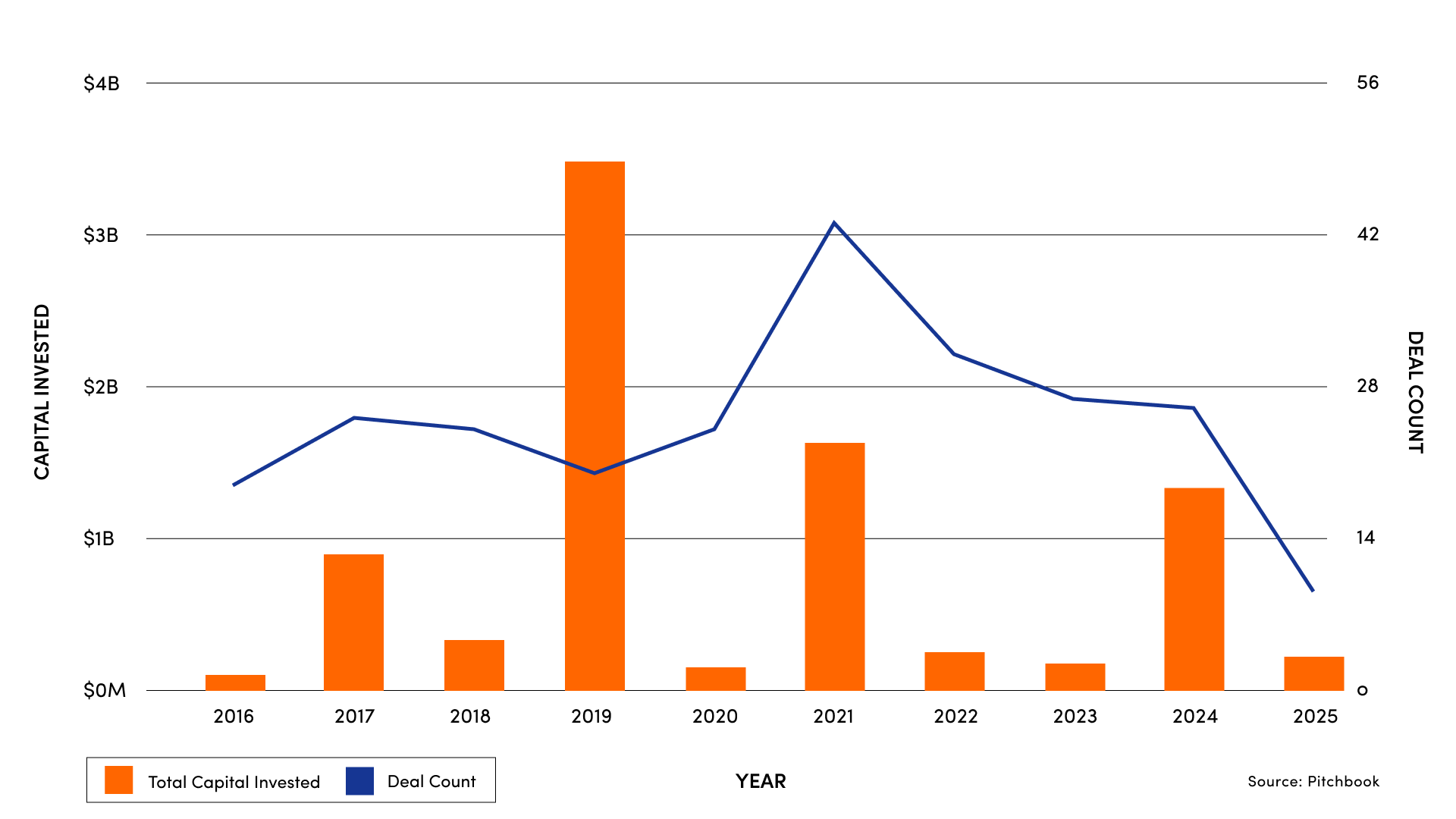
“When football is presented as entertainment – with strong storytelling, creator participation and modern production values – it resonates with a broader audience than traditional formats,” says Felix Starck, Baller League’s founder and CEO.
More than 2 million people tune in each matchday across broadcast TV and streaming sites like YouTube and Twitch, according to Starck, with around 80 percent of that audience being Gen Z, born between 1997 and 2012. Baller League’s first U.S. event, in March, drew 3.6 million online viewers.
Baller League isn’t the only upstart looking to reboot long-established sports. Other examples include SailGP, the motorboat E1 Series and cricket’s The Hundred. The trend can be read as a vote of confidence in humans’ desire to watch other humans achieve at the highest levels, according to Christian Shin Høegh Andersen, EQT’s head of Denmark and Norway.
“One place where AI has a lot less impact is in live entertainment,” he says. “You can have AI build you a football game but you don't really care. You want the actual thing.”
Care can’t be coded
It’s not just sports. When looking for potential investment opportunities that exemplify the best of humanity, EQT’s Sharma is also looking hard at healthcare.
Even if AI is increasingly playing a role in helping to diagnose patients, “at the core level patients still want to be in touch with a doctor,” he says. The U.S. Bureau of Labor Statistics forecasts that overall employment of physicians and surgeons will grow by 3 percent in the decade to 2034, about as fast as the average for all occupations.
In 2023, EQT invested in Indira IVF, India’s largest fertility company. Fertility clinics offer hand-holding and counseling. Clinicians guide couples through what can be a multi-month process towards – hopefully – a pregnancy that enables them to realize their dreams of starting a family.
“People may accept AI for low-intensity support and routine interactions, but when someone is afraid or overwhelmed, the demand is often for a human relationship,” says Joshua Killalea, head of AI at software company Panoram.
Human performance still steals the show
EQT’s Andersen is also bullish on the entertainment industry, where younger people in particular are willing to spend their hard-earned cash on experiences. More than 60 percent of Gen Z would rather spend their money on 'life experiences' like traveling or concerts than save for retirement, according to a 2023 poll from Experian.
Even if AI makes it easier to deliver an end product or service, when some element of the process requires human involvement because it cannot be replicated by a machine, the associated human roles become significantly more valuable. In the music industry, for example, Taylor Swift's record-breaking Eras Tour consisted of 149 shows performed in front of 10.2 million people and grossing around $2.08bn in ticket sales.
When looking at investments in entertainment, Andersen says he prefers a “picks and shovels” approach. That means ticketing companies, back-end software or even production management companies. Since 2022, EQT has owned a stake in United Talent Agency, which represents actors, singers, celebrities and sports stars across the globe.
“We are essentially riding the trends of the underlying market, but in a way where we are part of the enablement of these industries,” he says.
Even in a world built on AI, EQT’s Sharma expects the future to reflect human history.
“At their very core, human beings still love to bond with each other over things like sports and music,” he says. “People will continue to find and love their idols as we have done over thousands of years. And so the attraction for these businesses will remain intact and could, perhaps, even increase.”

ThinQ by EQT: A publication where private markets meet open minds. Join the conversation – [email protected]
On the topic ofTechnology






Exclusive News and Insights Every Month
Sign up to subscribe to the EQT newsletter.