



€1.2tn: The Hidden Cost of Europe’s Tech Exodus

New estimates from EQT and McKinsey show Europe has lost tech firms worth more than €700bn ($800bn) from overseas stock market listings or acquisitions. Today, these companies are worth more than €1.2tn, highlighting the region’s historic challenges and future potential.
- Over the past decade, technology firms worth more than €700bn ($800bn) left Europe through overseas stock market listings or acquisitions, according to estimates compiled by EQT and McKinsey.
The hidden cost of Europe’s tech exodus over the past decade is detailed in a new analysis by EQT, highlighting the region’s historic struggle to retain its most promising companies – and the potential opportunities ahead.
Technology firms worth more than €700bn ($800bn) left Europe between 2014 and 2025 through overseas stock market listings or acquisitions by non-European buyers, according to estimates compiled by EQT in collaboration with McKinsey. The report compiled the valuations of the largest 37 purchases of European companies by overseas acquirers with the top 25 European firms who shifted their listing elsewhere. Accounting for growth in valuations using conservative assumptions, this group of companies today is worth more than €1.2tn, similar to the annual economic output of the Netherlands or the market valuation of Meta – or enough to construct more than 100 Large Hadron Colliders.
“€1.2tn is a striking number – but look at it differently, and it illustrates the size of the opportunity ahead,” says Victor Englesson, EQT’s head of early stage technology. “Europe has spent decades exporting its best ideas, companies and talent. We need to flip that – and there are already signs we are. If we get the conditions right, the value created here over the next decade could far exceed what we have lost.”
No part of Europe has been entirely insulated from this trend. In the UK, Google acquired AI lab DeepMind in 2014, and Japan’s SoftBank snapped up Cambridge-based chip designer Arm two years later. Spotify, the Swedish streaming giant, and UiPath, a software company founded in Romania, both shunned their domestic markets to list their shares in New York.
Tech firms worth more than €1.2tn left Europe between 2014 and 2025
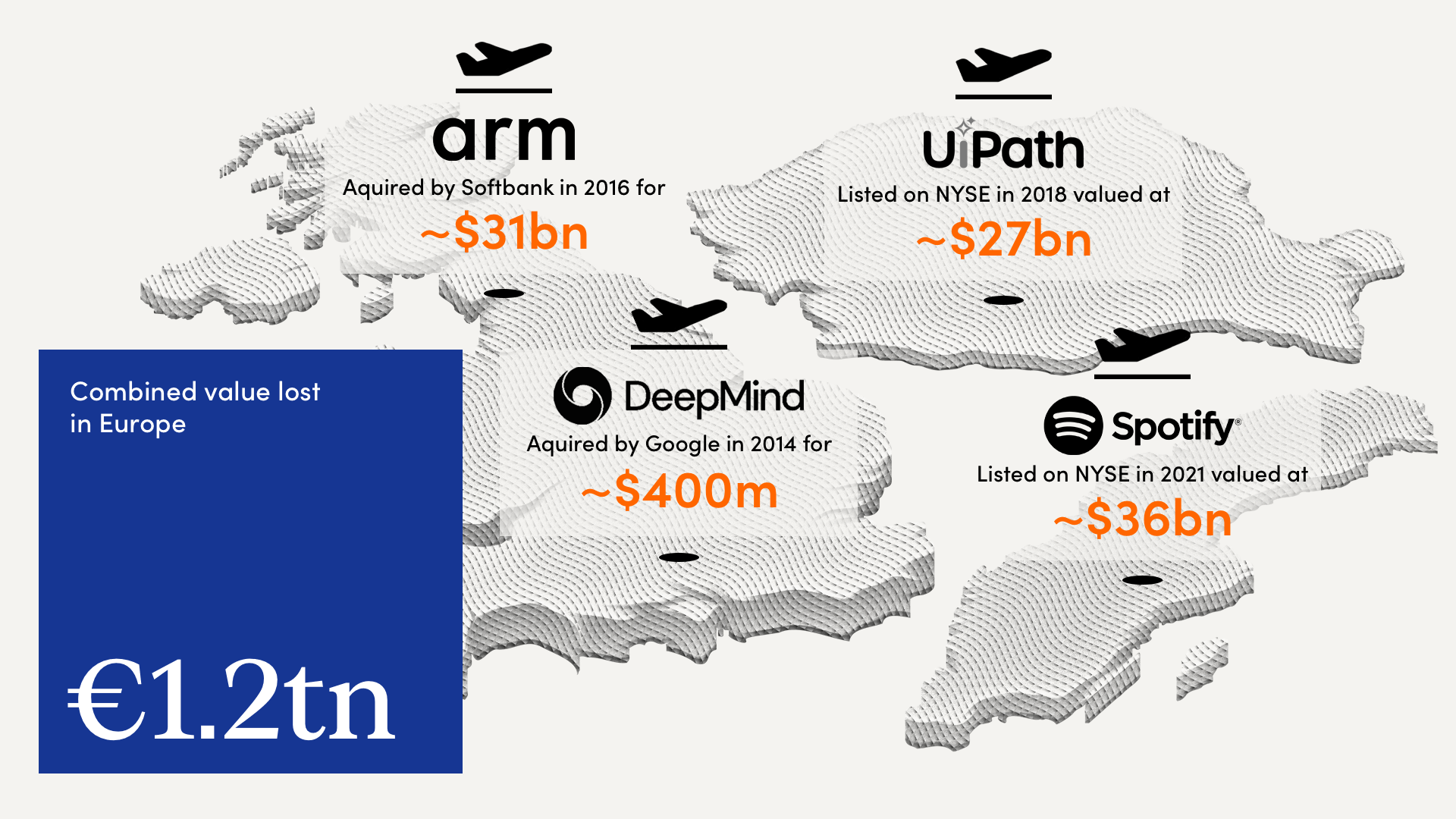
Source: EQT, McKinsey
Englesson explains that the estimates of lost value compiled by EQT and McKinsey were compiled using very conservative assumptions. The methodology deliberately errs on the side of caution, and the true number may be significantly higher.
“Think of €1.2tn as a floor, not a ceiling,” he says. “DeepMind alone – bought by Google in 2014 – could be worth close to a trillion dollars today. Had it stayed and scaled in Europe, we might already have our first trillion-dollar tech company. Instead, that value compounds elsewhere.”
Europe’s competitiveness challenges
The analysis underscores the structural competitiveness challenges facing Europe. While many high-growth tech companies are founded in Europe, they often leave to scale and monetize. Between 2008 and 2021, nearly 30 percent of unicorns founded in Europe moved their headquarters overseas, with the vast majority heading to the U.S., according to the 2024 report on EU competitiveness from former European Central Bank president Mario Draghi. Companies raised $51.1bn in initial public offerings on EU exchanges in 2025, compared with $74.2bn on U.S. exchanges, Pitchbook data shows.
“The financial loss is only part of the story,” says Ted Persson, a partner at EQT Ventures and EQT’s head of deep tech. “When a high-growth company leaves, it takes with it something harder to quantify: the tribal knowledge of how to build at scale. The alumni of these large companies go on to found and fund the next generation. Right now, that knowledge is being created and disseminated in Silicon Valley, not in Stockholm, Warsaw or Amsterdam.”
Still, there are signs of renewed life in the European tech ecosystem. In a time of geopolitical uncertainty, Europe’s well-educated population, leading research institutes and strong industrial base are key advantages. In the past five years, EQT has invested €120bn in Europe. Over the coming five years, the firm aims to double that to more than €250bn.
Looking to the future, Persson sees reasons to be optimistic about Europe.
“There is a real shift happening,” he says. “Capital that has flowed almost exclusively to the U.S. for decades is now looking at Europe again – and for good reason. The tech pipeline is strong, and the geopolitical case for building sovereign capability in Europe has never been clearer.”

ThinQ by EQT: A publication where private markets meet open minds. Join the conversation – [email protected]





Exclusive News and Insights Every Month
Sign up to subscribe to the EQT newsletter.