

Why These High-Flying Tech Execs Are Relocating to Europe



EQT data suggests a growing number of U.S. tech and startup execs are relocating to Europe from the U.S. in search of their next career opportunity.
- A steady stream of top talent is ditching the U.S. in favor of roles in Europe, drawn by a fresh challenge and a better quality of life.
It’s a cold winter morning in Stockholm. At minus 7 degrees Celsius (19 degrees Fahrenheit), it’s a far cry from the sunshine of the Bay Area, which Maryanne Caughey has recently traded in to lead the People Team at Lovable, one of Europe’s hottest AI companies.
A few years ago, the move to Sweden might have been deemed a step down for an American exec of her caliber. For a long time, ambitious tech talent seemed to flow one way: from Europe to the U.S. Why would anyone leave the world’s best funding landscape for a smaller ecosystem?
But now, the tide seems to be shifting. Caughey says she represents a growing throng of American tech expats based in the Swedish capital – and indeed across Europe – drawn by opportunities at some of the world’s most innovative companies.
“It’s not a side step in my career,” she says. “It’s the same – if not better – than a company I would have worked for in the U.S.”
Data collected by investors and recruiters supports the trend, showing a growing number of U.S. tech executives in C‑suite and “C‑minus‑one” roles crossing the Atlantic eastwards. For instance, across EQT’s tech portfolio, 8 percent of C-suite hires in the past two years came from America, up from just a handful before that. Executive search firm Riviera Partners says about 7 percent of its European placements last year came from the U.S., a record. Previously, it would take “one crazy opportunity” to tempt someone over, says Pete Alexander, who leads the Ventures practice in Europe for Riviera, but today there are a broader range of companies that can compete with U.S. alternatives.
Tech sector worker flows are reversing
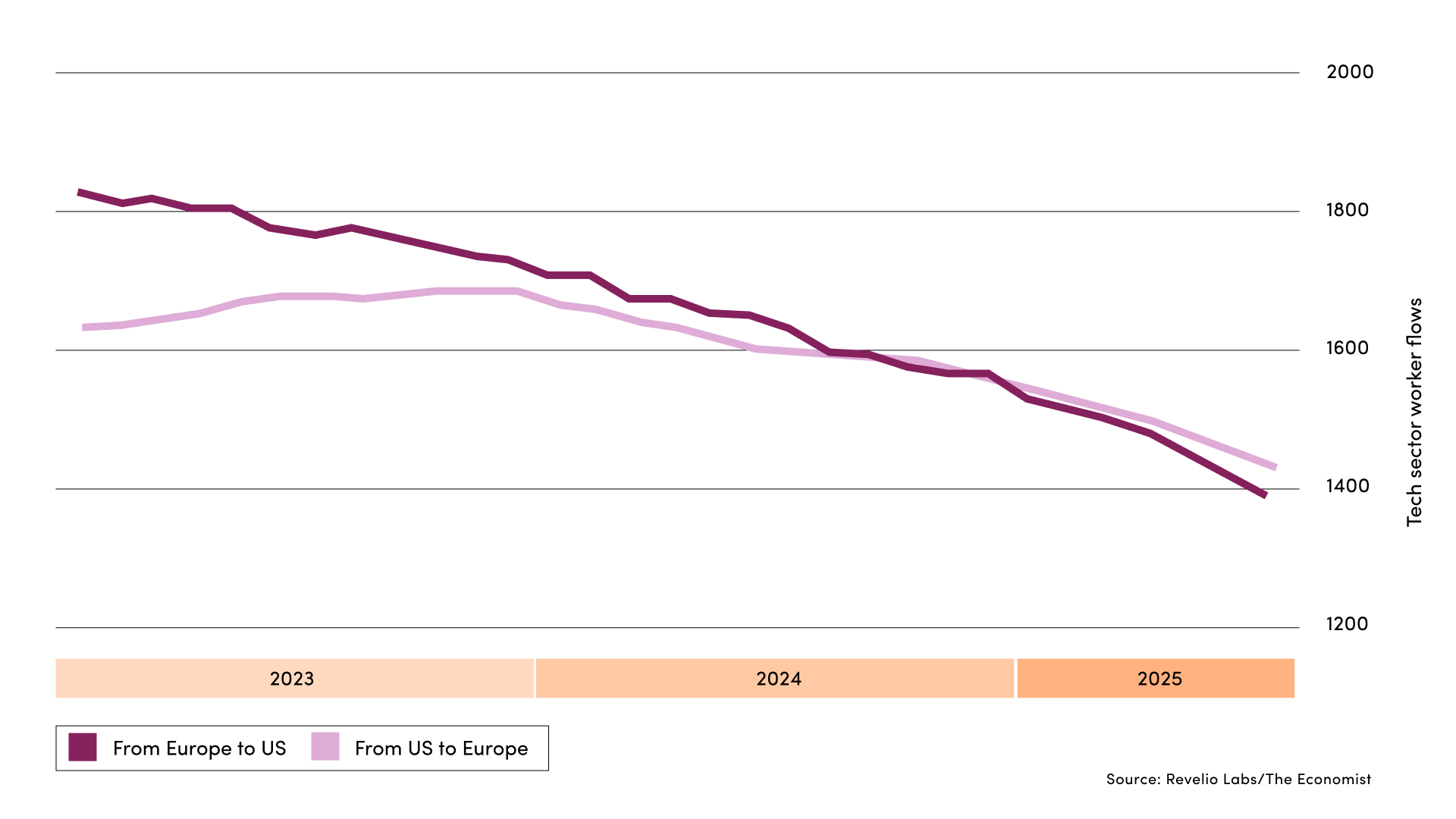
“Five or six years ago, people kind of laughed down the phone at you,” says Frankie Greenwell, who leads Early Stage Talent at EQT, recalling attempts to recruit in Europe. Now, that conversation has “really changed,” Greenwell says. “Relocating native-born Americans to Europe is much more well-received.”
So why is Europe gaining traction as a serious place to cement a career, far away from the Bay Area or New York?
The opportunity equation
The influx of American talent reflects both a fundamental change in Europe’s tech ecosystem and its perception overseas.
Over the past decade, Europe has minted an unprecedented number of decacorns, private companies worth more than $10bn. It’s become home to companies such as Lovable, an EQT portfolio company that crossed $100m in annual recurring revenue within 10 months of being founded. “Europe is a more attractive investment and tech landscape than it ever has been,” says Greenwell. “There are enough proof points of success that people are willing to take a risk.” In particular, it has crystallized its strengths in sectors including fintech, hardware and robotics, where it can now actively compete with the U.S. That has put Europe firmly on the talent map, creating a critical mass of internationally recognized startups.
New European decacorns created
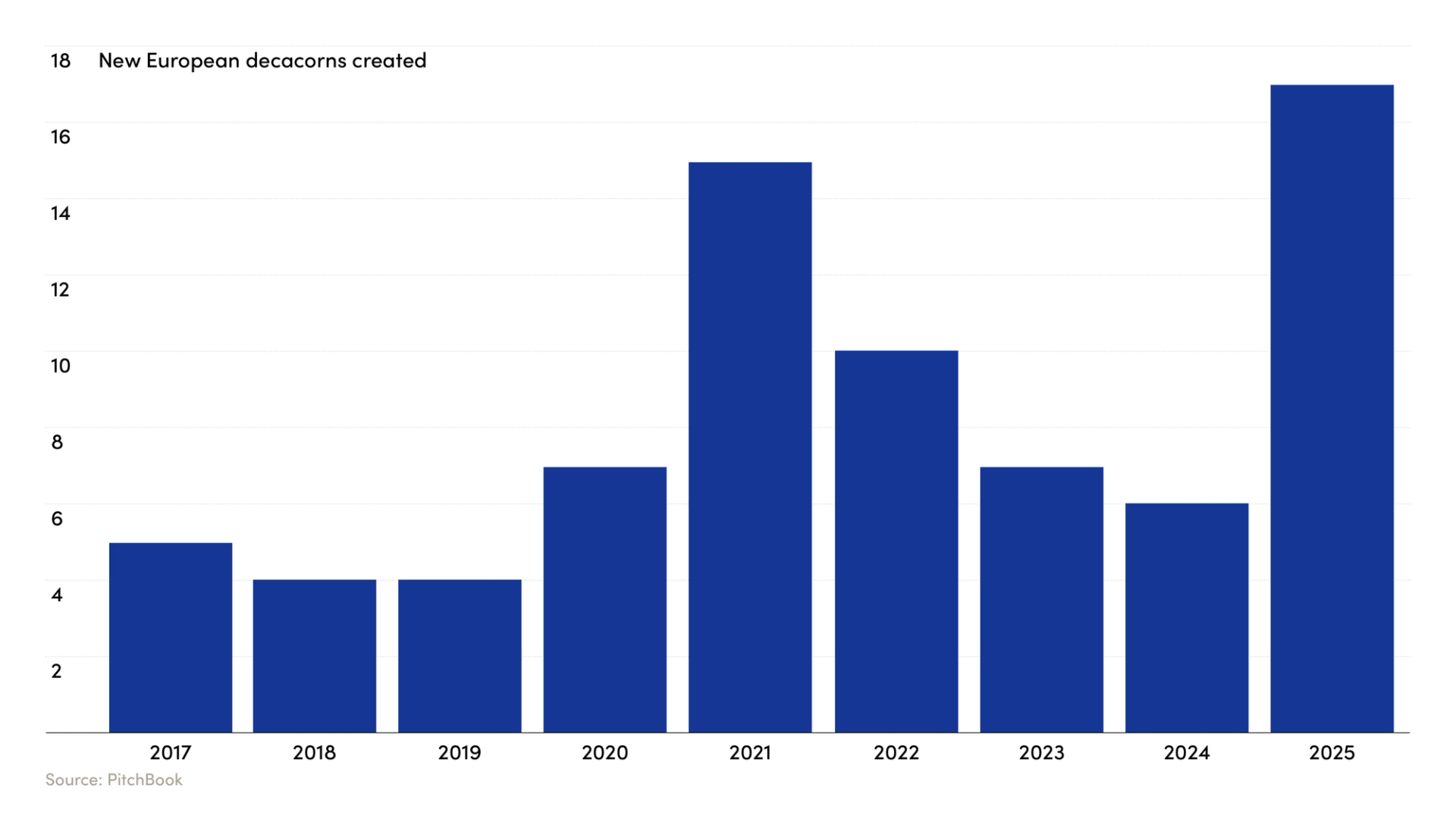
Companies with a minimum post-deal valuation of at least $10bn
“Every hub in Europe has a handful of companies that are scaled enough, ambitious enough and well-funded enough that they can actually attract top-tier talent,” says Jonas Helgesson, CEO of Erevena, a recruitment firm.
Far more European companies now have the budgets and appetite for costly international hires, says Helgesson. They’ve learned to factor in weekend visits to showcase Europe to the candidates and their families, alongside protracted negotiations.
A different way of life
But career opportunities aren’t the only pull. Cities such as London, Paris, Lisbon and Berlin also offer a different relationship to work than San Francisco’s always-on culture, notes EQT’s Greenwell. “Weekends are a bit more sacrosanct,” he says. “You don’t work less, but there’s a different rhythm.” For executives with children, this shift can be particularly appealing.
There are other quality-of-life perks too, Caughey notes. In Stockholm, she now enjoys a 15-minute commute and lives a five-minute bike ride from her children’s school. “We explore a new museum every weekend. The kids now love cross-country skiing and orienteering,” she says. “I’ve found the impact of a Bay Area job, in an environment where my family can live a better life.”
While compensation packages tend to be lower in Europe, the gap is partly mitigated by local rules. Several countries also give tax incentives for expats in their first five years, a contrast for high earners used to paying significant taxes in California or New York. Factor in benefits such as government pension matching and a lower cost of living, and they’re often no worse off, says Caughey.
Europe’s pull factors aside, the political situation in the U.S. may also be serving as a push factor for some. “It’s definitely an open question,” Greenwell nods. Nonetheless, he believes it’s a cursory point; the trend had already started under former President Joe Biden, he says, suggesting discontent with the current administration isn’t the main driver.
Executives like Caughey illustrate this case. The move was “pure” pull factors, she says. “I chose it for Lovable. And it was almost like: ‘Oh, that’s a plus – I get to move to Europe.’”
Indeed, for many, the plan is to return to the U.S. after a three- to five-year equity vesting period, rather than to stay indefinitely.
Specific target
Europe isn’t an alluring prospect for everyone. According to Riviera’s Alexander, executives who have never lived outside the U.S. tend to be less open to moving. Family considerations matter too: teenagers often make things harder. The job of convincing execs can still be painful, Alexander says.
The typical “pro-Europe” candidate, he says, has studied, worked or built relationships in Europe before. They may have already accumulated significant wealth from previous roles, making them less motivated by compensation and more by lifestyle and impact. Some may also be becoming a C-level or VP-level executive for the first time and are excited about a step up.
For now, evidence shows a small but growing pool of Americans looking to Europe. This is a positive indicator for the region’s tech ecosystem, and a signal of its growing influence.
“Relocating is a real commitment,” Greenwell says. “It shows people are genuinely buying into the European opportunity.”

ThinQ by EQT: A publication where private markets meet open minds. Join the conversation – [email protected]
MoreInsights







Exclusive News and Insights Every Month
Sign up to subscribe to the EQT newsletter.