

How EQT’s Early-Stage Operating Team Helps Portfolio Companies Scale



The playbook for scaling a startup has shifted. EQT’s early-stage operating team is helping companies navigate this new world and find scale.
- The playbook for scaling has shifted as startups navigate a landscape of higher interest rates, the rise of AI and geopolitical tensions.
Startup founders across Europe are operating in a very different world from the class of the 2010s, who chased growth at all costs. With AI redefining entire industries, heightened geopolitical tensions and higher interest rates, the playbook for successfully scaling a startup is being rewritten.
“Two things have changed,” says Laurabeth Harvey, who leads EQT’s early-stage operating team following a career that has included seven years in sales at LinkedIn and running go-to-market functions at three startups. “One, the speed of innovation in AI transcends just the tech. There’s a reinfused culture of speed and energy in decision-making and in execution across the board in these AI-native businesses. And two, there’s a much more judicious balance of growth and efficiency.”
Around 78 percent of companies that have found so-called product-market fit still fail to scale, according to research from consulting firm McKinsey, either collapsing or failing to maintain growth and being bought while still sub-scale. For businesses to successfully transition from founder-led to industrial growth they often need to be “rewired throughout,” McKinsey argues.
Recognizing the shifting requirements for scaling, in 2024 EQT saw an opportunity to formalize its assistance for founders by creating the early-stage operating team, which works across the Ventures and Growth portfolios. While the investment firm has always provided operational support to companies it backs, this new team brought together former operators who could work across its portfolio of over 100 startups, providing support on attracting the best talent, formulating go-to-market strategies, developing products and handling media communications.
Startups in Europe often grow more slowly than their U.S. counterparts. McKinsey’s research found that European software companies take 15 years on average to reach €100m ($119m) in annual recurring revenue (ARR), five years longer than their U.S. peers.
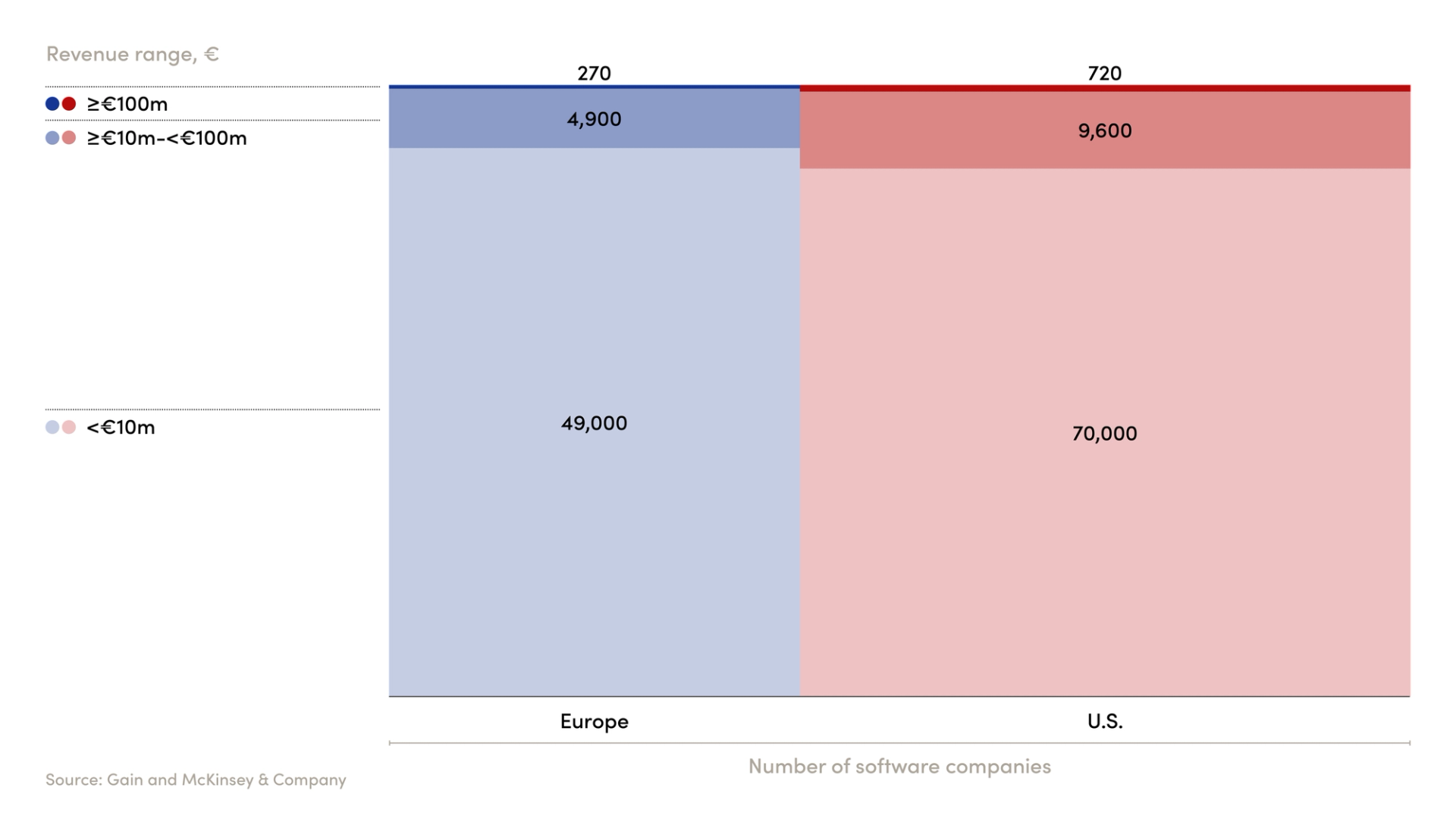
Around 5-10 percent of U.S. software companies that hit that milestone eventually scale to €1bn in ARR, according to data from Gain and McKinsey. In Europe, meanwhile, the comparable figure is less than 3 percent. The European Union is recognizing that there is an issue with growth and, in 2025, unveiled nearly 30 proposals to support startups.
How EQT’s operating team adds value
At EQT, the early-stage operating team has been key to overcoming these barriers. The firm has found an edge through having its investing partners identify potential growth blockers within startups early and then brokering introductions to the operating team.
Take, for example, CluePoints, an AI-powered data analytics platform from EQT’s Growth portfolio. After a workshop identified opportunities to create new roles and incentives better aligned with customer management and revenue growth, Harvey worked alongside EQT’s Early Stage Talent team to complete a reorganization of the company’s management and success organization.
It might take years for this revamp to show in the bottom line, but these decisions have provided the scaffolding for further scale, according to Harvey. By operating as a united platform team, Harvey was able to partner with EQT’s Polly Barnes on the talent side, who helped to complete the change management side of the transformation. In addition, EQT helped CluePoints recruit its Chief Product/Technology Officer, Chief People Officer, VP of Talent, VP of Finance, and VP of Legal.
Other talent-related examples from the portfolio include 1X, a designer of humanoid robots, where EQT assisted in finding the firm’s Chief Financial Officer, VP of Talent and VP of Manufacturing and Production. For Cleo, a digital financial assistant, the Talent team drove hires for the Chief Product Officer and Chief Marketing Officer – along with several board and VP roles.
“Operating teams don’t always add meaningful value in practice, but EQT has been a genuine exception,” says Matthew Maher, Cleo’s Chief People Officer. “Their targeted introductions, rigorous approach to building and providing talent insights across their portfolio, and thoughtful perspective on key talent questions have made a real difference to our decision-making and outcomes.”
The executive hiring challenge
The most consistent scaling problem across EQT portfolio companies is executive hiring, according to Harvey, as turnover among executive leadership is exceptionally high at startups. Data from equity management platform Carta shows that in 2024 the median job tenure for employees at startups using Carta was just 2.2 years, versus 3.9 years across all businesses in the U.S.
“You can have an excellent Chief Revenue Officer who’s just not a good fit with an excellent CEO,” Harvey says. “Our talent team does a great job at understanding what makes a founder/CEO tick and the DNA of the company, and then really strategically advising and helping build up the executive team around them.”
The pressures of running a business at full steam and the gaps left when critical executive roles are open can lead to rushed hiring decisions. The talent team uses its expertise to catch this by engaging the right search agencies, crafting “eyes wide-open” job specs, and inserting an expert interviewer, Harvey said.
“I always try to lean into the idea that there are many roads to Rome, and here are the pros and cons and drawbacks to each of those roads,” Harvey says. “At the end of the day, you, as a founder or CEO, have to make the right decision for your business, but I, as a former operator, can bring in the learned lessons and provide guidance here.”
More startups are choosing to scale out of Europe, including EQT portfolio companies Lovable, an AI coding tool, and Cleo, a personal finance app. Having a reputation for supporting this scaling process helps ensure EQT’s Ventures and Growth teams continue winning over the Generation-Defining Companies that dream big.
“We can help win some competitive deals because – at the end of the day – businesses that are trying to scale to €100m and beyond like it when there’s former operators in there asking them questions in a detailed way,” EQT’s Harvey says. “Whenever a business actually enjoys the due diligence process, you’re building a relationship, you’re building rapport, and that ultimately can help us win the deal.”

ThinQ by EQT: A publication where private markets meet open minds. Join the conversation – [email protected]
MoreInsights






Exclusive News and Insights Every Month
Sign up to subscribe to the EQT newsletter.