

Zongzhong Tang: The Missing Link In Aviation’s Decarbonization Story
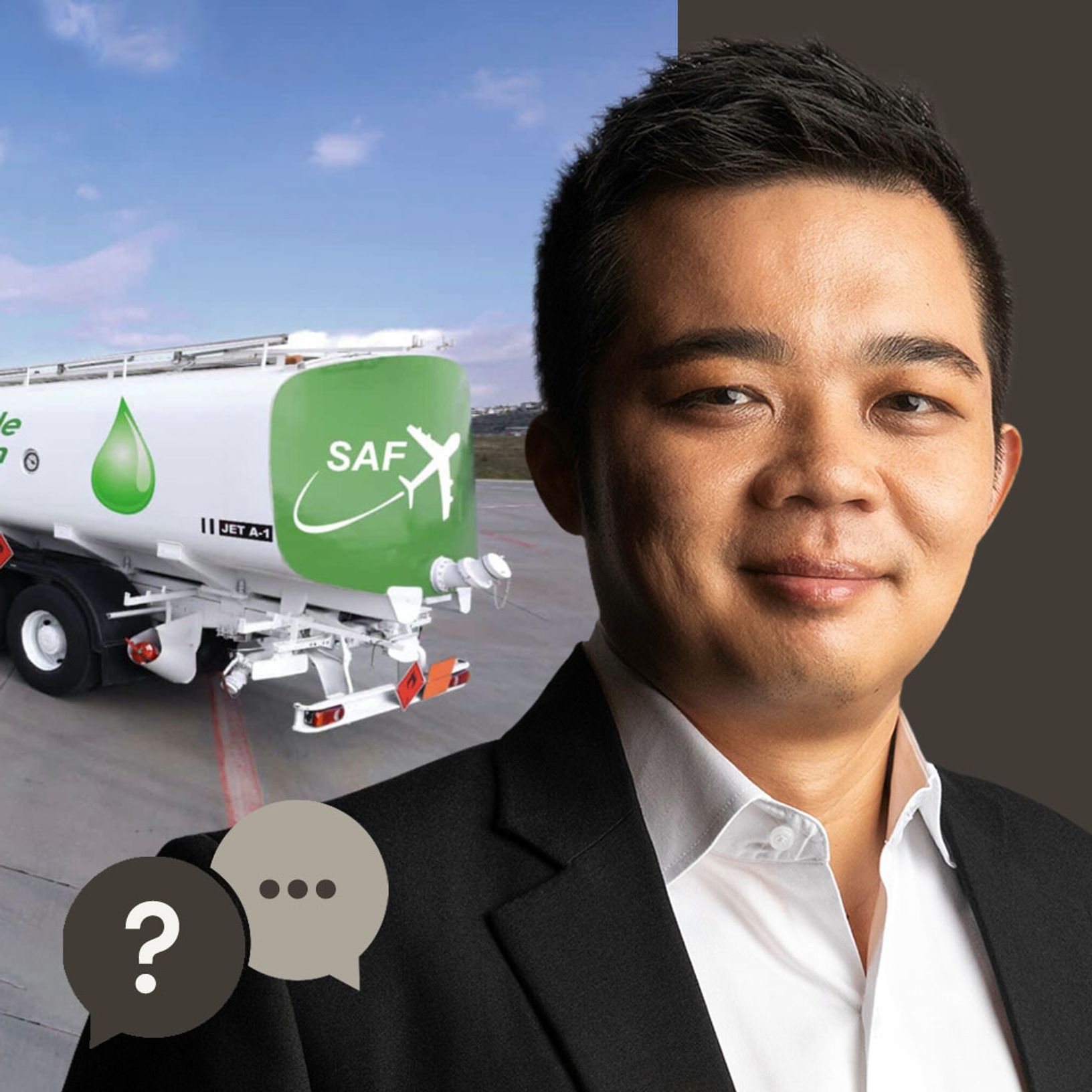


The sustainable aviation fuel market will not scale on airline economics alone. Corporate buyers have a critical but underestimated role, writes EQT’s Tang Zongzhong.
Aviation is one of the hardest sectors to decarbonize. Unlike road transport, air travel depends on energy-dense fuel for which there is no commercially ready low-emission substitute. Battery technology remains too heavy for longer-haul routes, and flights powered by hydrogen may not be viable until 2035. The bottom line: The transition is not happening fast enough to achieve global climate goals.
Airlines, fuel producers, governments and financial institutions all play a role in making flying more sustainable. But so do the companies that fill the planes. For industries like ours, where business travel remains essential, we need to prioritize these efforts alongside our day-to-day sustainability initiatives.
Sustainable aviation fuel (SAF) is one of the best tools we have today to address the gap.
SAF, most commonly produced from waste oils and animal fats and blended with conventional jet fuel, can reduce lifecycle greenhouse gas emissions by up to 80 percent compared to conventional jet fuel and is a key part of our efforts to offset emissions through our internal carbon price and voluntary carbon removal program.
EQT has signed a three-year agreement with Cathay Pacific to purchase at least 3,000 tonnes of the sustainable fuel. Deployed at select global hubs including Hong Kong International Airport and Amsterdam Schiphol Airport, the fuel is expected to generate at least 9,800 metric tonnes less lifecycle emissions compared to conventional aviation fuel, equivalent to roughly 11,000 economy-class round trips between Hong Kong and London.
It’s really a demand problem
Given those benefits, why does the fuel still account for less than 1 percent of global aviation fuel consumption? The answer lies in the short-term economics: SAF costs roughly two to five times more than conventional jet fuel. Producers need predictable, long-term revenue to justify building infrastructure – and that requires multi-year commitments from buyers.
With air travel demand forecast to more than double by 2050, the stakes are significant. Companies that fly employees, clients, and cargo are collectively among aviation’s largest customers. When they commit to purchase SAF, they create exactly the kind of durable demand signal that producers and investors need.
Why Asia matters
Asia – projected to outpace the rest of the world in aviation demand growth – is key to the next phase of the story. Hong Kong sits at the crossroads of some of the world’s busiest long-haul routes, and Cathay Pacific has been driving voluntary SAF expansion across Asia. Japan and Singapore have set 2030 SAF targets of 10 percent and 3-5 percent, respectively, commitments that will accelerate investment in the infrastructure needed to blend and deliver the fuel in the region.
As a global investor with a significant and growing presence in Asia, EQT sees participating in that development as both a responsibility and a reflection of our broader climate commitments. This is integral to our ambition to future-proof our own operations and support the global energy transition.
The case for corporations
The sector is making progress, albeit slowly. Bloomberg New Energy Finance expects a 10-fold increase in demand for SAF by the end of the decade. Still, producers need the right incentives to invest.
Our three-year purchase agreement will not move the needle in isolation, but markets in early development are disproportionally shaped by strong demand signals. Multiplied across enough corporations, these investments can structurally change the business case for SAF and help the industry tackle the decarbonization challenge.
Tang Zongzhong is the Head of Sustainability for EQT Private Capital Asia. He is responsible for the overall sustainability strategy in Asia, and works with portfolio companies across multiple industries on sustainability risk mitigation and value creation. He is also currently serving on the Sustainability Committees at several global portfolio companies and is the Co-Chair of the ESG & Impact Committee at SVCA (Singapore Venture and Private Capital Association). Prior to joining EQT in 2021, Tang was at Partners Group, where he was the regional head for ESG integration and impact investing in Asia Pacific. Before that, he was an Associate Director at Blackpeak in Singapore, where he oversaw fraud, bribery and corruption assignments, focused on Southeast Asia and Greater China. Tang holds an MA Global Affairs from Yale University and a BSc in International Relations from the London School of Economics and Political Science

ThinQ by EQT: A publication where private markets meet open minds. Join the conversation – [email protected]
On the topic ofSustainability





Exclusive News and Insights Every Month
Sign up to subscribe to the EQT newsletter.