

Europe Can Still Regain Its Edge in Life Sciences


Europe is a science powerhouse, yet it is losing its appeal for the biotech industry. What will it take to close the gap with rivals?
- Europe leads the world in bioscience research, yet its economies and health systems are not reaping the full rewards.
In life sciences, Europe is a tale of two halves.
Its laboratories and scientists are world-leading, generating more impactful research than any other region. The two most widely used Covid-19 vaccines originated in Europe, along with scores of other biomedical breakthroughs. And many of its health systems are among the best-funded and most resilient on the planet.
Yet Europe falls short in reaping the rewards of its home-grown innovation. A case in point: Although researchers in Europe have produced more scientific publications on advanced treatments, such as gene and cell therapies, than any other region, clinical trial activity for these approaches is twice as high in the U.S. and almost three times as high in China, according to Charles River Associates, a consultancy.
“Europe remains a significant center for research activity, for both large pharma and biotech, but needs to regain its competitive edge,” said Sarah Rickwood, vice president of EMEA thought leadership at IQVIA, a global life sciences research organization.
Recognizing the chasm between scientific prowess and life science investment, European leaders are tackling the confluence of factors hampering the region’s competitiveness. Earlier this year, the European Commission launched a new strategy aimed at positioning the bloc as the world’s most attractive life sciences destination by 2030. Brussels has committed €10bn annually to the plan, which will be used to facilitate multi-country clinical trials, develop clusters of expertise in areas such as advanced therapies, and incentivize early-career scientists to choose Europe.
Funding for the Stars
Financial support from European investors pales in comparison to the U.S., leading many of the continent’s start-ups to look across the Atlantic to access deeper pools of capital. That often involves opening up or expanding U.S. operations, and strengthening the economy in life science centers like Boston and San Francisco at the expense of European hubs.
“There’s a lot less capital available in Europe than in the U.S., and we need more funding for the stars,” said René Kuijten, head of EQT Life Sciences.
The resulting disparity in career opportunities means nearly three-quarters of European science graduates choose to remain in the U.S. after completing their doctorates.
Tough nation-by-nation drug price negotiations in Europe have long driven companies to prioritize the more lucrative U.S. as their first market, creating an ever-widening gap between the number of innovative medicines available on either side of the Atlantic.
A complex and fragmented regulatory environment is pushing drug developers toward more streamlined places like the U.S. and China for their clinical trials, meaning European patients are missing out on cutting-edge medical developments.
Europe’s position is slipping just as competition from its biggest rival steps up. President Trump’s trade policies are attracting multibillion-dollar manufacturing investments in the U.S. from European pharmaceutical giants like AstraZeneca and Roche in a bid to swerve punishing import tariffs. Meanwhile, China is fast emerging as a biotech powerhouse thanks to a decade of reforms and investment. While Europe’s share of clinical trials had fallen to just 21 percent in 2024, China’s had grown to 30 percent. Europe is also on the brink of being overtaken by China in terms of the number of innovative medicine launches.
Number of novel active substances
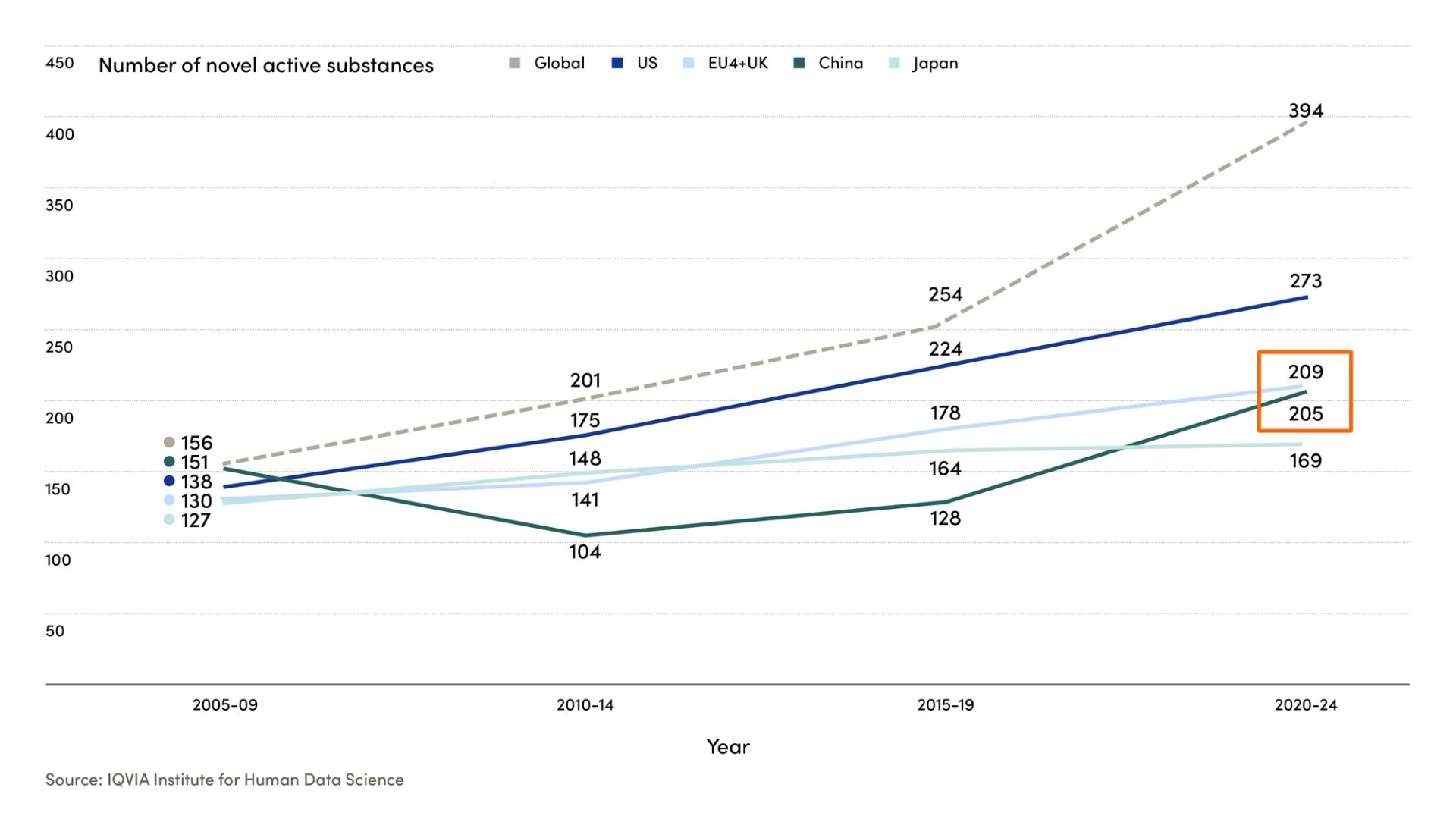
This is a concern because biotech is of vital strategic importance to the continent’s economic growth and health security. The sector creates high-value jobs and attracts investment, offering expertise and infrastructure, such as biological manufacturing facilities, that bolster the region’s ability to quickly respond to health crises.
Pockets of Success
“The sense of urgency and recognition of how important an updated operating environment is for attracting pharmaceutical investment to Europe is clear,” Nathalie Moll, director-general of the European Federation of Pharmaceutical Industries and Associations, a trade group, said in a statement.
The Commission also plans new legislation, the European Biotech Act, to ease the path for scientific innovations to become real-world medicines. The proposals are still under consultation and are expected to be published in 2026.
The top priorities should be coordinating public and private investment, strengthening European biotech hubs, and removing regulatory barriers, said IQVIA’s Rickwood.
“It is also critical to ensure the commercial environment for pharmaceutical companies in Europe remains attractive, meaning that medicine prices must be fair, medicine spending must be fit for purpose, and decision-making on access to medicines must be rapid and based on clear and predictable criteria,” she added.
Europe is seeking to leverage its strengths. Rickwood highlighted that Europe remains the world’s second-most valuable prescription medicine market, after the U.S. In specialty areas like cancer, it accounts for 34 percent of the global market, according to IQVIA.
Pockets of success also show what can be achieved with policy change. Spain has become a leader in clinical trials thanks to a group of centers with international expertise, a favorable regulatory environment and strategic government investment.
Europe’s edge in fundamental research – which is likely to sharpen further as biomedical research in the U.S. comes under pressure from deep funding cuts – also provides a strong foundation on which to build.
“Science is where it starts, and compared with the U.S., Europe is extremely strong, and probably only getting stronger in the next decade,” said EQT’s Kuijten.” This is the opportunity for Europe to shine.”

ThinQ by EQT: A publication where private markets meet open minds. Join the conversation – [email protected]
On the topic ofHealthcare






Exclusive News and Insights Every Month
Sign up to subscribe to the EQT newsletter.