



Compass Education and the Secret Sauce for Improving School Performance

EQT’s 20 years of education investing led to the acquisition of Compass Education – and a new model for scaling smarter, AI-driven schools.
- Compass Education is the leading cloud-native school management information system in Australia.
Compass Education had been on EQT’s radar for years before the opportunity arose to acquire the school management software company.
EQT first met founder and CEO John de la Motte in 2021, when he was considering selling a stake in the business. At the time, however, the opportunity was too small for EQT’s flagship fund.
“It was one of those companies that really stuck with us,” says Nicholas Macksey, Partner in the EQT Private Capital Asia team in Singapore. “It was actually one of the case studies for why we wanted to get back into the mid-market here in APAC.”
When EQT launched the Mid-Market Growth Fund in 2024, a dedicated vehicle for mid-sized investments in Asia-Pacific, Compass was an obvious fit – a well established cloud-native school management information system, with a growing presence in Australia, serving a market EQT already knew intimately. The deal closed in January 2025.
Lessons from an earlier investment
EQT’s journey to discover Compass began even earlier. Some 20 years ago, Baring Private Equity Asia (now part of EQT) invested in Nord Anglia Education, then an operator of six international schools. Today, Nord Anglia runs more than 90 schools across 35 countries, educating more than 100,000 students worldwide, and was valued at $14.5bn in March 2025.
The key insight gleaned from nearly two decades of ownership was that each school’s central management system was critical to management efficiency.
By replicating IT systems across each school, Nord Anglia could better ensure consistency, drive improved academic outcomes for students, and scale faster as the group expanded. “Having that same set of systems really was the hidden secret sauce,” says Jacob Van der Wiel, Director in the EQT Private Capital Asia team.
Those systems allowed Nord Anglia to see what was and wasn’t working in each school – pupil-teacher ratios, classroom space, hours – and drive consistent improvement across all schools, both in terms of financial metrics and academic performance. It allowed EQT to scale Nord Anglia from $10m to more than $800m EBITDA as of August 2025.
“So we had that knowledge of how powerful the school management system is and how critical it is to the school,” says Van der Wiel. “That gave us the valuable insight to go, ‘Hey, Compass is doing this for more than 3,000 schools across Australia. This is a massively important business, and there’s much more that you can do with it.’”
Private equity investment in education related firms
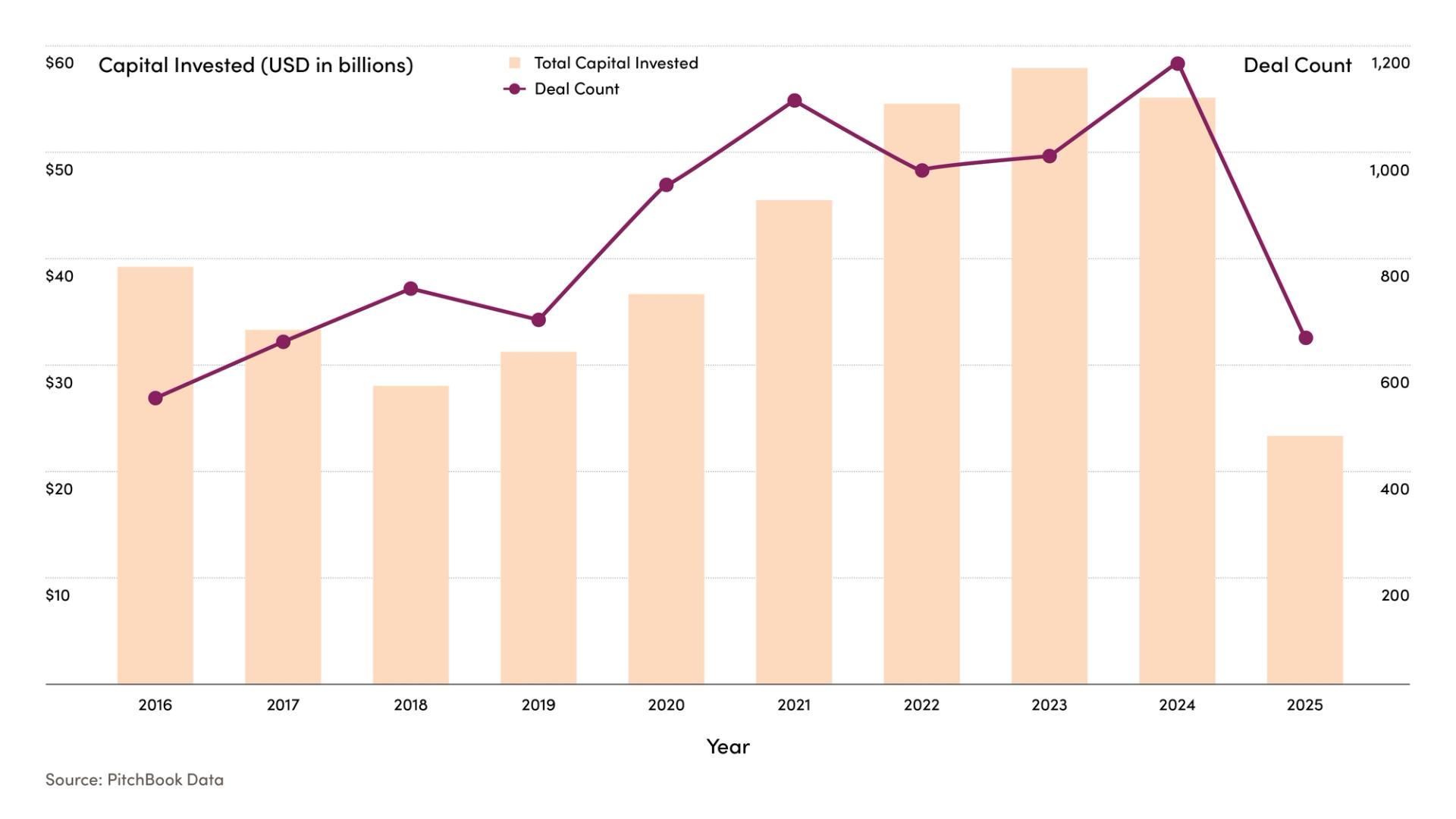
When EQT acquired Compass, the company had been growing rapidly since its founding in 2010, but was still operating like a startup. “John had been essentially the CTO, CPO, and the Head of Sales,” says Macksey.
EQT’s first step was to bring in the organizational structure needed to scale Compass up to an institutional business while keeping its entrepreneurial core. So far, that’s meant appointing Bill Priemer, the former CEO of a portfolio company owned by private equity firm Thoma Bravo, as non-executive chair, and adding new roles and talent to the leadership team.
The strategy hinges on backing de la Motte as the founder and CEO, and building the resources and infrastructure around him to support the next stage of growth. EQT is applying its core value creation playbook, putting the systems and processes in place to build for scale. The goal is to more than double the annual recurring revenues in the next few years.
The School Bytes acquisition
Barely a month after the acquisition, Compass bought School Bytes, a school management software company based in New South Wales, Australia, with a strong presence in the primary school market.
This expanded Compass’s footprint and also brought in new engineering talent, including Blake Garrett, School Bytes founder and CEO, who joined Compass as Chief Product Officer.
“He’s really helped bring a ton of great AI know-how into the business,” says Van der Wiel. “In terms of our portfolio in Asia, Compass is probably the leader in terms of leveraging AI across the business.”
School Bytes had automated around 90 percent of its customer support queries using AI. Compass quickly migrated its customer support function onto that system, and today its AI agent, called Terry, handles 65 percent of Compass’s and 90 percent of School Bytes’s enquiries. Compass’s customers rate their interactions with Terry as faster and more accurate than those with a human.
This was a “light bulb moment” for de la Motte, says Van der Wiel. “He basically went back to the company and said, ‘Look, I want everybody across every function to explain to me what you’re using, and why you’re not using AI if you’re not using it.’”
The AI roadmap
That cultural shift quickly translated into product innovation. Engineers began using generative AI tools, such as Copilot and Cursor, for development, code review, and debugging, cutting development cycles and expanding the product roadmap. One of the first AI features to launch was the Class Builder – a tool that allows teachers to automatically create balanced classroom compositions based on factors such as gender, academic performance, and even friendship preferences.
“Teachers used to spend hours and hours poring over this,” says Macksey. “They can now add all of these fields automatically and compile classes in minutes.”
Because Compass is already cloud-native, the company has been able to implement AI into the product very quickly. “It’s also changed the calculus on buy versus build from an M&A perspective,” says Van der Wiel.
“There’s a bunch of stuff we can go buy – but a lot of it we can build. Our team is taking products from concept to production much faster, and it allows them to be much more responsive to schools’ needs at the end of the day.”
Compass has become a case study for AI adoption in EQT’s Asia portfolio, recently presenting its AI strategy and learnings to other portfolio companies.
Even in the short time since the acquisition, Compass is already showing measurable results. Automation through AI has reduced the need to rehire after natural attrition in customer support and engineering, while, at the same time, margins have increased and the pace of product innovation has improved. EBITDA has increased by more than 40 percent year-over-year, and revenue is growing by around 25 percent.
Pattern recognition
Compass has built its reputation in Australia’s state school system, but its next phase of growth lies in the independent, fee-paying sector, which has higher budgets and expectations. EQT, leveraging its experience with Nord Anglia, is helping them. Compass has been recognized by TIME as a leading EdTech provider, creating momentum to take on the broader private school market.
EQT’s effort forms part of a pattern: investing in areas where the firm’s deal teams have domain expertise and where core technology upgrades can quickly power growth.
It’s the approach that led to the Mid-Market Growth Fund’s first investment, Quantios, whose platform streamlines administration for the trust and corporate services industry. EQT already knew the market well through investments in global fund and corporate services provider Vistra and business expansion specialist Tricor.
For Compass, further expansion in Australia is the near-term focus; however, it’s already gaining traction in Europe, with plans to expand further globally in the future.
Compass also sees wider potential opportunities to improve school operations.
“The scale of the admin opportunity in schools is underappreciated,” says Macksey.
Macksey believes there are opportunities to make schools more efficient and effective, “so that you’re improving teacher experience, student engagement and academic outcomes, and you’re saving money.”
“Teachers are so much more effective when they’re doing what they’re good at, which is engaging and motivating kids,” he adds.

ThinQ by EQT: A publication where private markets meet open minds. Join the conversation – [email protected]
On the topic ofCase Studies








Exclusive News and Insights Every Month
Sign up to subscribe to the EQT newsletter.