

How Renewable Energy Transition Can Still Give Europe An Edge
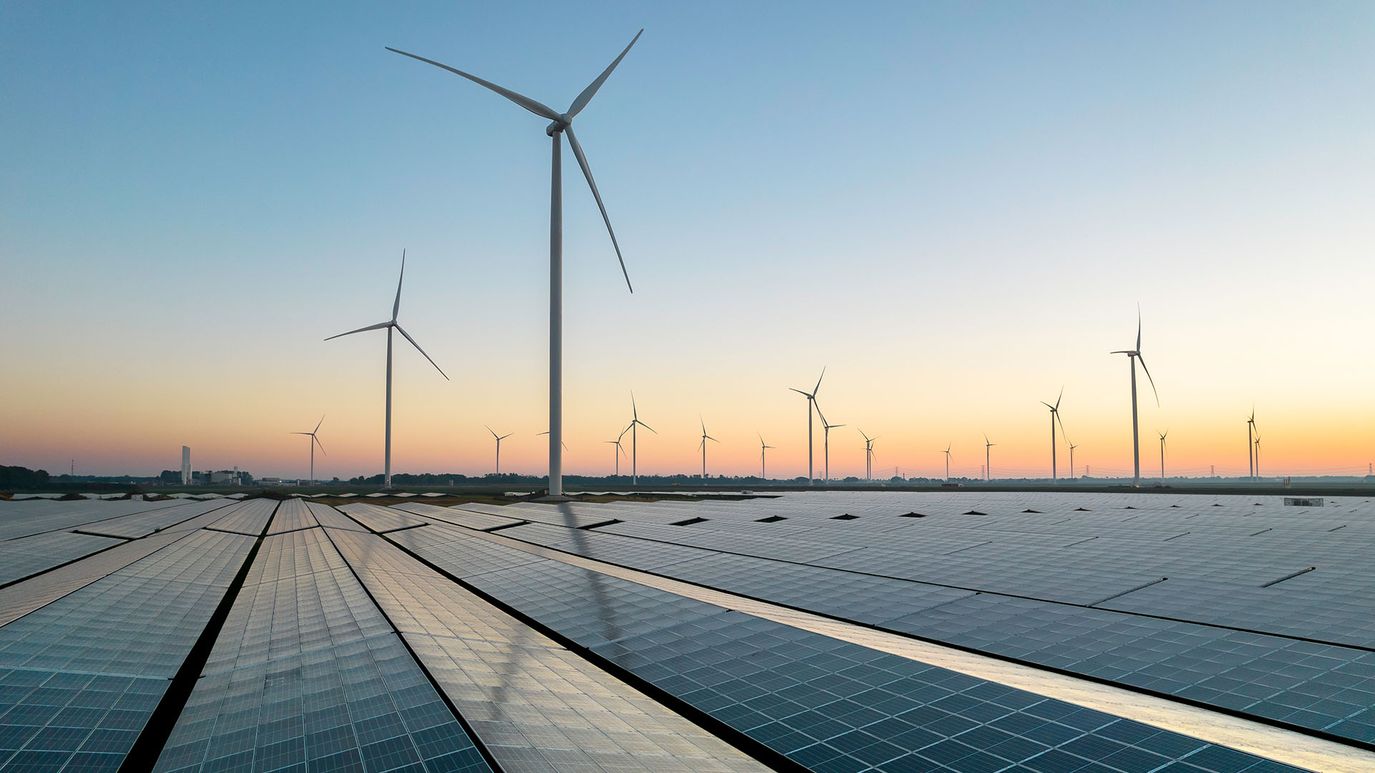

Europe’s plan to double down on renewables may yet give its companies a competitive advantage over economies that cling to fossil fuels.
- Europe remains committed to net-zero emissions by 2050, as trillions of euros are needed to upgrade the energy network.
Last year’s COP30 climate negotiations in the Brazilian rainforest saw the European Union and the UK largely isolated in their efforts for more aggressive climate action, as other countries favored extending fossil fuel usage. Yet, despite the mixed outcome, Europe’s plan to double down on renewables may ultimately give its companies a competitive advantage.
Europe’s commitment to net-zero emissions by 2050 has sparked an electrification of the energy sector that will require more than a trillion euros in fresh infrastructure investment by 2030 alone. Networks of renewable energy-powered generators, battery storage farms, and distribution cables are currently being built across the continent by companies including EQT-owned Statera, Zelestra, Tion Renewables and OX2.
The EU needs to ensure affordable energy to sustain business competitiveness, which means tackling energy prices that are higher than in most other industrialized economies. The price disparity stems largely from its reliance on imported fossil fuels, which expose it to geopolitical and other risks. Russia’s weaponisation of gas exports and invasion of Ukraine caused European wholesale electricity prices to spike nearly 10 times higher to €0.40 per kWh in 2022.
Prices have since fallen but remain above pre-2022 levels. In 2024, EU gas wholesale prices were nearly five times those in the U.S., while industrial electricity prices were more than double those in the U.S. Industrial electricity prices in the EU – wholesale prices plus network fees, taxes, levies and supplier margins – reached €0.199 per kWh in 2024, compared to €0.075 in the U.S.
Strategy to cut prices
The EU strategy to reduce and stabilize electricity prices focuses on reducing import dependence on fossil fuels and boosting resilience. It seeks to derisk through diversification using multiple renewable energy sources, especially solar and wind, while also expanding the pan-European grid.
“Regulators and policymakers need to understand the implications of this big shift,” says Francesco Starace, Partner at EQT, who notes that in the EU, policymakers recognize that the direction of change in the electricity mix is irreversible and that it creates opportunities. He adds that those who fail to understand the changes could face serious economic consequences through loss of competitiveness.
“It doesn’t matter where you are, technology works the same because it’s governed by the laws of physics [not borders or policy],” Starace says. “A revolution is a big source of inequality, because it discriminates between those who understand and those who don’t, and that’s very important in what’s going on in the energy field.”
Electricity prices can be broken into three parts: energy price, network charges (transmission and distribution), and taxes and levies. Taxes and levies are policy choices, whereas network charges are similar across energy sources. But the energy price potentially offers big savings: the International Renewable Energy Agency (IRENA) and UK government estimated that solar and onshore wind in Europe is generated at a price 40 to 60 percent below that of gas generation assets, and without any fossil fuel market volatility.
Share of renewables in 2024 net electricity generation
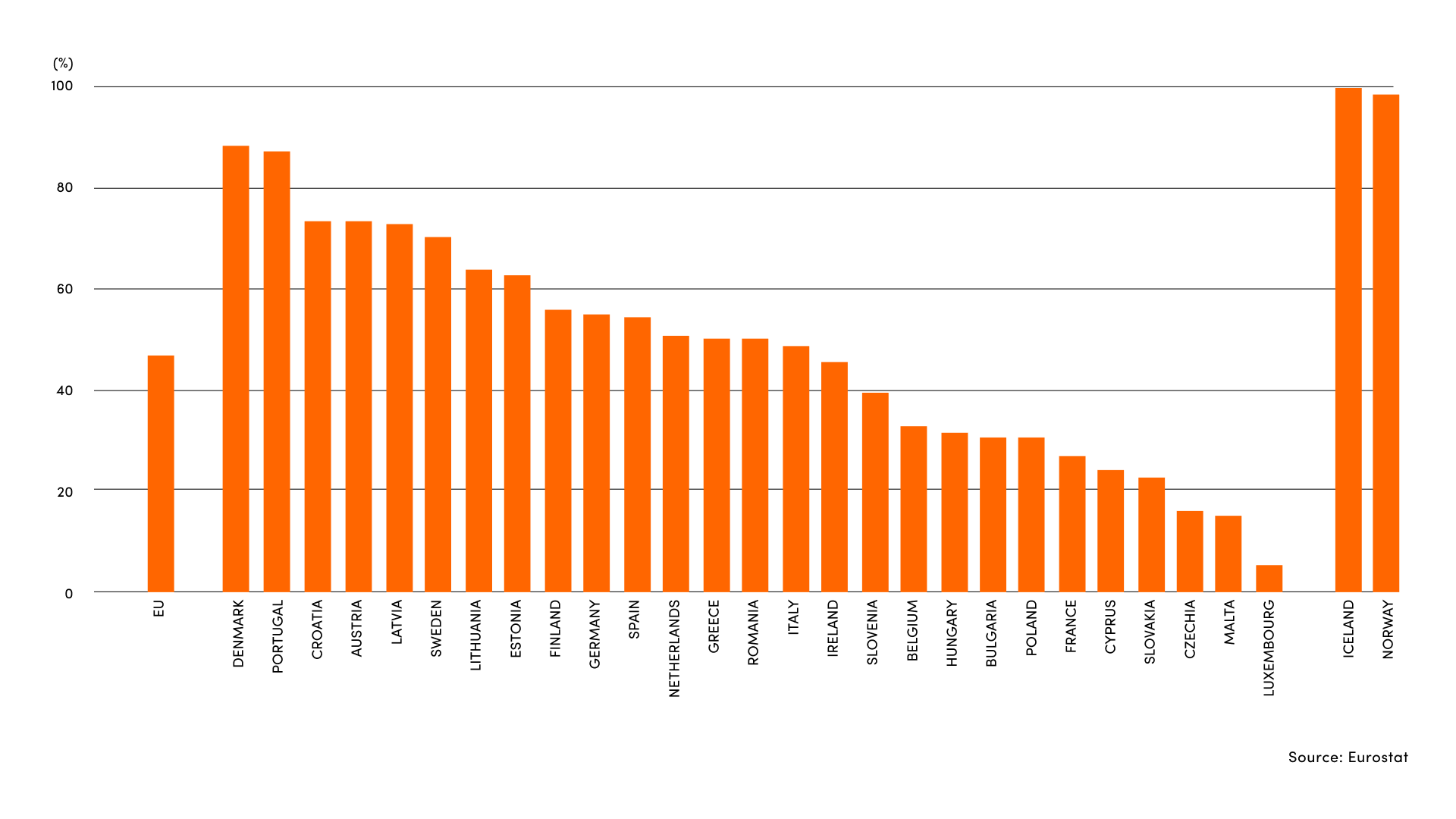
In 2024, Europe accounted for nearly a fifth of global renewable power capacity, similar to its share of global gross domestic product. EU renewable power capacity could potentially nearly triple by 2030 and quadruple by 2040 from 2021 levels, according to the IRENA. The agency estimated this will raise renewables share of EU electricity generation to 71 percent in 2030 and 75 percent in 2040, from 36 percent in 2021.
EU renewable energy sources include wind, solar, hydro, tidal, geothermal, ambient heat and biofuels. Among these, the priorities are solar and wind, which accounted for 28.8 percent of Europe’s electricity mix in 2024, with solar the leading electricity-generating source in 2Q 2025 at 19.9 percent and wind contributing 15.8 percent. In contrast, during the first three quarters of 2025, the combined share of solar and wind globally was just 17.6 percent.
Yet higher energy prices in recent years have caused some lawmakers and voters to question the merit of investing in renewables. In the European Parliament, the Identity and Democracy (ID) group is at the vanguard. The group includes parties such as Rassemblement National (France), Lega (Italy), AfD (Germany), PVV (Netherlands), many of which host outright climate‑sceptic or denialist voices.
Europe’s push to wean itself off Russian oil and gas is putting upward pressure on gas prices. Apart from Hungary and Slovakia, which continue to import Russian oil and gas, the EU has largely stopped importing these products. It still imports LNG from Russia – notably France, Belgium and Hungary – but this is set to be phased out by late 2027. Importing LNG by ship from other countries is estimated to cost about 50 percent more than by pipeline from Russia.
Importance of marginal pricing
The wholesale gas prices in Europe directly impact the price of electricity, because it often determines the marginal price – the cost of the last unit of electricity needed to meet demand. This marginal unit is set by the costliest generator, typically a gas peaker plant that is only turned on to provide power at times of ‘peak’ demand, which is expensive.
Thus, the need for more wind and solar generation in the electricity system at near-zero marginal cost will lead to lower short-term electricity costs, reflected in the wholesale market price. However, a critical mass is needed for solar and wind to have an impact on prices.
To decouple gas prices and electricity costs, the percentage of gas usage in the energy mix needs to drop below the 20-percent threshold, says Starace. At that point, renewables would take over as the marginal price setter in electricity markets for a sufficient part of the year.
A coordinated policy is recommended for Europe’s patchwork of energy networks. Starace notes that “perhaps Europe is penalized by its own fragmentation and complexity.” Different climates, geographies, resources and regulations lead to diverse clean-energy choices – solar in Spain, wind in Germany, hydro in Norway, and nuclear in Sweden – fragmenting the market.
At times, the expansion of wind and solar farms has outpaced the grid’s capacity to utilize the additional sources of electricity. “Renewable build-out outpaced the correspondingly necessary grid investment, and the resulting mismatch is becoming an increasing constraint,” says Johann-Christoph Balzer, Partner at EQT.
Bottlenecks can lead to negative pricing, which occurs when electricity supply exceeds demand, such as on sunny days when demand is low, causing wholesale prices to fall below zero. Operators incur costs to offload excess electricity or turn off production, which discourages investment and can sometimes result in governments paying energy firms not to produce.
Batteries to help tackle bottlenecks
Battery storage can address such demand imbalances. Take EQT-backed Statera’s Thurrock Storage, the largest battery storage facility in the UK and one of the largest in Europe. This facility can power 680,000 homes for over two hours, enough to cover surges in peak usage – at local prices, not global gas rates.
“If you put batteries next to it, you can hedge your revenue stream and improve the risk profile of a project – charging your battery when the sun shines and selling power when it isn’t, and prices tend to be higher,” says Guillermo García-Barrero, Partner at EQT.
As with solar, the costs involved with batteries continue to fall even as technical capabilities improve – prices have fallen as much as 40 percent over the past two years, Starace says.
The investment needed for the EU to reach its 2040 climate target and cut emissions by 90 percent is estimated to increase EU GDP by 2 percent by 2040, rising to 2.3 percent by 2050. This would boost demand for EU manufacturing, while fostering economic convergence between Western and Eastern Europe.
Fossil-free power delivers secure, low-cost competitiveness for businesses and households in Europe – to stall would put that at risk.

ThinQ by EQT: A publication where private markets meet open minds. Join the conversation – [email protected]
Spotlight OnInfrastructure






Exclusive News and Insights Every Month
Sign up to subscribe to the EQT newsletter.