



Why EQT Is Making Big Bets on Space

As the space economy comes of age, Nils Ketter and Carl Sjölund explain how EQT’s teams are positioned from launch to landing station.
- The space industry has reached a pivotal moment, with 2026 on course to be a record year for investment.
Space has captivated humans for generations, from Sputnik’s pioneering journey into orbit to Elon Musk’s visions of interplanetary travel. As the sector grows, many business leaders are setting their sights on the stars.
The core space economy is forecast to grow to $755bn in revenue by 2035, up from $330bn in 2023, according to estimates from the World Economic Forum. This growth will split across four main segments, the WEF predicts:
- Service and end user equipment. Commercial satellite communication, navigation and Earth observation services – and the devices that use them.
- Infrastructure and support. Manufacture, launch and ground operations that enable satellite deployment.
- Civil. Government space programs for science, exploration and Earth observation.
- Defense. Government space programs for national security, such as intelligence, surveillance and secure communications.
Forecast market size of global space economy
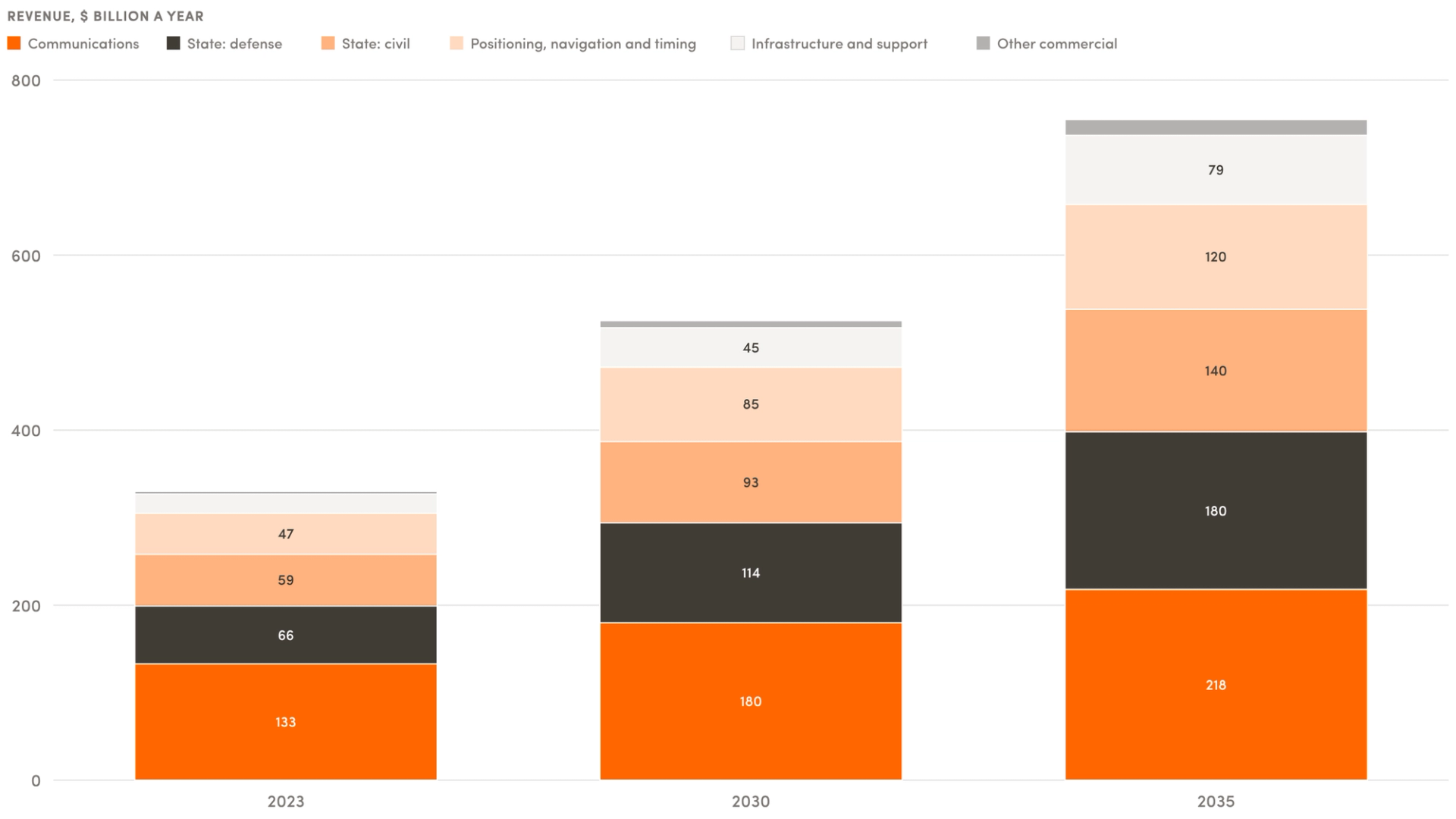
Source: World Economic Forum, McKinsey, estimates from 2024
Another key indicator of the sector’s momentum – mass launched into space – is also rising fast. Annual payloads climbed to more than 3,000 tonnes in 2025, a ninefold gain in a decade, according to data compiled by Jonathan's Space Report, a long-running newsletter created by astrophysicist Jonathan McDowell.
Payload mass launched to orbit
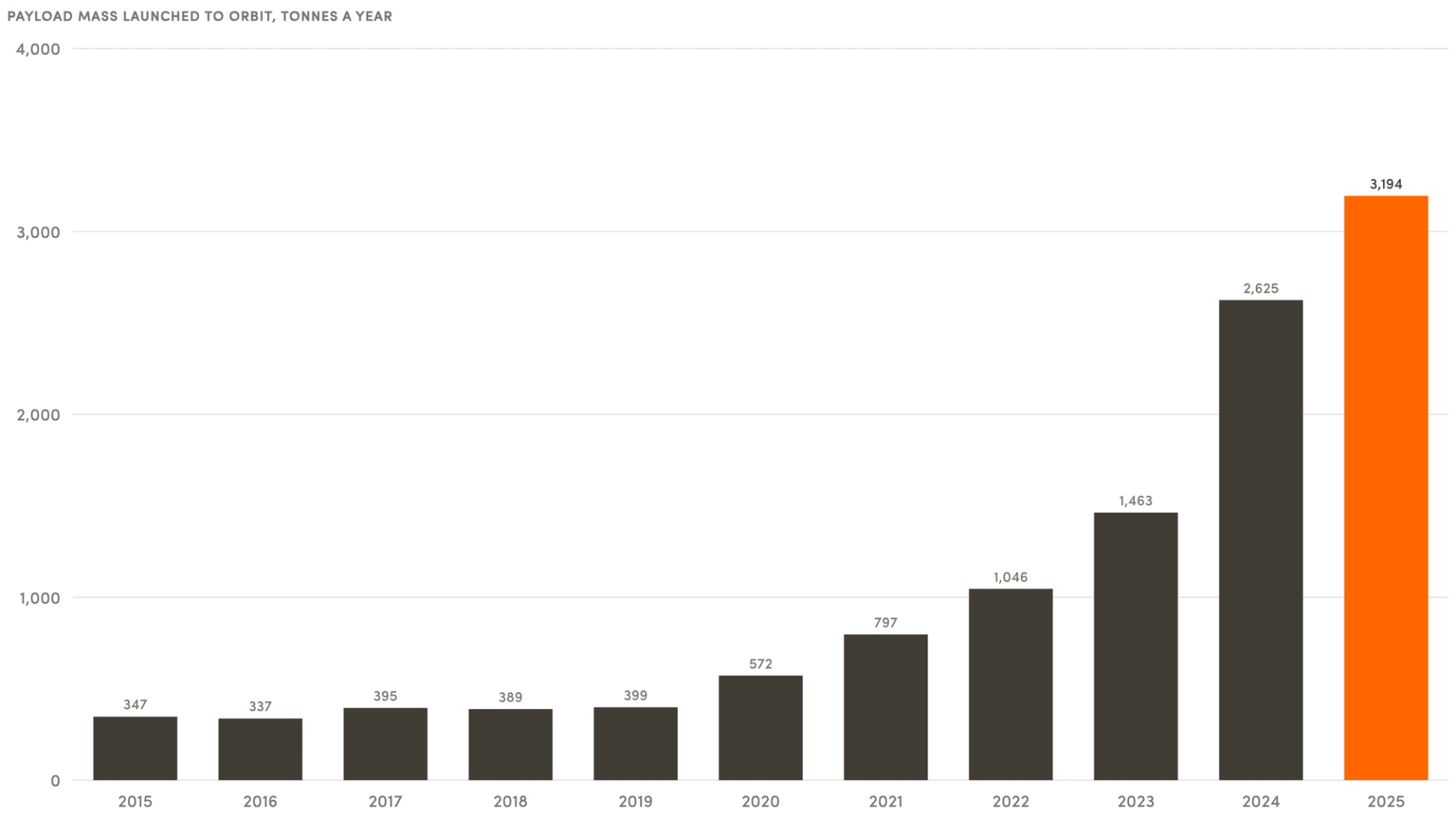
Source: Jonathan's Space Report, data complete through 2025
EQT is positioned across the sector, from early-stage ventures to mature private equity and ground infrastructure investments. At the early stages, EQT Ventures has backed fast-growing businesses such as The Exploration Company, a startup that develops reusable space capsules. The private equity team, which invests in more mature businesses, this month closed the acquisition of satellite deployment solutions firm Exolaunch. And the infrastructure division is funding the construction of satellite ground stations.
“In space, you can actually see how all pockets of EQT come together to capture this growth opportunity,” says Nils Ketter, head of EQT’s industrial technology private equity team.
A changing landscape
Much of the space industry’s expansion has been driven by the shift from geostationary orbits to low Earth orbits. Spearheaded by SpaceX, companies moved their focus from large satellites tracking a single point on the globe to constellations of smaller satellites. “All the growth comes from people figuring out lots of value-adding ways to use that,” says Ketter. “A low Earth orbit architecture is intrinsically more resilient because you don't place your bets on one big satellite somewhere.”
Although EQT had been tracking the opportunity in space for some time, it was not until about five years ago that the space economy was de-risked enough to invest, he explains.
Currently there are more than 16,000 active satellites in orbit according to SatFleet, two-thirds of which are owned by SpaceX’s Starlink. Carl Sjölund, EQT’s digital infrastructure lead, says this number is set to grow significantly, potentially breaching 60,000 by the early 2030s.
Active satellites by launch year
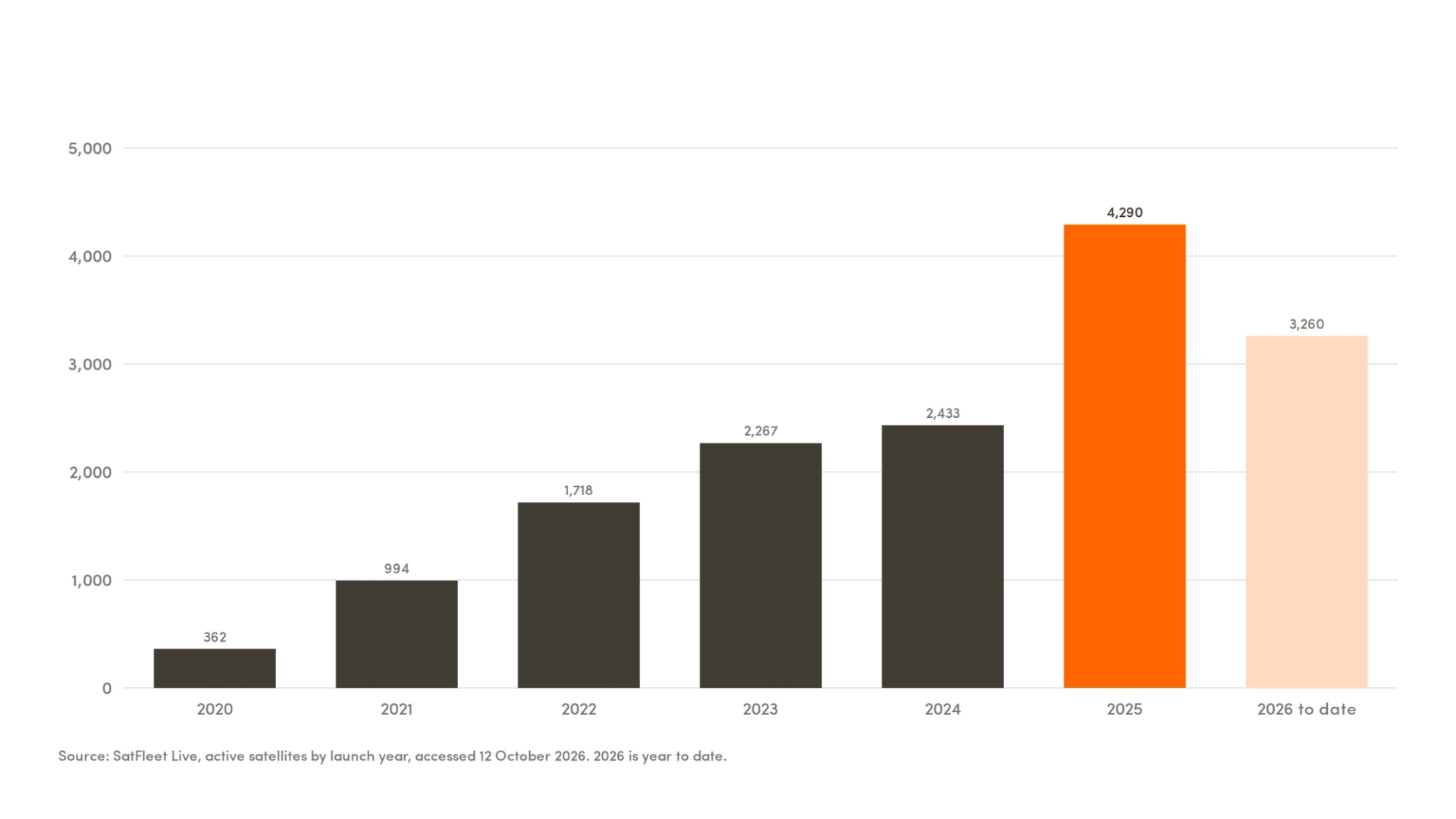
Source: SatFleet, as of Oct 12th 2026
He points to a combination of factors that he expects will drive this growth, with cheaper and more frequent access to orbit chief among them. Reusable rockets have brought launch costs down sharply, which in turn has made it economical to put large numbers of more efficient, mass-produced satellites into orbit.
The multi-team strategy
EQT’s first investment in the space industry was with the venture arm in 2023, leading the Series A funding of The Exploration Company. EQT Ventures has since invested in Starcloud, an orbital data center development company, while the EQT-managed Scaleup Europe Fund led The Exploration Company’s Series C and co-led the Series F round of micro-satellite producer, ICEYE.
“The fact that we started looking at space very early in equity ventures means that we can draw that competence and that theme into all of our strategies,” says Christian Sinding, EQT’s former CEO, institutional partner and chair of the Scaleup Europe Fund’s investment committee.
In October, EQT’s private equity team closed its first deal in the sector, acquiring satellite management firm Exolaunch. The choice of company was strategic, said Ketter, as Exolaunch stands in the middle of satellite operators and launchers. “They serve a pivotal role in the space industry and allow us to see a lot of what is going on.”
Private equity’s entrance into the space, “is a natural evolution,” he explains. “It’s this new ecosystem coming of age with companies that are becoming profitable and of sufficient maturity for investment.”
From the ground up
Where others have been drawn to focus on the launch and operation of satellites, a major part of EQT’s thesis has its feet planted firmly on the ground, targeting the Earth-based infrastructure that is essential to satellite communication. Sjölund explains that investing in this side of the space sector follows the progression of the communications industry and aims to add to the resilience of EQT’s long-term approach.
Although satellites were initially used primarily for military functions and Earth observation, the influx of private, mass produced satellites spearheaded by Starlink has broadened the scope of satellite communications to more commercial usage including broadband for homes, and data collection that can feed into a variety of use cases. “All of them need to communicate with Earth,” he says. “They will do that through teleports or ground stations.”
EQT’s primary investment in ground stations is through SatPort, a carrier-neutral satellite infrastructure company. Sjölund explains that the company was built and backed with long-term capital from EQT, with the goal of scaling all over the world.
Since SatPort’s creation in 2024, “The market has continued to develop at an even stronger pace,” he says. “It has also become a lot more efficient.” SatPort currently has ground stations in more than a dozen countries, but Sjölund expects the number to rise as more companies launch their own large-scale satellite constellations. The company completed its first major partnership with Telesat in September, supporting the expansion of its satellite constellation. In November, SatPort acquired the teleport infrastructure business of communications services provider Speedcast, adding a further 12 ground stations across five continents.
Just the start
“We’re just at a starting point,” said Ketter, when asked how he sees the space opportunity evolving. He expects new mega-launchers such as SpaceX’s Starship to open up entirely different business models, with missions back to the moon and beyond creating opportunities for the companies that support them.
The growth is unlikely to be linear, Ketter acknowledged. The positioning of EQT’s investments across the ecosystem and at different stages of maturity, however, enables privileged insights and connectivity, giving it a bird’s eye view of the sector’s secular expansion.

ThinQ by EQT: A publication where private markets meet open minds. Join the conversation – [email protected]
On the topic ofTechnology




Exclusive News and Insights Every Month
Sign up to subscribe to the EQT newsletter.