



Is Diversification Dead?

Many portfolios continue to be built on assumptions formed in a different economic context, one characterized by stable geopolitics, abundant liquidity and diversification derived from varied sector, asset class and geographic exposure.
- This article is adapted from “The New Rules of Capital”, a report that considers how value is created, captured and compounded in a more complex world. Read the full report here.
For decades, diversification has been built on a set of relatively stable relationships: equities and bonds offset each other, geography spreads risk, and sectors provide meaningful differentiation. In a world shaped primarily by monetary cycles, these assumptions held.
In the new paradigm, true diversification requires a different framework.
2022 is worth examining. Both global equities and bonds declined meaningfully in the same year, challenging one of the most widely used portfolio construction assumptions. Whether this represents a structural break or a temporary dislocation remains debated, but what is clear is that correlation stability cannot be taken for granted. Since then, correlations have remained less stable, reflecting a shift toward environments driven by inflation, policy decisions, and real-world constraints rather than purely monetary conditions.
Most traditional asset classes are increasingly correlated to large-cap equities
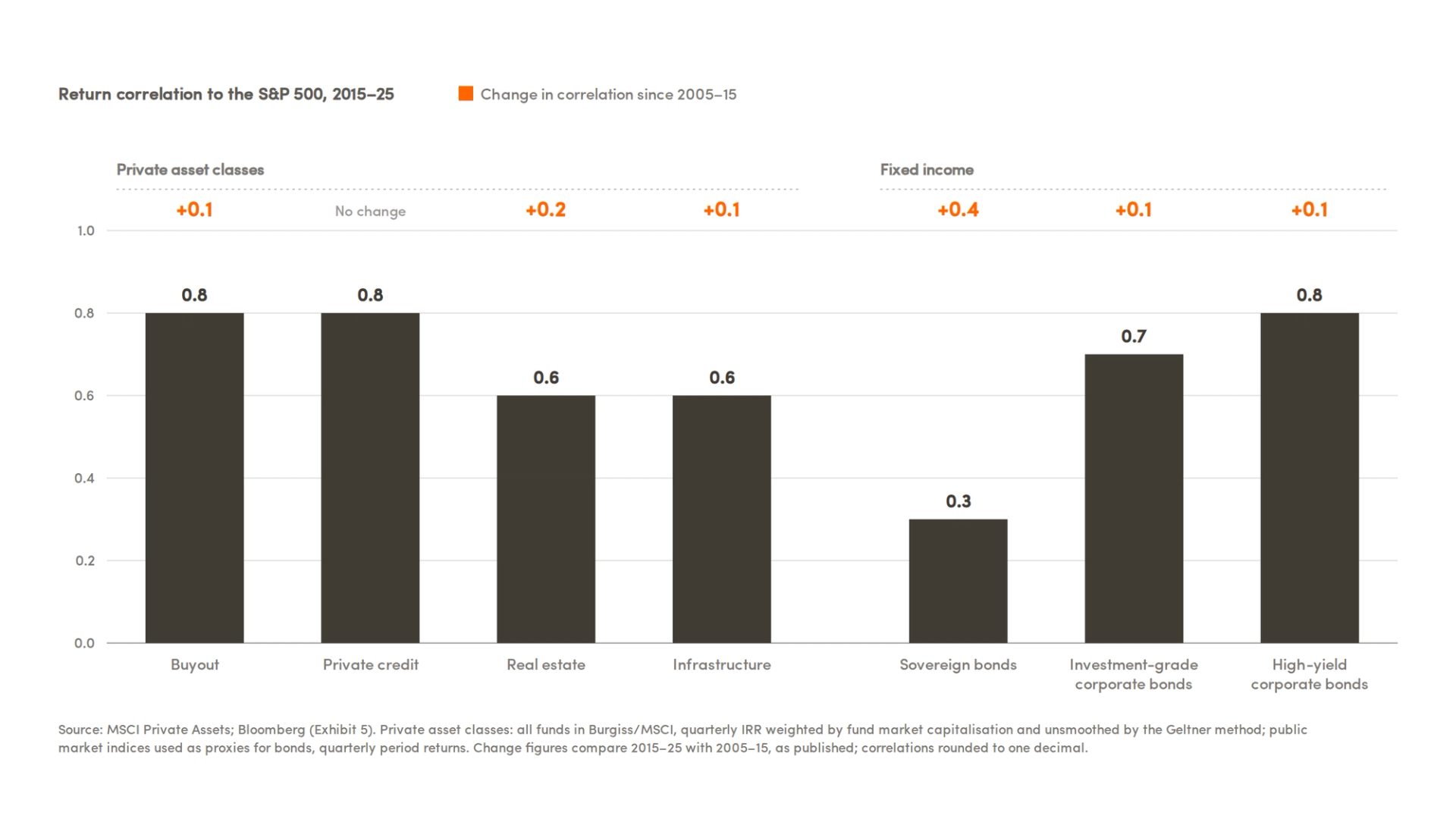
Source: MSCI Private Assets, Bloomberg
At the same time, traditional diversifiers are becoming less effective. Sector distinctions are blurring as technology becomes embedded across industries, while geographic exposure is increasingly misleading.
Supply chains, energy systems and policy decisions create shared dependencies across regions, so what appears diversified can still be exposed to the same underlying shocks. As one CIO observed, “Geography doesn’t work as a diversifier in the way it used to, almost everyone is exposed to the same drivers.”
“Diversify your diversifiers”
Diversification needs to be redefined. What matters now is not asset class labels but underlying exposures: to bottlenecks, to policy regimes, to technological change and to
real-world constraints. “You now have to diversify your diversifiers,” another CIO said. For example, this means diversifying by energy dependency (grid-connected vs. off-grid vs. fuel-agnostic), by technology positioning (bottleneck owner vs. bottleneck dependent), by value creation lever (organic growth vs. M&A-driven vs. operational transformation), and by policy exposure (regulated vs. unregulated, single-jurisdiction vs. multi-market) – not simply by geography or sector label.
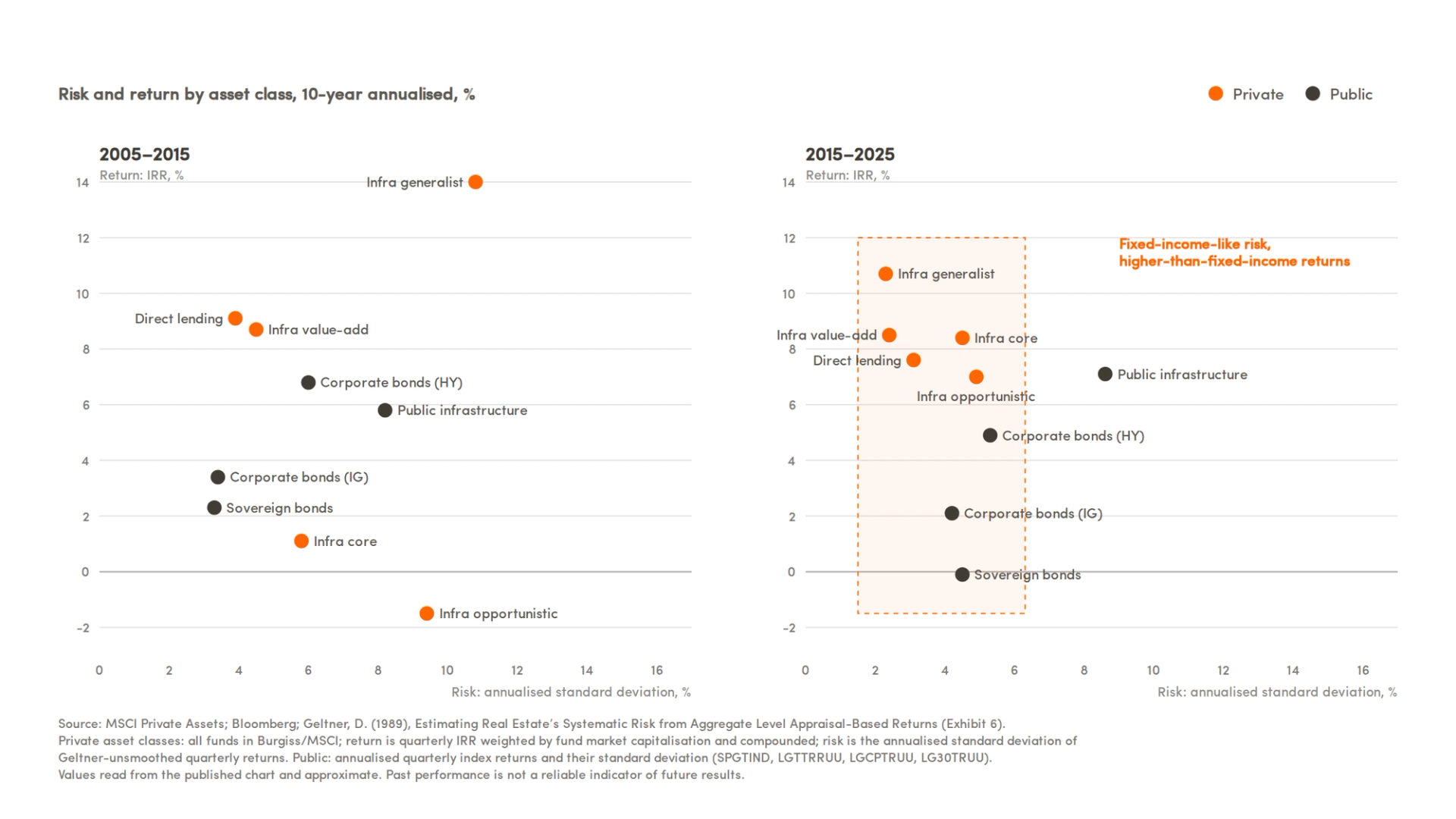
The redefinition is most visible in how defensive portfolio assets are evolving (see chart below).
Infrastructure is fixed-income-like risk with higher returns
Source: MSCI Private Assets; Bloomberg; Geltner, D.
Fixed income used to mean bonds; today, infrastructure offers a 300-basis-point premium over high-yield corporate bonds at comparable cash flow stability for long-dated investors. Infrastructure delivered with genuine liquidity should as such compete for the fixed income allocation.
From allocation to construction
Diversification is less reliable when exposures are driven by shared dependencies. Public markets no longer provide full access to where value is being created. And private markets, while structurally advantaged, must evolve to meet higher expectations around consistency, transparency, and liquidity. As one CIO said, “The question is no longer how to allocate, it’s how to construct a portfolio that actually works in this environment.”
The traditional playbook of allocating across asset classes, relying on historical correlations, and capturing market beta was built for a different world. Returns today are less about broad exposure and more about positioning: access to the right opportunities, alignment with the right partners, and the ability to execute consistently through cycles.
That shift, from allocation to construction, is what will define the next generation of investment models. To be clear: the argument is not for concentration. It is that diversification itself requires more deliberate construction, understanding underlying dependencies rather than relying on labels. The goal is not fewer positions but positions that are genuinely uncorrelated.
This article is adapted from a section of “The New Rules of Capital”, a report that considers how value is created, captured and compounded in a more complex world. Read the full report here.

ThinQ by EQT: A publication where private markets meet open minds. Join the conversation – [email protected]
On the topic ofPrivate Markets





Exclusive News and Insights Every Month
Sign up to subscribe to the EQT newsletter.