



The Five New Rules of Investing

The investment environment that underpinned many investment portfolios has changed. Stable geopolitics, cheap and abundant liquidity, predictable diversification and public markets at the centre of price discovery are a thing of the past. In a new report, we have identified five major shifts with a profound impact on today’s risk-return dynamics.
- This article is adapted from “The New Rules of Capital”, a report that considers how value is created, captured and compounded in a more complex world. Read the full report here.
As the old world gives way to the new, everything can feel uncertain. It isn’t. The five forces reshaping the investment landscape are not random but structural, visible and already under way.
Taken together, they point to a different set of conditions for how capital is deployed, how value is created, and how returns are generated.
Shift 1: More multipolar – and more interdependent
The global economy is fragmenting – and becoming more connected at the same time.
Economic power is no longer concentrated in three poles. India, the Gulf States and parts of Latin America are reshaping trade and capital flows, reducing the relative dominance of the U.S., Europe and China. The shift is visible: the U.S. dollar’s share of global foreign exchange reserves has declined from around 70 percent two decades ago to the mid-50s today, while new pools of capital (particularly in the Gulf) are scaling rapidly and deploying globally.
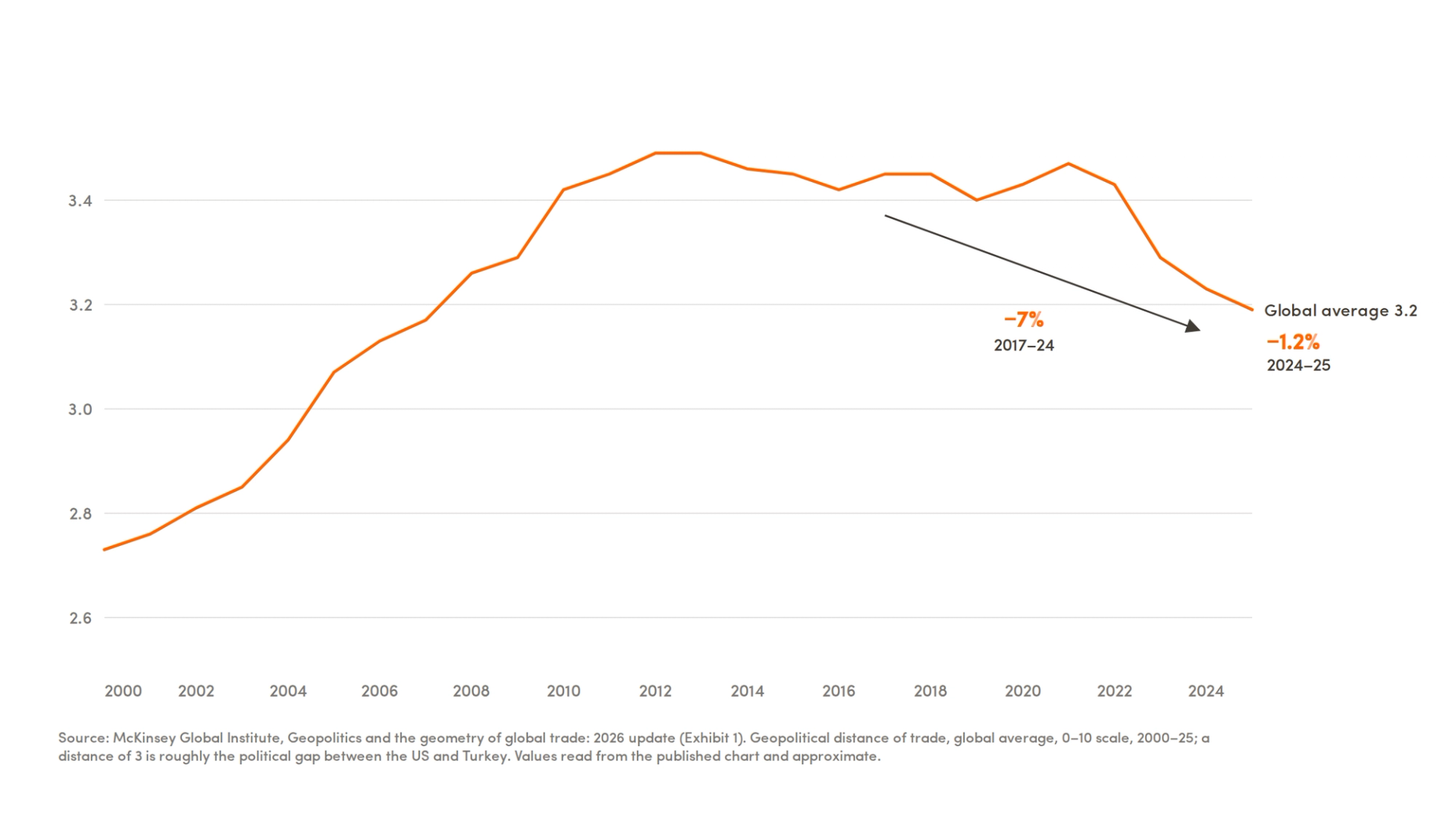
Trade patterns are adjusting accordingly. As the chart below shows, the geopolitical distance of trade has declined since 2017 as countries re-route flows toward political allies. Today, roughly half of global trade takes place between aligned blocs.
Geopolitical distance of trade, 0–10 scale
Source: McKinsey Global Institute
Yet this is not deglobalization. In critical ways, interdependence is deepening, particularly in services, technology and the commodities that underpin modern economies. Global trade in services is growing at 8 percent per annum.
The result is a different geometry of risk. What looks like diversification is often concentrated exposure to the same underlying dependencies. A portfolio spread across regions may still rely on the same semiconductor supply chains, the same energy inputs, or the same policy pathways.
As one CIO noted, “Geography doesn’t diversify you if the underlying dependencies are the same.”
Chokepoints matter more than borders, and new ones are constantly being created as flows are redirected. In this paradigm, the role of the state has expanded. Industrial policy, subsidies, export controls, and national security considerations are now shaping industry outcomes. Governments have become more than regulators. They are allocators of capital, creators of demand, and, at times, competitors.
As traditional macro, geopolitical and trade considerations are changing, portfolio construction requires a new approach to diversification. Within-country dynamics, sector exposure, and global linkages increasingly determine outcomes. Diversification frameworks built on geography and asset class have become insufficient. The challenge is not simply to diversify, but to understand what is truly uncorrelated.
Shift 2: AI – energy-fed and adoption-led
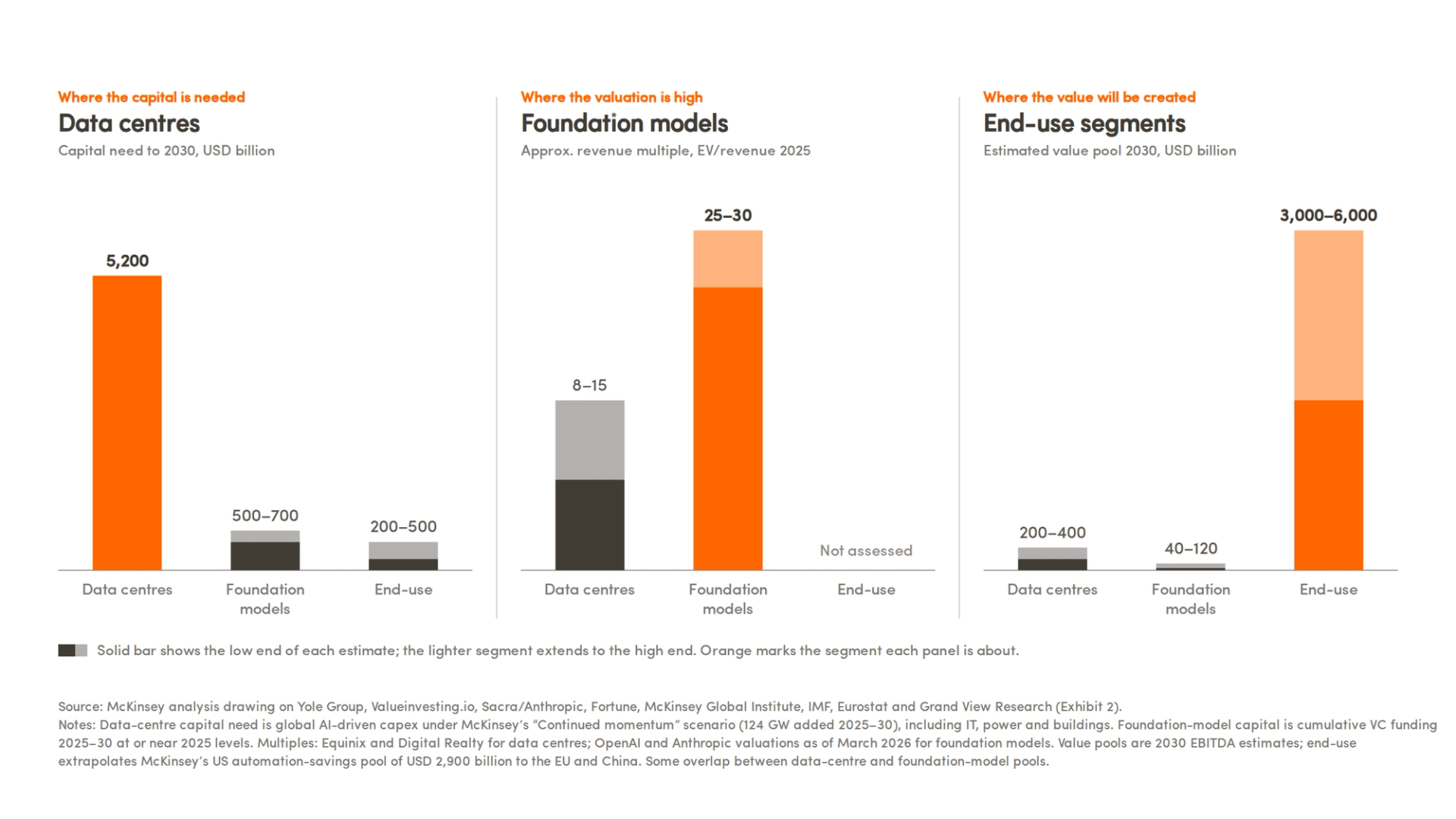
The scale of the AI opportunity seems clear: AI could unlock between $3tn and $6tn in incremental value across the global economy by 2030, according to estimates from McKinsey. Capital is already moving accordingly, with hundreds of billions of dollars deployed in just the past two years for data centers, compute infrastructure and enabling technologies, with several trillion more required over the remainder of the decade to meet expected compute demands. However, value creation is likely to develop as a barbell, concentrated at each end with greater uncertainty in the middle.
AI could unlock up to $6tn in incremental value by 2030
Source: McKinsey
At one end, value is concentrating in the infrastructure layer: compute, data centres, power, cooling and networks. These are physical systems with binding constraints. Access to energy, grid capacity, permitting and land is shaping where capacity can be built and how quickly it can scale. As demand for compute accelerates – across both
training and inference – these constraints are becoming more acute, not less. As an EQT leader put it, “Infrastructure stands out because it still gives you something rare: exposure to real growth with demand risk protections (without pretending the downside does not exist). In a market full of abstractions, that combination of stability and upside is unusually valuable.”
At the other end, AI has the potential to drive significant productivity gains across end-use sectors. The opportunity extends beyond automation to the redesign of workflows, decision-making processes and business models. Capturing it depends on execution: embedding AI into operations in ways that measurably improve output, cost and speed.
Between these two ends sits the most visible and most contested part of the ecosystem: models, platforms and applications. While the pace of innovation is rapid and the opportunity for category leaders significant, the durability of advantage is still unclear. Cost curves are moving, capabilities are converging, and competitive positions are shifting
quickly. The challenge for investors is how to identify those that will capture value consistently over time, rather than picking the short-term winners.
What connects both ends of the barbell is constraint. AI is fundamentally compute-constrained, and the availability and cost of compute and the energy underpinning it will increasingly shape who can build, scale and deploy effectively. At the same time, realising the productivity upside is an organizational challenge. As one CEO put it, “The value is not in the model, it’s in how you change the way the company works.”
The result is a skewed distribution of returns. Value will accrue disproportionately to the owners of constrained infrastructure, the providers of critical inputs, and the operators who can translate AI into sustained productivity gains. For investors, AI is not a theme to allocate to but a system to navigate, requiring careful judgement about where, when and how to participate.
Shift 3: New industries emerging where winners are yet to be made
A growing share of global economic value is concentrating into high-growth industries,
where both the pace of scaling and the intensity of competition are materially higher than in the rest of the economy.
In 2005, 12 industries accounted for less than 10 percent of global economic profit. Already by 2019, these industries had grown to dominate markets, representing roughly half of global profits. These industries are not only larger but scaling faster, attracting more capital and producing a disproportionate share of the world’s leading companies.
18 identified industries have the potential to reshape the economy. These industries range from digitization such as AI software and services, cloud services, semiconductors, to hard technology industries such as robotics and autonomous vehicles. What distinguishes them is not just growth, but dynamism. Market positions that once took decades to establish can now shift within a few years, as technology, regulation and capital flows reshape the competitive landscape. The gap between leaders and laggards is widening at the same time as leadership itself becomes less stable.
These industries are also inherently global in how they scale, even as the conditions that shape them remain local, such as policy, infrastructure and access to inputs. Companies must expand across borders while navigating increasingly fragmented operating environments, and competitive advantage often depends on how effectively they manage both.
The result is a different pattern of value creation. Returns are increasingly concentrated in specific industries that capture a disproportionate share of growth. As one CIO observed, “Missing these dynamic markets is not a neutral position, you are left holding the slower parts of the economy.”
Timing and capability readiness matter more than ever. Early visibility and understanding of market indicators allow for early positioning, creating durable advantage as ecosystems form and standards emerge. In contrast, late entry is increasingly expensive, not just in terms of valuation, but in the ability to secure a meaningful position. The challenge is not in identifying high-growth sectors, but in being invested in and shaping markets where winners are still being determined.
Shift 4: High-growth opportunities increasingly sit off public benchmarks
As value creation concentrates in these industries, value is increasingly being created and captured outside public markets.
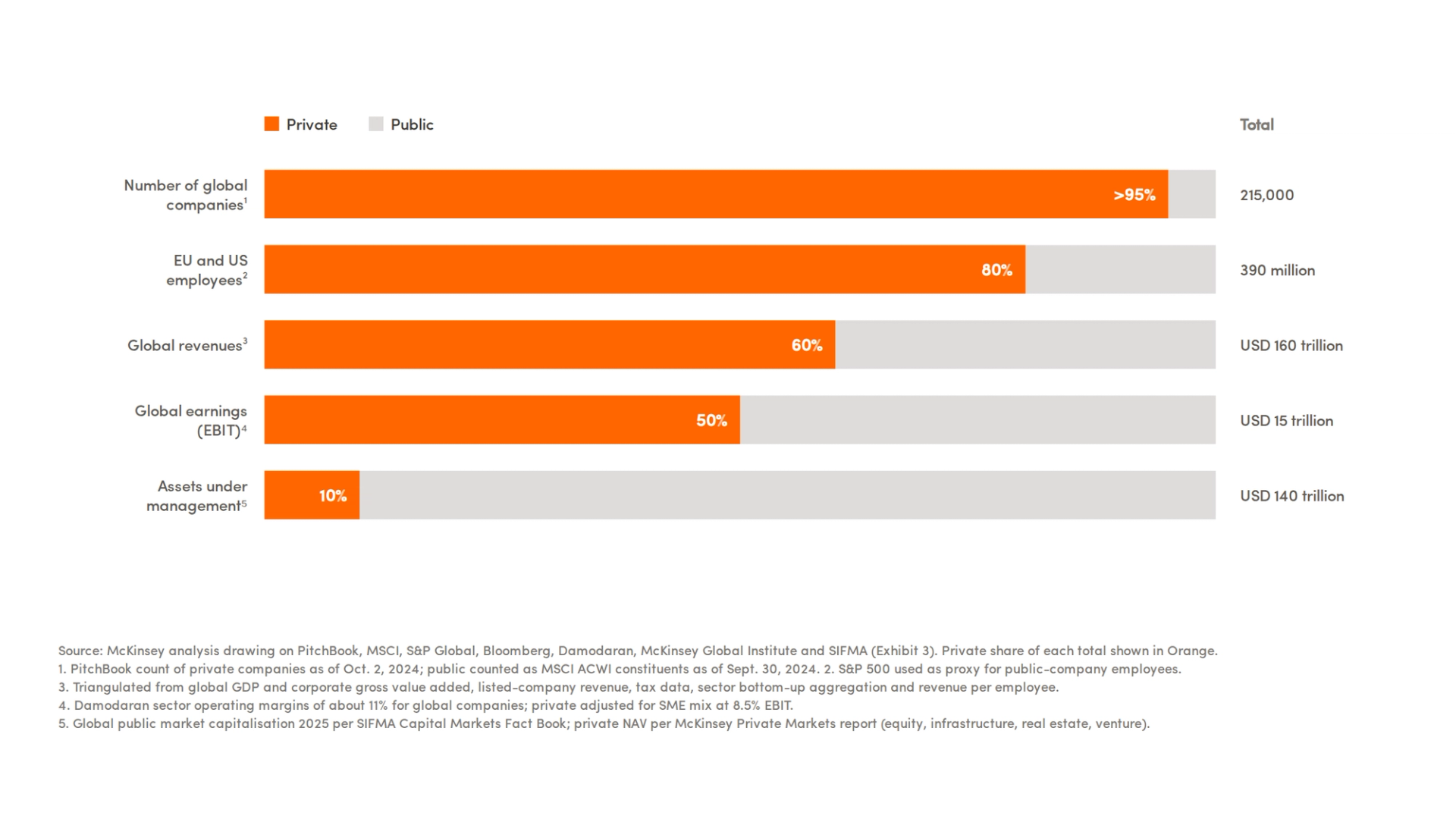
Private and public markets are not substitutes; they are becoming more complementary. Today, an estimated 60 percent of global revenue and around half of global profits sit in private businesses, yet institutional portfolios allocate on average just 10 percent to private markets. (See chart below.) Many of the companies shaping the most dynamic parts of the economy are staying private for longer.
While 95 percent of companies are private, only 10 percent of invested capital is
Source: Analysis based on PitchBook, MSCI, S&P Global, Bloomberg, Damodaran, McKinsey Global Institute, SIFMA
This is partly a function of scale, as private markets can now fund companies across
their full lifecycle, from early-stage innovation to large-scale infrastructure. But it is also
structural. The types of transformations required in today’s environment – such as AI adoption, supply chain reconfiguration and business model reinvention – are often difficult to execute within the constraints of public markets.
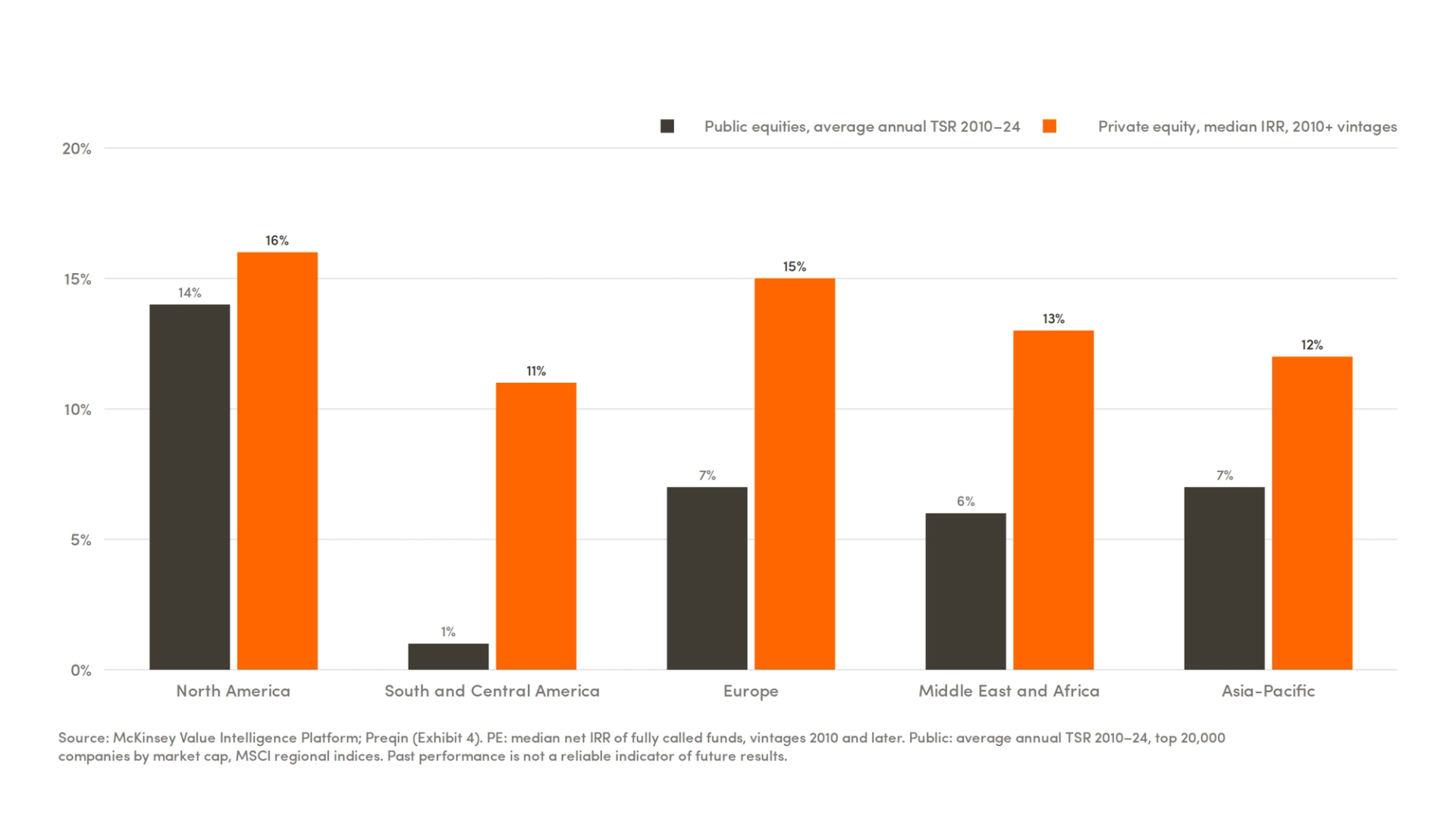
The result is a shift not just in where value is created, but in how it is accessed. Public markets continue to provide broad geographic exposure but, as the chart below illustrates, outside of the U.S. that has not translated into returns. Index composition, sector concentration, and the timing of listings mean that much of the underlying growth, particularly in newer or more dynamic segments, is not fully reflected in a public portfolio.
Private markets have historically better translated geographic diversification into returns
Source: McKinsey Value Intelligence Platform, Preqin
Private markets, by contrast, offer a more direct way to access how value is being created within regions. They allow investors to target specific companies, sectors, and business models rather than relying on aggregated market exposure. In a multipolar world, where opportunities are increasingly localized and diverse, this ability to convert exposure into returns becomes more important.
Public markets remain essential, particularly for liquidity. But they are increasingly capturing companies at a later stage of their development, after much of the growth and transformation has already taken place. For investors, relying on public market exposure alone provides an incomplete view of the opportunity set.
Shift 5: New sources of capital are reshaping competition for assets
The competitive landscape for assets is changing. Not only is there more capital, but the capital is fundamentally different to traditional institutional sources in terms of deployment, returns and liquidity requirements.
A broader set of investors is now active across private markets. Sovereign wealth funds, insurers, private wealth channels, family offices and principals, and retail vehicles are increasing in scale and participation. In public markets, retail investors now account for roughly a quarter of trading volumes, up from around 10 percent a decade ago. In private markets, evergreen vehicles have grown rapidly, bringing new pools of capital (e.g. retail
investors and family offices) into segments that were historically more institutional.
The importance of this shift lies in how it changes the economics of competition. Different investors operate with different costs of capital, return requirements, time horizons and liquidity constraints. These differences increasingly shape marginal pricing,
and, in turn, who can win assets. An insurance balance sheet targeting mid-single-digit returns can justify valuations that a private equity fund targeting mid-teens net returns would not. Sovereign investors may accept lower financial returns in exchange for strategic objectives. As these participants become more active, they not only add capital but redefine clearing prices.
Simultaneously, the expansion of the investor base is introducing more complex dynamics around capital deployment and alignment. Evergreen and retail-oriented vehicles, by design, require more continuous deployment of capital. As one CIO put it, “The emergence and growth of evergreen vehicles can materially alter the supply/demand dynamics for co-invest, at the potential expense of institutional allocators and significantly altering the economics of private investing.” While still evolving, this dynamic was raised consistently across our interviews as an emerging tension in the market, challenging investment firms to devise deployment models meeting the needs of a broader set of partners without short-changing their longest-established relationships.
The geographic distribution of capital is also shifting. Sovereign wealth funds in the Gulf alone now manage more than $5tn in assets, up 60 percent since 2020, while domestic capital pools are deepening across regions such as India and Southeast Asia. Capital is becoming more multipolar, mirroring the broader economic landscape.
Simultaneously, the access points into private markets are evolving to match the needs of a broader and more diverse investor base. Traditional drawdown funds remain the foundation, but longer-dated vehicles, evergreen structures, and direct investments in their various forms – co-investment, continuation vehicle rollovers, separately managed investment strategies to future-proof accounts – are expanding the architecture available to different types of capital. Evergreen vehicles in particular are increasingly adopted by institutional investors, not only private wealth channels, offering continuous compounding while reducing reliance on any single vintage year. Continued innovation is critical for more savers to benefit from the long-term returns that private ownership can generate.
This has two implications. Competition for assets is increasingly shaped by structural advantages, not just investment capability, and navigating this environment requires a
more flexible approach to capital that combines origination, partnership, and alignment across different pools of capital. The private markets investor base is permanently more diverse, and that diversity brings both capital and complexity. The firms that thrive will be those that welcome differentiated capital while holding themselves to consistent underwriting standards and radical transparency – on allocation, on deployment pacing, and on how different pools of capital are treated.
Taken together, these shifts help explain why familiar portfolio building blocks are coming under strain. Diversification is less reliable when exposures are driven by shared dependencies. Value creation is increasingly concentrated in specific industries and often captured outside public markets. And competition for assets is being reshaped by new forms of capital with different economics.
This article is adapted from a section of “The New Rules of Capital”, a report that considers how value is created, captured and compounded in a more complex world. Read the full report here.

ThinQ by EQT: A publication where private markets meet open minds. Join the conversation – [email protected]