



The Rise of Secondaries: From Niche to Mainstream

Once a niche corner of private equity, secondaries have become a fast-growing segment in private markets.
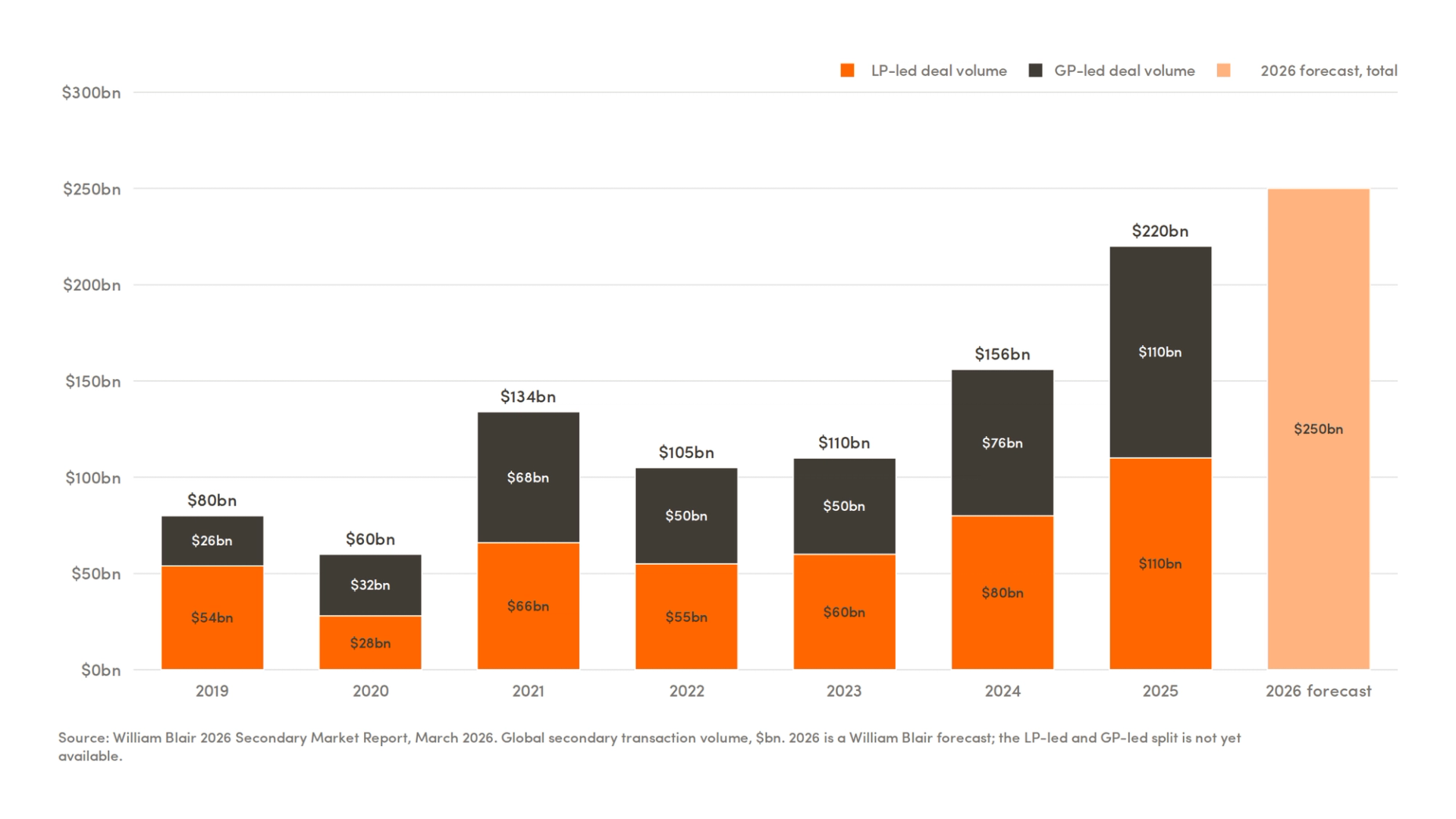
The global secondary market reached a record $220bn in transaction volume in 2025. By 2030, that figure has the potential to exceed $500bn. For professional investors, understanding the opportunity has never been more important.
What exactly are secondaries?
A secondary transaction involves the purchase of an existing interest in a private equity fund or portfolio, as opposed to a primary investment where capital is committed at the outset of a new fund.
There are two broad types:
- LP-led secondaries, where a limited partner sells their stake in a fund to a secondary buyer, often to raise liquidity or rebalance their portfolio.
- GP-led secondaries, where a fund manager restructures existing assets, typically moving high-conviction portfolio companies into a new continuation vehicle. Existing investors have the option to cash out or reinvest in the continuation vehicle.
These two routes offer distinct opportunities for investors, and a diversified approach to secondaries often draws on both.
Demand is stronger than ever
Fifteen years ago, secondaries were a niche strategy dominated by distressed sellers and opportunistic buyers. Today, the market looks very different.
A surge in GP-led transactions, rising demand from LPs for liquidity solutions, and greater sophistication among buyers and sellers have pushed secondaries firmly into the mainstream.
Industry consolidation is reinforcing this trend as LPs look to reduce the number of GP relationships they maintain. Many are using secondaries to exit non-core exposures and concentrate capital with a smaller group of high-conviction managers.
In 2025, transaction volume rose 42 percent year-over-year, and fundraising momentum remains strong, with deal value expected to reach a record $250bn in 2026, according to William Blair.
For wealth advisors and private bankers, this signals that secondaries are no longer just an institutional story. They are becoming an essential building block of a well-constructed private markets allocation.
Global secondary market volume
Source: William Blair
For clients looking to build exposure to private markets, secondaries may offer several compelling differences to primary investments. Here are a selection of potential benefits.
Buying at a discount
Secondary-market discounts may result from several factors, such as a seller rebalancing their portfolio, adjusting vintage exposure, or seeking liquidity. As a result, buyers can often purchase high-quality investments for less than their reported net asset value, which may lead to stronger returns at exit.
Reduced blind pool risk
Unlike primary funds, where investors commit capital before the portfolio is built, secondaries allow buyers to invest in known assets with visible performance histories. This transparency reduces uncertainty and allows for more informed due diligence.
Capital goes to work sooner
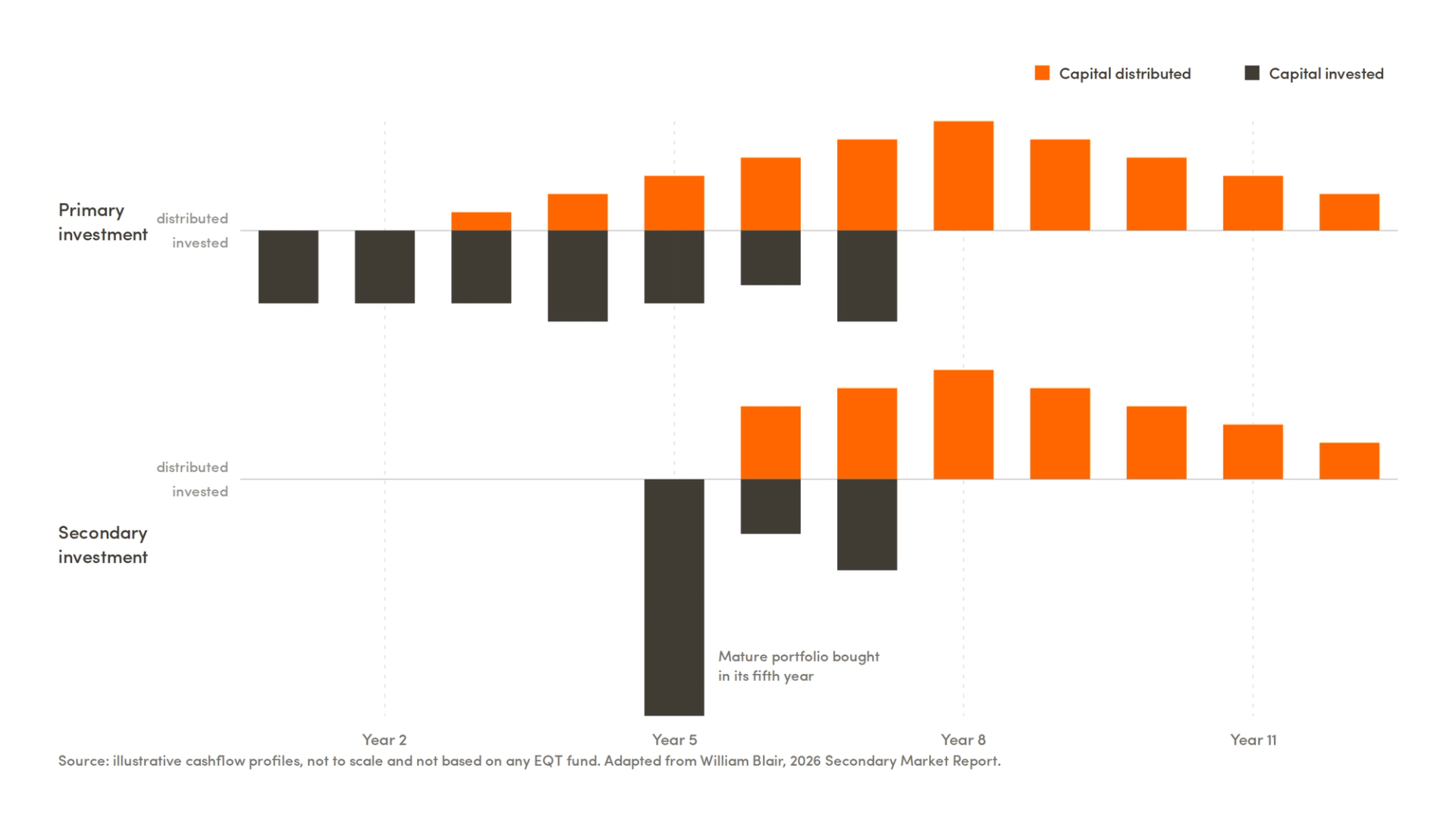
In primary funds, capital is called over time as the manager makes investments. In secondaries, buyers typically pay the purchase price in a single transaction. So, the investor’s capital is put to work sooner, and private market exposure can be built more quickly.
J-curve mitigation
Secondary investments are already partway through their lifecycle. That means investors typically begin receiving distributions sooner than they would in a primary fund, reducing the early negative return period known as the J-curve.
Example cashflow profiles
This is where manager selection becomes critical. EQT's recent acquisition of Coller Capital is a significant development for clients seeking institutional-quality exposure to secondaries.
Coller Capital is a pioneer in secondaries with nearly $50bn in total AUM and a track record spanning decades of market cycles. Their expertise spans LP-led and GP-led transactions across geographies and asset classes.
The result is a partnership that combines global private markets infrastructure with one of the deepest secondaries specialisms in the industry.
For EQT clients, that could mean direct access to the Coller Private Equity Secondary Fund, providing exposure to Coller's differentiated secondaries strategy through EQT's client solutions platform.
Where next for investors?
A large and growing pool of private equity assets, increasing demand for liquidity solutions, and the maturation of the GP-led market have created a dynamic environment for secondary investors to potentially generate strong, risk-adjusted returns.
For wealth advisors building private market allocations for their clients, secondaries have the potential to offer a rare combination: diversification, discount-driven return potential, and earlier liquidity potential.
The question is no longer whether secondaries belong in a private markets portfolio. It is how to gain the best possible access.

ThinQ by EQT: A publication where private markets meet open minds. Join the conversation – [email protected]
On the topic ofPrivate markets




Exclusive News and Insights Every Month
Sign up to subscribe to the EQT newsletter.