

Boris Maeder: How Private Markets Are Moving From Closed Doors to Open Access




EQT's Boris Maeder outlines the opportunities being created as private markets open to individual investors.
Private markets have long been an important part of institutional portfolios, yet they have remained largely inaccessible to individual investors. That is beginning to change. Today, evergreen strategies are making private markets available to a broader range of investors, offering welcome diversification, reduced volatility and access to value created away from public markets – but navigating this opportunity requires the right partner.
As private markets become an asset class open to individual investors rather than one reserved for institutions, the obvious questions are: should I invest, how much – and with whom? This article attempts to answer those three key questions for individuals thinking of adding a fresh asset class to their investment portfolio.
Why private markets?
Private markets – private equity, private credit, infrastructure, real estate and secondaries – bring welcome diversification to a portfolio. They can reduce volatility and increase exposure to the value being created in the vast majority of the global economy that’s not listed on public stock markets.
Let’s talk about performance first. Over the long term, private equity investments have outperformed the public stock markets. While an index of global stocks rose by 11 percent each year over a 15-year period through June 2024, an index of private equity returns climbed 15 percent, according to an analysis by Cambridge Associates.
Private markets returns versus public markets returns
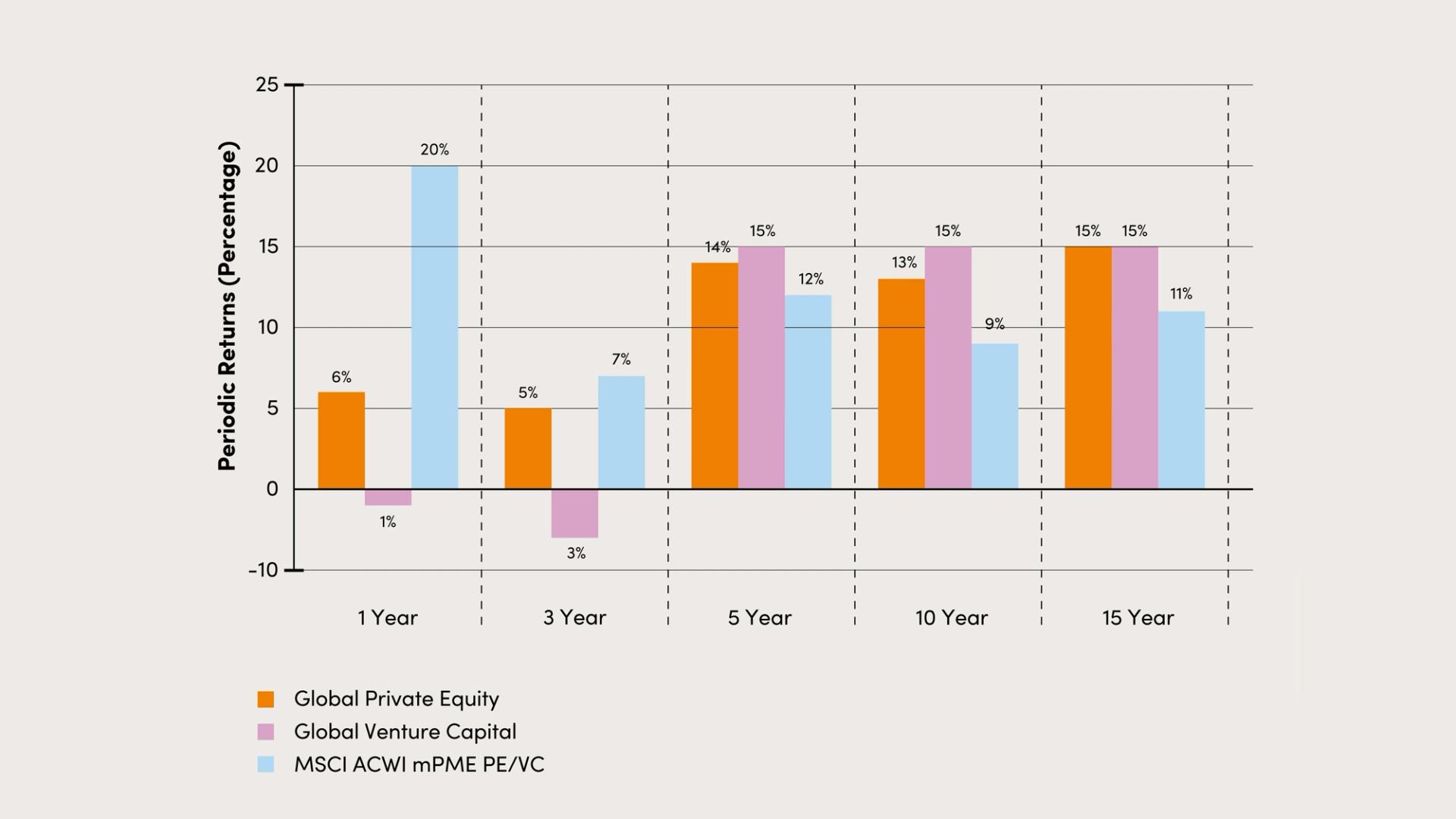
Source: Cambridge Associates
Private markets can be more resilient during market downturns while public markets tend to react quickly and sharply to uncertainty. The moves in private markets also tend to have lower correlation to stocks than some other investments, reducing overall volatility in a portfolio. This can be particularly important in times when government bonds lose their negative correlation with stocks.
Despite these advantages, most individual investors still have the vast majority of their portfolios invested in public equities. The average allocation to private equity by individual investors is only about 3-5 percent. In contrast, some institutional investors allocate 50 percent or more of their portfolios to private assets.
Adding private markets to an individual's suite of investments allows them to benefit from the billions of dollars of value being created away from Wall Street, creating a more rounded portfolio.
How individuals can better access private markets
If the benefits of private markets to investors are clear, historically they have been out of reach for individuals. Investors had to sign up to large minimum tickets, complex documentation, capital calls and decade-long lock-ups.
Evergreen strategies have fundamentally changed this equation, offering new options for the private wealth audience.
Unlike traditional closed-ended funds that run for 10-12 years with fixed commitments and J-curve dynamics, evergreen structures operate indefinitely. Investors can allocate and redeem capital at set intervals. Critically, capital can be fully invested in a diversified portfolio from day one, with proceeds reinvested to compound returns on both original capital and prior gains.
With evergreens, individuals can now access similar institutional-quality deal flow, sourcing and governance to that long reserved for pension funds and large institutions.
Not all evergreens are created equal
The recent proliferation of evergreens, however, can make it difficult for investors to choose a preferred provider.
We believe that investors should seek out evergreen providers who put investors at the heart of their approach: providers that act as guides along the journey, have local representation in many markets and offer education as needed.
Building on our 30-plus years of private markets investing expertise, EQT has built our evergreen strategies with the end client in mind. We care about our clients becoming better investors, who grow their knowledge and confidence in a space that can sometimes be intimidating.
Why EQT is a better partner
EQT was founded in Stockholm in 1994, inspired by the Wallenberg family’s history of responsible ownership, and on a premise we still hold: we make better investments by striving to build better companies. That’s what active ownership means in practice – developing companies purposefully and sustainably for the long term.
We’ve lived through multiple economic cycles, technology shifts and geopolitical shocks, including the dotcom boom and bust, the global financial crisis and the Covid-19 pandemic. From each crisis and technology transition we have learned important lessons – and we have come out stronger every time.
Three decades on, we’ve built on those Nordic roots to grow into the largest private markets firm outside of the U.S. We manage €291bn ($332bn) on behalf of our clients across private equity, infrastructure, real estate and secondaries. Our investments are split roughly 50 percent in Europe, 35 percent in North America and 15 percent in Asia-Pacific. We rank number 2 globally in private equity by capital raised over the past five years. In infrastructure, we are the largest investor based in the European Union. That track record reflects our institutional platform's strength, and it's the foundation on which our private wealth expansion is built. It's also part of why the European Commission entrusted EQT with the €5bn Scaleup Europe Fund.
We invest our evergreens alongside our institutional closed-ended funds – not in separate, inferior pools. It's how individuals access the growth stories of the companies we build. And the family whose principles inspired the firm never left: through Investor AB, EQT's largest shareholder, the Wallenbergs remain invested to this day.
Doing private markets better
At EQT, we recognize that many individual investors will be new to private markets as an asset class – and that advice and guidance is required from your partners. That's why we’ve built a team of more than 100 focused entirely on those concerns, helping private wealth investors and their advisors get their head around this new opportunity.
The question for individuals is no longer whether private markets belong in their portfolios. The question is how much, with whom and when.
EQT's answer is grounded in three decades of European heritage, global scale, operational discipline and a commitment to systematic value creation. We believe that the eventual winners in this space will be those who consistently deliver better performance and offer better access for individual investors.
As we say at EQT, better never ends.

ThinQ by EQT: A publication where private markets meet open minds. Join the conversation – [email protected]
On the topic ofPrivate markets




Exclusive News and Insights Every Month
Sign up to subscribe to the EQT newsletter.