

STOREX's Mission to Turn Self-Storage Into a Tech Business

The EQT-built company has grand expansion plans as it looks to disrupt the self-storage sector with technology.
- STOREX, a self-storage startup, is a rare example of a company that EQT has built from scratch.
EQT has backed hundreds of companies in its 32-year history. But it had rarely built them from the ground up.
The idea for STOREX, a self-storage operator, began in 2022 as EQT’s real estate arm sought exposure to the fast-growing sector. After ruling out making an acquisition, EQT decided to build its own business, betting that a technology-first offering could out-perform incumbents like Shurgard, Access, Big Yellow and Safestore.
“If you're going to start a self storage company from scratch today, what would you do differently?” says Robert Grant of EQT’s Real Estate team. “We said, let’s digitalize this.” The logic was simple: "If a market can be digitalized, it will be.”
Grant knew the sector well, having led the European expansion at Shurgard before it went public in 2018. He could also run a team with military precision, having spent 24 years as a civil engineer in the British army. He brought on Anthony de Wael, Shurgard’s former real estate finance lead and Pete Saville, as a site acquisitions specialist. The first STOREX site went live in mid-2024.
The tech engine
The team began by mapping out the customer's journey, step-by-step. They also outlined everything a site needed from back-of-house operations, and security protocols. This was built in-house by Daniel Cserhalmi from EQT’s technology team.
The outcome was a proprietary, award-winning app that let customers sign and move into a unit within five minutes, at any time of the day, without any staff members. “Anywhere else, it takes at least 20 minutes,” says Hannah Smith, STOREX’s operations lead who previously spent 11 years at Big Yellow. “Customers love STOREX. They love the ease.”
Even competitors who offer apps still require in-person ID or contract approval, limited by opening hours, she added. Nobody else offers end-to-end digitization at the moment, and it will take years for them to catch up, according to Smith.
It’s not just consumers who reap the benefits of this push to digital; it also allows STOREX to keep staffing costs in check. For instance, STOREX uses door contacts and motion sensors to monitor units remotely rather than needing round-the-clock guards; it uses AI-customer service assistants, and has a facilities-management platform that reduces the need for a bloated compliance team.
The long-term goal, Smith says, is for storage sites to run semi-autonomously with a single staff member acting more as a “caretaker”.
STOREX currently operates at five locations around London and has a medium-term target to reach 50 sites. Each site is aiming for 30-35 percent occupancy in its first year, and 65 percent by year two, at which point a facility is making a healthy profit. The goal is to be more profitable than the competition while running fewer sites.
Building in an under-served sector
Grant’s thesis is that self-storage in Britain is still broadly underserved relative to the addressable market. “There’s a massive supply and demand imbalance,” he says. The UK has roughly a seventh of the self-storage capacity per capita of the U.S., meaning there’s still a compelling opportunity.
STOREX’s prime customers are typically homeowners aged 35 to 55. Many are going through a life event – a move, a divorce, a downsizing, a new business – and need space quickly. The other target demographic is those with limited home space. The average London flat is around 670 square feet (62 square meters) and getting smaller. “We’re a cheaper third room,” says Smith.
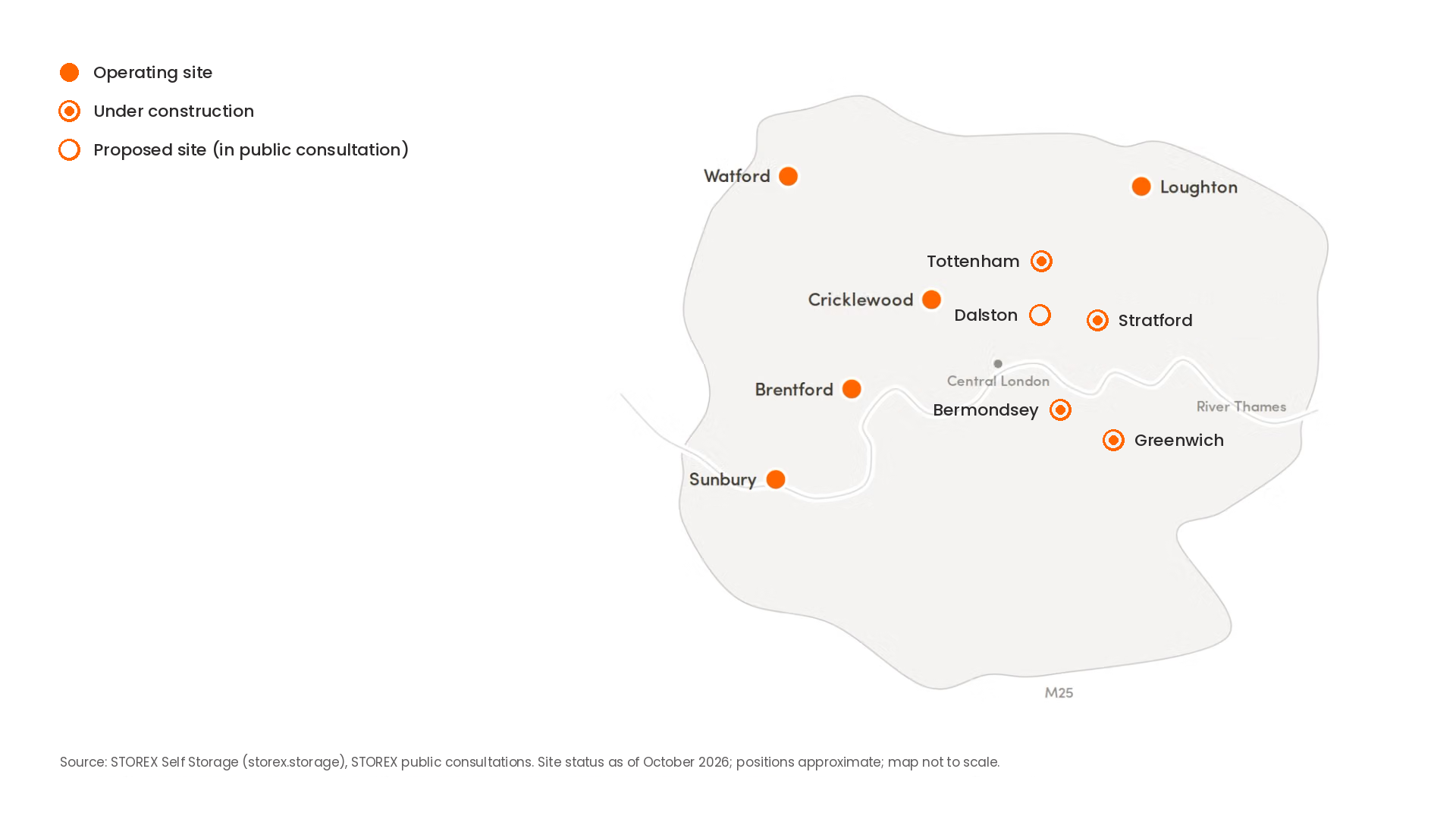
To have real appeal for customers, a site needs to be within a 10-to-15-minute drive, so STOREX is focusing on densely populated areas. Its five existing sites are all located inside the M25, the highway encircling London. A sixth store is set to open in Greenwich in the coming months and four more are due by the end of next year.
STOREX’s self-storage sites around London
The UK isn’t the only market on STOREX’s radar. The team is also already scouting Madrid and Paris, where apartment sizes are shrinking, using its data-analysis platform to calculate the optimal site selection.
One of STOREX’s other advantages so far, Grant says, has been speed. “Normally, the development process would take two and a half to three years. But we’re developing and constructing our stores in about a year and a half. So, we're buying a site, six months for a permit, nine to 12 months to build them and then we start to operate.”
Part of this is that it’s building up – into the sky – to fit more units on a plot. It’s also innovated with sustainable construction materials, including cement from Cemvision and facades from Made of Air, two businesses backed by the EQT Foundation. STOREX has also intentionally avoided buying existing storage assets at inflated multiples. While the firm looks at every opportunity, it’s very selective in its acquisition process.
The final innovation is STOREX’s Fab Lab units, ground-floor work spaces that serve as shop fronts. “It’s like the high street in a box. We have soapmakers, flower sellers, we've got people who do podcasts, who do pilates,” explains Grant. “It’s affordable, you’re not tied into a long lease, and you can use it as you wish,” except for sleeping or eating.
Educating the consumer
Despite plentiful demand, STOREX still needs to earn consumers’ trust ahead of the competition. Indeed, at its Brentford site in west London, STOREX is one of eight self-storage competitors within a one-mile radius.
STOREX must therefore convince customers that its offering is premium, with top-tier security, carbon-negative credentials and a unique ventilation system (the air is replaced every 4 hours, avoiding mould damage). “We are using bank-grade security. There are no padlocks; the lock is on your phone,” says Grant. In time, STOREX will be priced accordingly, offering higher margins.
The other part of the education pie is that many customers are "not quite ready" to fully self-serve, says Smith. Some will need “hand holding.”
But so far, so good. Many of the first customers in the Watford site have stayed loyal and retained their units. Around 70 percent of STOREX's customers are first-time self-storage users, drawing in a new, previously unserved audience. And crucially, STOREX’s occupancy is climbing despite the “cost of living crisis" hitting occupancy rates in some sectors of real estate, says Grant. “We’re solving a problem.”
Note: STOREX currently sits as a portfolio company inside EQT's Real Estate arm. The plan now is to spin it out into a standalone operating entity. The company is currently raising a round, split evenly between seed and growth capital, to fund its next phase.

ThinQ by EQT: A publication where private markets meet open minds. Join the conversation – [email protected]
On the topic ofCase Studies





Exclusive News and Insights Every Month
Sign up to subscribe to the EQT newsletter.