

What Exactly Is An Evergreen Fund?



Evergreen funds offer a middle ground between fully liquid and illiquid investments, striking a balance between access to capital and high potential returns. This guide explains what evergreen assets are, why they might appeal to investors, and the trade-offs involved.
- Evergreen funds provide the flexibility to access capital during the investment period and high potential returns, making them attractive to private investors.
When investors talk about ‘liquidity’, they are really talking about how easily an asset can be converted into cash without affecting its price. So, the more liquid an asset, the easier it is to convert. Nothing is more liquid than cash, of course, and less liquid assets might be things like property, where there is a long lead time to close a sale.
This all begs the question, why do investors care about liquidity in the first place? For the most part, it comes down to flexibility. If you have an urgent financial commitment, enduring a long wait to access cash is a problem. Similarly, if you sense a market downturn on the horizon, you may wish to rebalance your portfolio quickly. The upshot is that liquidity matters, especially today.
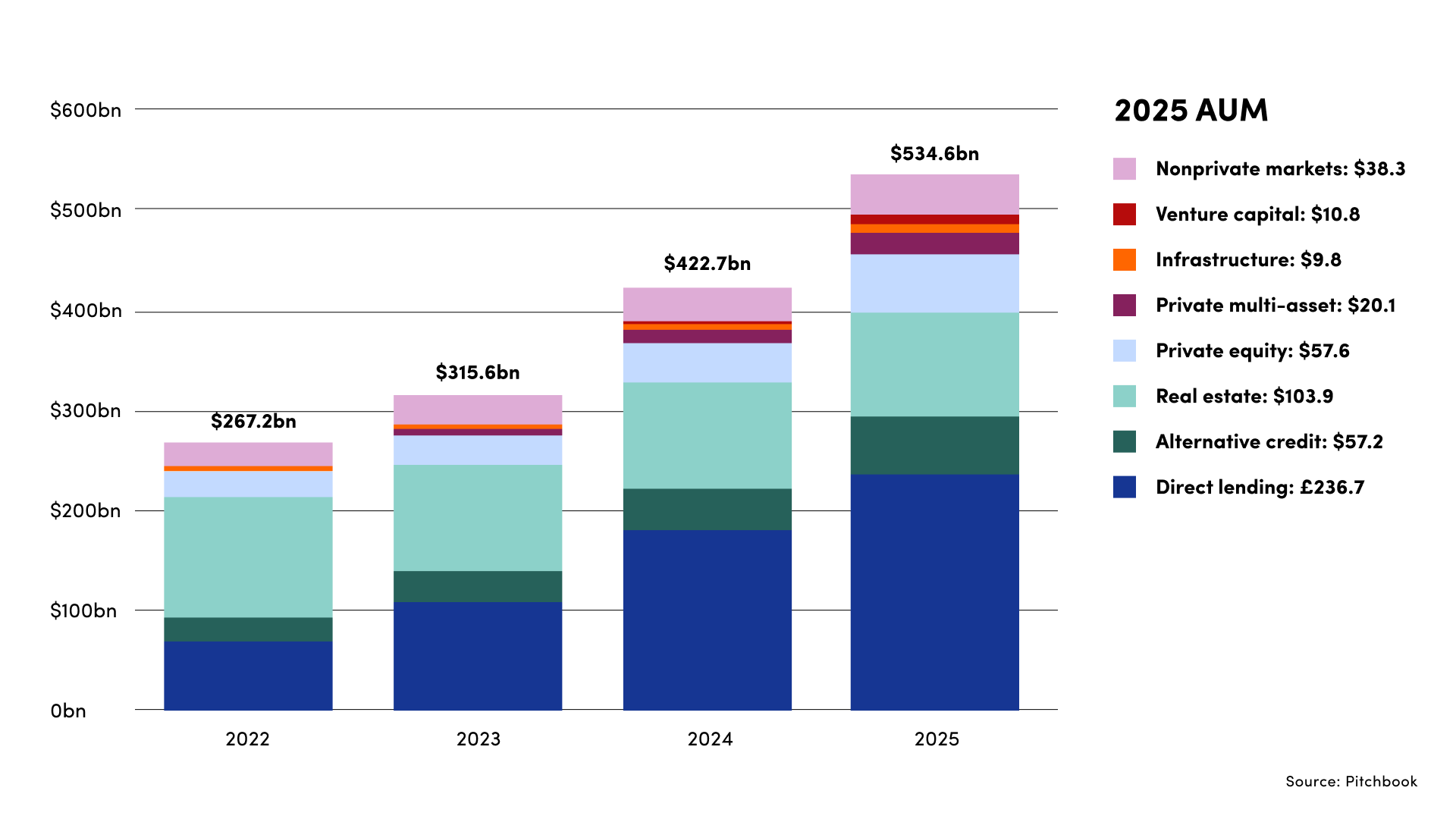
When it comes to private equity (PE), though, investments are mostly made over a longer term, meaning liquidity is typically limited. Evergreen funds are changing that. As one of the fastest-growing structures in private markets today, they offer a fundamentally different way to invest, with more accessibility for individual investors. In the U.S. alone, evergreen net assets under management totaled $534.6bn in 2025, up from $267bn in 2022, according to data from PitchBook.
But what exactly is an evergreen fund, and how does it differ from a traditional private equity vehicle?
No End Date, No Expiry
A traditional private equity fund, sometimes called a closed-end or drawdown fund, has a fixed lifespan, typically 10 years. Investors commit capital at the outset, the fund manager draws on those commitments as opportunities arise, and the fund eventually winds down and returns proceeds to investors. It is a linear process with a clear beginning and end.
An evergreen fund, by contrast, operates on a perpetual basis. There is no fixed end date. Capital is raised continuously, invested on an ongoing basis, and reinvested as assets are sold. Investors can typically enter and exit at periodic intervals, usually quarterly. This is why evergreen funds are also referred to as “semi-liquid” funds.
In the context of this concerted push, private investors might be attracted to semi-liquid PE funds for several reasons:
- Increased liquidity: compared to traditional PE, semi-liquid assets offer the flexibility to access capital while still benefiting from high potential returns.
- Diversification and risk reduction: investors can gain exposure to a wider array of alternative assets via semi-liquid funds, such as private equity and real estate, which are less linked to the performance of public markets.
- Lower barriers to entry: typically, evergreen funds have lower investment minimums than closed-end PE funds, making semi-liquid assets more accessible to individual and smaller institutional investors.
- Immediate exposure to markets: when they invest, investors get immediate exposure to the assets already in a semi-liquid fund. With a closed-end fund, they would typically have to wait several years for the fund to build capital, and then invest it.
The term “evergreen” itself is borrowed from forestry, where it describes trees that retain their leaves year-round, a metaphor for the continuous, self-renewing character of this fund structure.
Asset type breakdown for U.S. evergreens
How Evergreen Funds Work
Rather than issuing capital calls and distributing proceeds at exit, evergreen funds maintain a rolling portfolio. When a portfolio company is sold, the proceeds are typically reinvested into new opportunities rather than returned to investors. Investors own shares in the fund, priced at net asset value (NAV), and updated regularly to reflect the underlying portfolio.
This creates a fundamentally different experience compared to traditional drawdown funds. Investors can gain immediate exposure to a diversified portfolio from day one, rather than facing the “J-curve”, the dip in returns that typically occurs in the early years of a drawdown fund as capital is deployed but companies have not yet been developed and sold.
To support periodic liquidity, most evergreen funds hold a small sleeve of liquid assets that can be used to fund investor redemptions. This is the key structural trade-off: some portion of the fund is held in more liquid but lower-yielding assets, which can modestly dampen overall returns compared to a fully invested closed-end fund.
Why Evergreen Funds Are Growing Fast
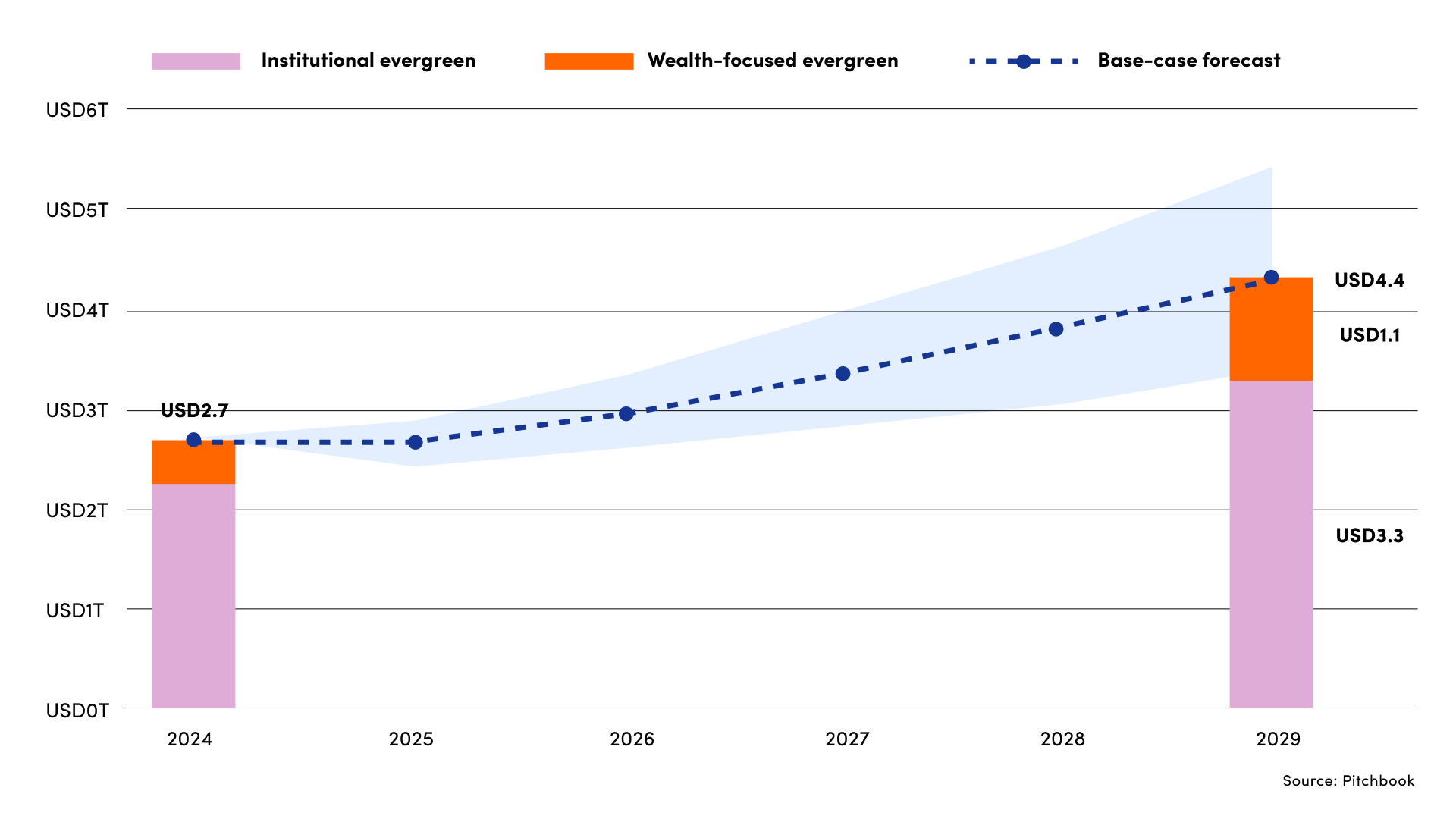
Evergreen structures have existed in various forms for years, but their growth has accelerated dramatically in the last half-decade. According to HSBC, around $2.7tn globally was managed in various indefinite-life formats at the end of 2024, a figure projected to rise to $4.4tn by the end of 2029.
Two forces are driving this expansion. The first is the growing interest from wealthy individuals and family offices in accessing private markets. Globally, more than 23 million people worldwide held upwards of $1m in investable assets in 2024. The total wealth held by these high-net-worth individuals was $90.5tn, according to Capgemini. Private markets, long the preserve of large institutions, are an increasingly natural destination for that capital.
The second force is the desire of fund managers to offer a more operationally straightforward product. Evergreen funds remove much of the administrative complexity of traditional drawdown funds: there are no capital calls for investors to manage, no reinvestment headaches when distributions arrive, and no need to time commitments across multiple fund vintages.
Evergreens to be a $4.4tn strategy by 2029
The Trade-Offs
Evergreen funds offer genuine advantages, but they are not without limitations. The liquidity they provide is periodic, not guaranteed. In periods of market stress, redemption queues can build up, and the fund manager may restrict or suspend withdrawals to protect remaining investors.
The cash held in these funds to support a liquidity mechanism can also dampen overall returns when compared to drawdown funds, which are unencumbered by periodic tender offerings.
Understanding the unique characteristics of evergreen assets and the trade-offs involved can help investors make more informed decisions and tailor their investment strategies to support their financial goals.

ThinQ by EQT: A publication where private markets meet open minds. Join the conversation – [email protected]