

Startup Hub Profile: Paris Comes of Age



EQT Ventures’ Pierrick Cudonnec and Rania Belkahia unpack Paris’s many advantages as a European startup hub.
- Paris is brimming with abundant talent, community resources and nuclear energy.
In 2017, just weeks into his first term in office, French President Emmanuel Macron declared his intention to make France a “startup nation”.
Backing up those words required action. It required funding, ecosystem builders and government incentives. And it required students.
Along with abundant talent, community resources and nuclear energy, this student renaissance lies at the heart of Paris’s emergence as a significant European startup hub. In the second of a short series of city profiles for ThinQ, we examine the French capital’s role as a vibrant part of Europe’s tech ecosystem.
‘Creating something new’
Ahmed Achchak, founder of EQT Ventures-backed cybersecurity company Qevlar AI, recalls the shift toward entrepreneurship at his engineering school, the renowned CentraleSupélec, where he studied from 2014 to 2017. “The school started to talk a lot more about entrepreneurship and startups, and it became a glamorous thing. A lot of students became interested in maybe creating something new.”
French universities are considered among the top institutions in Europe for producing valuable spin-out companies. Per analysis from the Royal Academy of Engineering, four of the top 20 deep-tech spin-out creators since 2010 are French, all of them in Paris. An MVA – a master’s degree in “mathématiques” (math), “vision” (vision) and “apprentissage” (learning) – from the Paris-Saclay University has become viewed as a key stepping stone for ambitious students seeking a career in AI.
“France produces a large number of highly trained engineers and mathematicians from institutions such as École Polytechnique, CentraleSupélec and the Paris-Saclay cluster,” says EQT Ventures director Pierrick Cudonnec. “This feeds into a vibrant deep-tech ecosystem.”
Pruna AI, a deeptech company backed up EQT Ventures that’s developing world-class performance models, was founded by a team who graduated from France’s CentraleSupélec and Germany’s Technical University of Munich, he notes.
Ranking of European Universities by Spinout Value Creation Since 2010
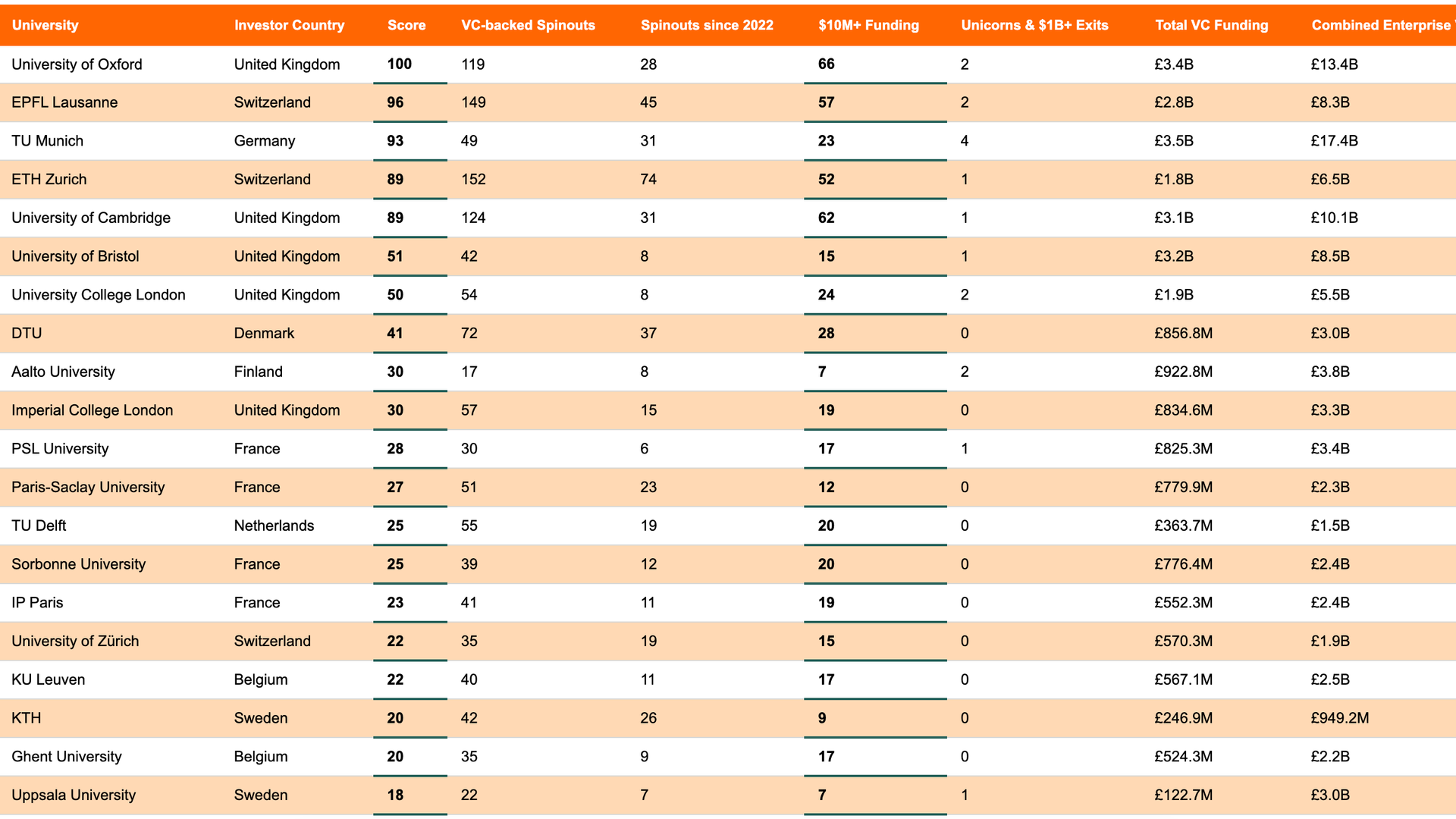
Source: Royal Academy of Engineering, Dealroom
The successors to Achchak and his classmates from the 2010s are today’s student hackers and vibecoders. As entrepreneurship becomes a more accepted career path, aspiring founders are following more structured ways into the startup world, including some overseen by the students themselves.
Unaite is a student-led federation between the AI clubs of several universities. The organizers have planned events in conjunction with the likes of Anthropic and Y Combinator.
“Students who are involved in AI clubs are seeking things that we don’t find in our own universities,” says Chakib Lahrach, the group’s president. That might be a chance to try new projects, or a way to meet like-minded peers and build their networks.
France’s startup scene has been bolstered by a series of high-profile funding rounds in recent years. Yann LeCun’s AMI Labs raised a $1bn seed round in March, just a few months after it was founded. H Company burst onto the scene in 2023 before raising a record $220m seed round the following year. In September, French AI champion Mistral closed a $3.5bn Series D, the largest equity round ever completed by a European tech company, backed by the EQT-managed Scaleup Europe Fund.
Despite these successes, Lahrach is hungry for more. “There’s not enough big startups that came out of France in comparison to the proportion of talent,” he says.
France’s power play
Away from the vibrant student and startup community scenes, Paris may have a key advantage in electricity. To potentially excel in the age of AI, one needs energy-hungry compute – and France generates around two thirds of its power from nuclear.
Just outside of the capital, in the tiny commune of Fouju, work is underway with the aim to build one of France’s key assets in the AI revolution. Campus IA, billed as Europe’s largest AI campus, is expected to ultimately reach a capacity of 1.4GW and be able to support everything from model training and inference to deployment of generative and applied AI systems. The project is the result of a collaboration between the French national investment bank Bpifrance, UAE investment fund MGX, chipmaking giant Nvidia, and Mistral.
CEO Thibaud Desfossés compares it to the physical infrastructure that supports trade in physical goods. “It’s like a harbor, right? What matters is what it enables,” he says.
“When you look at large harbor projects in France – such as what they’re doing in Dunkirk, for example – part of the magic happens when you use this core infrastructure to then aggregate and pool industrial and economic development through other related industries.”
That’s the plan for Campus IA as well. French and European AI developers will get privileged access to compute at scale. The site will also be part of efforts to get more European players selling into the AI value chain, linking those homegrown teams up with the cloud and AI giants to help them develop the right products. “We want for our project to make not a token but a meaningful contribution,” Desfossés says.
While other locations were considered, being close to Paris is advantageous from a fiber connectivity perspective – plugging it directly into one of Europe’s busiest data hubs.
“France has this critical resource of cheap decarbonated, abundant, stable nuclear energy,” says Desfossés. “And AI is very much the act of converting energy into intelligence.”
Going global
The convergence of these advantages in the past two or three years has moved the conversation from Paris catching up to Paris setting the pace in certain sectors, Cudonnec says. “That’s been driven by trends like an increase in the number of second-time founders and French companies raising larger seed rounds.”
It’s not just about growing the local scene either. Paris has a global outlook, in part enabled by practical advantages like its four high-speed rail lines which can take passengers across mainland Europe and directly into London. But it’s also part of the French founder mindset.
French startups often expand into Germany, Spain, Italy and the Benelux region relatively early – while also having a strong line into the U.S. market, notes Cudonnec.
“As the second-largest economy in the European Union, my view is that France offers startups a dense, lucrative domestic market before they scale globally,” agrees Rania Belkahia, a deal partner at EQT Ventures.
That was certainly the case for Achchak. “We do feel more like a European company,” he says of Qevlar. “We’ve always had, even from day one, customers outside of France. It has given us this depth.”
Some of Qevlar’s customers include huge multinationals such as Sodexo and U.S.-based market leaders like CloudFirst. It’s been a rapid pace. But that’s what makes it exhilarating. Thinking about how Qevlar has gone from two engineers trying to crack a problem to a team of 75 in just a few years, says Achchak, gives him energy. “That just fuels you.”
Large French firms listed on the nation’s benchmark CAC 40 have demonstrated a willingness to be buyers of products from startups and scale-ups, according to Belkahia. These multinationals – in sectors such as luxury and automotive – are keen to work with smaller companies to modernize their business processes.
‘More success stories’
The next challenge is to make more of these fast-growing companies into global names that can continue channeling success back into the Paris ecosystem. The French scene appears to have entered its “flywheel” phase, with second- and third-generation founders recycling capital, experience, and talent back into early-stage ventures, according to Belkahia.
“We need more success stories and we need more proof points that our companies can get to scale and escape velocity,” says Campus IA’s Desfossés.
Roxanne Varza, director of Station F, Paris’s famous startup incubator and events hub, is hopeful that more French firms will break out in coming years. “There are a few companies that I think could be big candidates,” she said last year on a podcast. “These are still very young companies and a lot can happen.”

ThinQ by EQT: A publication where private markets meet open minds. Join the conversation – [email protected]
On the topic ofthe Scaleup Europe Fund


Exclusive News and Insights Every Month
Sign up to subscribe to the EQT newsletter.