

Startup Hub Profile: Munich’s Deep-Tech Journey
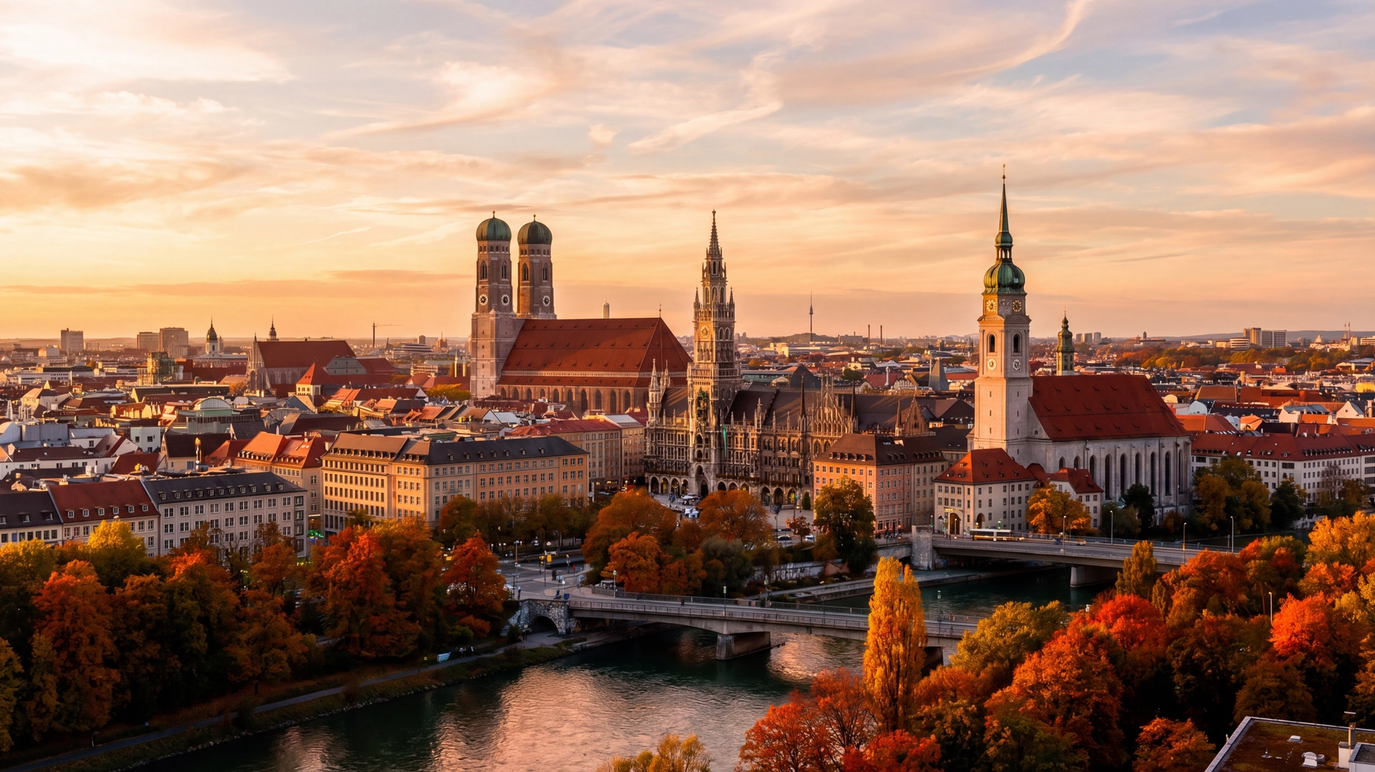

Building on a storied industrial heritage and deep pool of technical talent, Munich is becoming one of Europe’s most vibrant tech hubs, EQT’s Ludwig Scherm explains.
- Munich offers talented graduates, rich industrial-know and a distinct mix of laptops and lederhosen, attracting global talent.
“One could think that Oktoberfest is only for joy,” says Heike Freund, COO of EQT-backed Marvel Fusion, which is working to build a commercially viable fusion power plant. “But Oktoberfest is also for business.”
The famous Munich beer festival is just one way the German city’s ambitious entrepreneurs mix business and pleasure. On a sunny day, you can spend hours at the 900-acre Englischer Garten in the city center. Or within a short drive you can be in the Alps, for skiing in the winter or paddle-boarding across the lakes in the summer.
In the first of a series of city profiles for ThinQ, we examine Munich’s place in Europe’s growing technology ecosystem. A long-running refrain about Bavaria is that it is the land of both laptops and lederhosen: a place that combines traditions with a buzzing economy.
For those building ambitious businesses in the Munich area, there’s much more to it than that. The city offers rich industrial heritage as the home to businesses such as BMW. More recently it has become a hub for deep-tech startups, fed by a stream of talented graduates from the region’s universities.
“Munich’s startups are thinking really big now,” says Ludwig Scherm, a managing director in the Scaleup Europe Fund, an EU initiative to support the region’s most promising technology companies that’s managed by EQT. “They’re thinking SpaceX-big.”
Going big
When Scherm began his career in growth investing the heat outside of London was all in Berlin, Germany’s capital. “I remember, being in London, we were basically flying out to Berlin every second week or so.”
This was during a period when investors and founders alike were focused on building asset-light companies that would aim to disrupt often long-standing, mainly offline industries and scale rapidly. “The main skill for scaling something like that is digital company building and sales and marketing, and you had a lot of talent and expertise for that out of Berlin, fueled by the legacy of the Samwer brothers and Rocket Internet."
As many existing industries transitioned from offline to online, innovation slowed and the focus shifted to execution and, in many cases, consolidation, he recalls. But that has changed since a new cohort of companies, founded around the time of the pandemic, began to mature in the last couple of years. The AI boom has accelerated the trend as – in many industries – large language models (LLMs) redefined competition. Suddenly, there are big players requiring big checks.
Businesses built over the last few years scale to the kind of sizes that makes late-stage growth investors take notice. At the same time, the war in Ukraine shifted the focus to European resilience.
“We see demand coming from an entirely different direction, which is more deep-tech companies,” he says. “We see much more hardware-heavy, capex-heavy companies that are building, for instance, in space, in robotics, in defense and dual-use, even quantum.”
Besides LLMs, many novel technologies that for a long-time were restricted to the realm of research, are making their way to the market and in many cases creating new markets altogether.
Munich has become an important market for EQT Ventures, which has been backing the city’s next generation of technology companies from an early stage. In addition to Marvel Fusion, the local EQT Ventures portfolio includes startups such as The Exploration Company and Insempra, reflecting the shift towards more ambitious, technically complex businesses emerging from the region.
“Munich is exactly the kind of ecosystem we look for,” says Carolina Brochado, head of EQT Ventures and head of EQT Growth U.S. “It has exceptional technical talent embedded in a deep industrial network, and the ambition to build global category leaders from day one.”
Munich’s advantages
Munich attracts skilled technical talent to the prestigious Ludwig-Maximilians University (LMU) and the Technical University of Munich (TUM). Together these institutions run the Center for Digital Technology and Management (CDTM), which aims to instil key entrepreneurship skills in students. TUM also manages an influential startup lab called UnternehmerTUM, which has become a cornerstone of the city’s tech scene since its foundation in 2022.
On top of this educational foundation, Munich offers access to the region’s established manufacturing and research-led businesses: Siemens, BMW and Infineon, to name a few. This deep industrial heritage is doubly useful because up-and-comers need established players to be their suppliers, customers and partners. Marvel Fusion, for example, has a partnership with Siemens Energy, working together on power plant technology.
“As a fusion startup, you can’t do everything by yourself,” says Freund. “Having strong industrial partners is key.”
In addition to its existing reputation for automotive and industrial engineering, Munich is now becoming a growing hub for defense and dual-use tech.
“The geopolitical situation has accelerated that shift,” says Jan-Hendrik Boelens, founder and CEO of Alpine Eagle, a designer of anti-drone technology. “Founders, investors and policymakers increasingly recognize that resilience, sovereignty and security are technology challenges.”
Earlier this year, the Bundeswehr Innovation Center opened at the nearby Erding Air Base as part of Germany’s broader efforts to overhaul defense procurement. The site “enables much closer exchange with military users, faster feedback cycles and earlier validation of new technologies” says Boelens. “For a defense startup, that kind of access is of incredible value.”
Many companies founded with a non-defense focus have also embraced “dual-use” applications. Munich-based Ororatech, for example, makes thermal imaging satellites that can monitor wildfires from space. While the company initially restricted the tech to civilian usage, it is now expanding that to dual-use applications such as tracking marine vessels. Quantum Systems, whose drones have completed thousands of missions in Ukraine, started off developing civilian use-cases focused on agriculture, mapping and industrial data collection.
Though these changes reflect a fast-shifting geopolitical situation, they also echo Munich’s historical focus on defense. The Munich Security Conference, first held in 1963, is still going strong today. And Bavaria’s high tech development policies in the post-war era were focused on the arms industry.
Flow of funding
Bavaria’s regional government also plays its part. Bayern Kapital, the state investment fund, has been backing companies from seed to scale-up stage since 1995 and has grown to manage €1.3bn. Last year, the state parliament passed a rules shake-up that allowed Bavarian foundations to invest their money in venture capital.
This all helped Bavaria top Berlin for startup fundraising last year, according to data compiled by EY. The southern state was home to seven of the 10 biggest funding rounds. All that capital will be needed to help Munich’s growing companies compete globally.
“To actually make these companies successful you need to have a much longer breath as an investor,” says Scherm. “You need to potentially invest much more capital to support them at scale – and also it will take much longer to see whether a new technology actually works.”
That level of investment doesn’t just help individual companies. Freund says that collaboration between businesses is also a major feature of the city’s highly concentrated ecosystem, and contributes to its strength. “Munich is really becoming an important hub for deep-tech in Europe.”

ThinQ by EQT: A publication where private markets meet open minds. Join the conversation – [email protected]
On the topic ofthe Scaleup Europe Fund




Exclusive News and Insights Every Month
Sign up to subscribe to the EQT newsletter.