



Five Questions to Consider as Evergreen Strategies Proliferate

Evergreen strategies can make private markets more reachable for private wealth clients through lower thresholds, rolling subscriptions and periodic liquidity options.
Many private wealth investors are turning to private markets for potential long‑term growth, diversification, and exposure to unlisted companies.
As a result, demand has risen for more flexible strategies such as evergreen structures: single, continuously invested vehicles that can accept new capital over time and deploy it gradually.
Lower barriers could increase access, but they do not ensure a manager has the experience or controls to source suitable deals, run the fund responsibly or manage liquidity.
This guide may help investors judge whether a manager can be compliant with necessary requirements.
Evergreen strategies at a glance
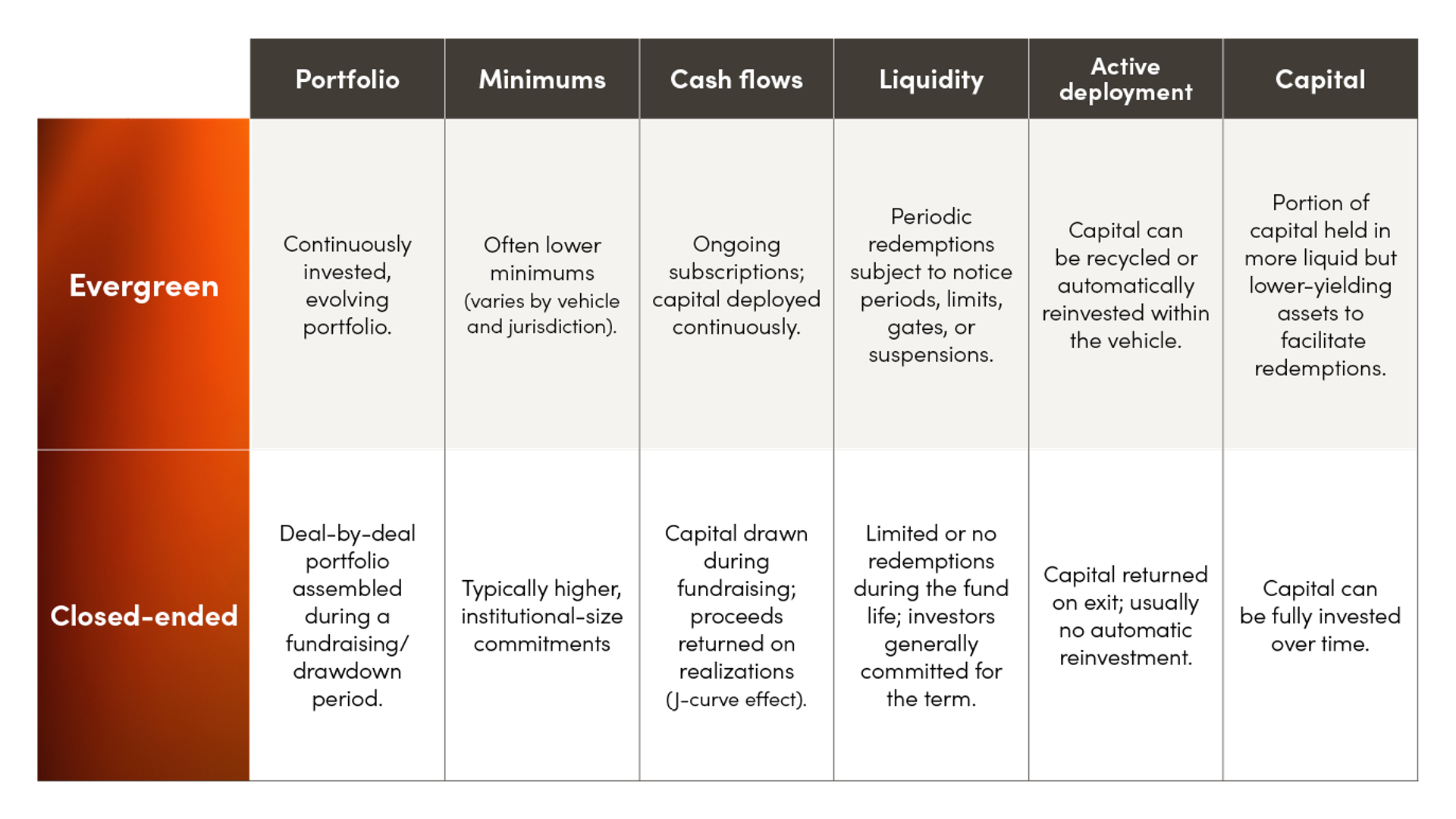
Evergreen and closed-end strategies differ in several ways. Some of the key differences are outlined in the table below.
Evergreen manager selection
1. Strong and continuous deal flow
Evergreen funds must keep deploying capital, so a manager’s ability to source investments on an ongoing basis is important.
In our view, deal origination should be predictable and repeatable across sectors, geographies and market cycles.
Potential points to consider
- Can the manager source sufficiently broad deals for an evergreen strategy, even in downturns?
- Does the manager directly control the underlying investments, or does a third party manage performance?
- Does the manager have experience successfully exiting investments through different market cycles?
2. Specialist team with hands-on experience
In our view, managing an evergreen strategy requires hands‑on experience with running perpetual capital across market cycles.
A good sign could be that a team that has actively managed deployment, redemptions, valuations, and liquidity as one integrated system, with a practical understanding of how they affect each other.
Potential points to consider
- Can the team show they’ve run evergreen or perpetual strategies through market cycles?
- Is there a dedicated, stable team with a clear mandate within the firm?
- What are the processes for deployment, redemptions, valuation and liquidity, and are they stress‑tested?
3. The investor’s interests come first
Evergreen strategies may provide the same deal access as that available to large institutional clients.
When the manager co‑invests alongside clients, this may support alignment of interests between the manager and its clients.
Potential points to consider
- Is the evergreen strategy investing in the same deals as large institutional clients?
- What are the selection criteria for co-investments?
- Has there been steady growth with a sufficiently diversified investor base?
4. Governance designed for stressed markets
In our view, the structure must stand up under pressure, not only in calm markets.
That means a consistent valuation policy, independent oversight and risk controls that have been stress‑tested – to help ensure fair pricing, orderly redemptions and transparent treatment for all investors.
Governance should include a dedicated Investment Committee whose members have no conflicting external roles.
Potential points to consider
- Is the valuation policy documented, consistently applied and regularly reviewed?
- Are stress tests, liquidity and concentration limits, and contingency triggers defined and practised?
- Can the manager quickly obtain accurate information on portfolio risks and directly oversee underlying investments during market shocks?
5. Economics the investor can understand
Fees should be simple, transparent and efficient.
A single, clearly explained fee layer could preserve long‑term compounding and makes net returns easier to understand. Eligible investors may consider reviewing clear illustrations of net returns after fees.
Potential points to consider
- Is there a clearly explained fee layer, and can charges be easily reconciled?
- How are underlying fees handled and disclosed?
At EQT, "Better Never Ends" is more than a tagline – it drives how we source deals, steward companies and manage opportunities.
That’s why we strive to put clients at the heart of our investment approach, with the aim of building the appropriate strategies for the right audiences and providing clarity, expertise and education throughout the journey.

ThinQ by EQT: A publication where private markets meet open minds. Join the conversation – [email protected]
On the topic ofPrivate markets



Exclusive News and Insights Every Month
Sign up to subscribe to the EQT newsletter.