

Tubulis Turns Novel Cancer Approach Into $5bn Deal

German biotech company uses novel chemistry to build “guided-missile” cancer drugs for precision chemotherapy.
- Tubulis uses novel chemistry to design more stable “guided-missile” cancer drugs.
In 2019, two scientists in Germany set out to solve a problem that had frustrated cancer researchers for decades. Just seven years later, Gilead Sciences agreed to acquire their company for up to $5bn in the biggest deal ever for a privately-held European biotech.
Tubulis co-founder Dominik Schumacher attributes the company’s rise to a few key principles: a strong belief in the company’s science, an openness to advice from experienced outsiders, and the discipline to adapt to new data. Underpinning all of that was a determination to deliver on the long-held promise of “guided-missile” cancer drugs.
The goal was straightforward in theory: hunt down tumor cells and deliver powerful drugs at close range. Yet early efforts to develop these treatments, known as antibody-drug conjugates, or ADCs, fell short. That was often because they would release the treatment prematurely, causing precisely the problem they sought to avoid: collateral damage to healthy tissue.
Those challenges, far from deterring Schumacher and his co-founders Jonas Helma-Smets and Ingo Lehrke, only sharpened their focus. Through their academic work in Munich and Berlin, they spent the 2010s applying novel chemistry to the problem.
“Everybody was asking us why we were doing this, because ADCs were not working,” Schumacher says. “We said, ‘That’s exactly why we’re doing it, because we believe that with our technology we can overcome the reasons why.’”
Surging pipeline
ADCs comprise three components: a protein, or antibody, designed to bind specifically to receptors on tumor cells, a powerful cancer-killing drug, and a molecular linker that holds them together. One of the key insights at Tubulis centered on the unique properties of phosphorus in building a more stable linker that released the powerful treatment only once it reached the cancerous cells.
Despite wider pessimism about ADCs, the promise of their work was recognized by the local biotech community. In 2017, the team was awarded a €500,000 grant by BioM, an organization that supports the Munich biomedicine sector.
“Although the appetite of pharma and investors in ADCs was rather poor at that time, we think our jury members still saw the superiority of the Tubulis conjugation technology,” recalls Christina Enke-Stolle, a member of the venture creation team at BioM.
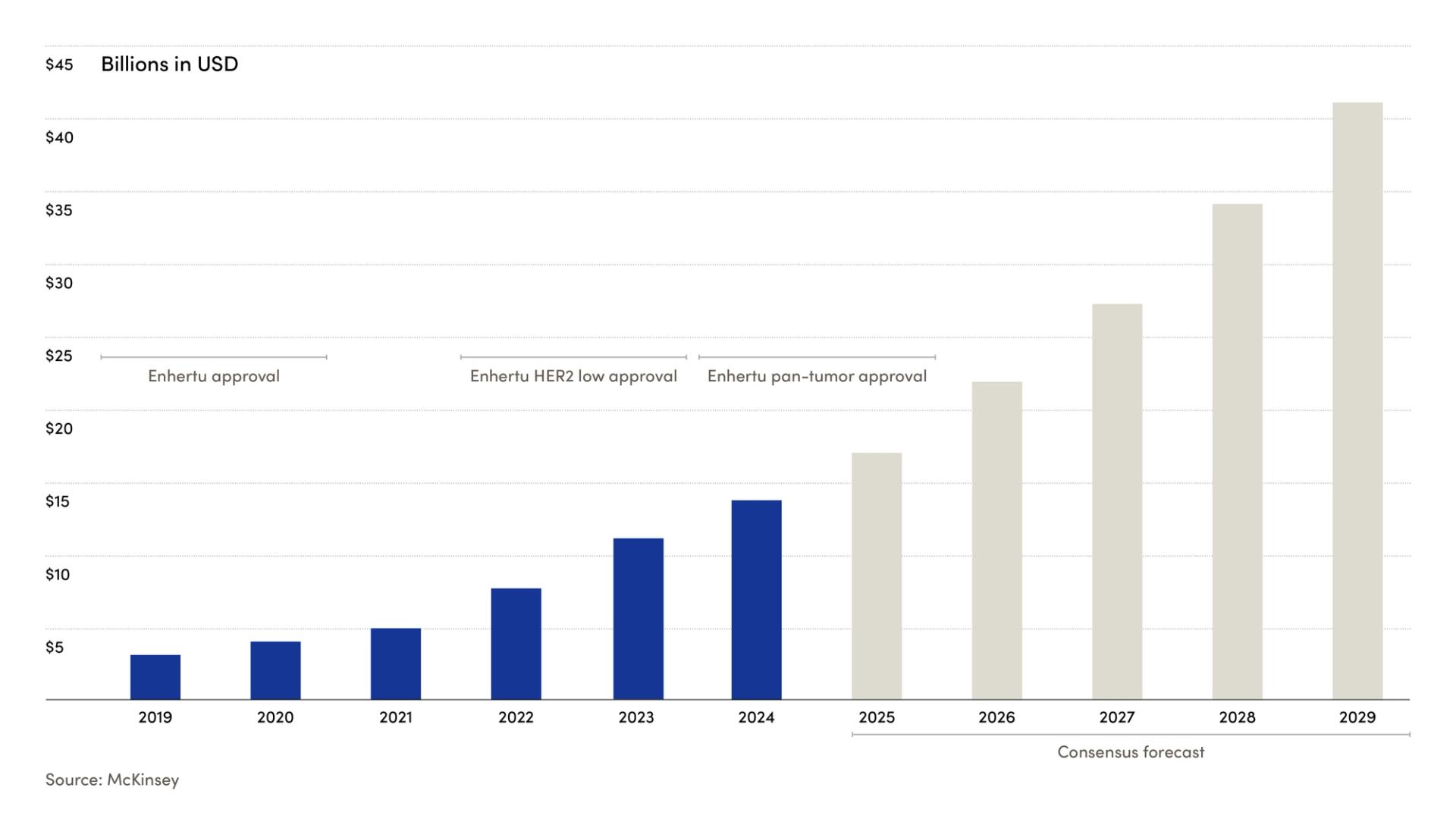
Schumacher and Helma-Smets’ conviction that better drug design was key to unlocking the promise of ADCs was soon validated by a major breakthrough. In 2019, just months after they spun out Tubulis, a new ADC called Enhertu, developed by AstraZeneca and Daiichi-Sankyo, was granted accelerated approval by the Food and Drug Administration after showing positive results in metastatic breast cancer.
Suddenly, the young company was working in one of the fastest-growing areas of cancer research. In the years that followed, Enhertu and several other ADCs became blockbuster drugs and the global development pipeline ballooned to include hundreds of new candidates.
Science-driven
Tubulis’ first drug candidate focused on lymphoma. That made sense at the time, Schumacher says, because it was a demonstrated target for ADCs and thus less risky. But as Tubulis continued to generate promising data, it became clear that the greater area of unmet need – and therefore stronger business rationale – was in solid tumors, which are more challenging to treat and account for 90 percent of new cancer cases worldwide.
“One day, everybody was running in that direction, and then the next day, everybody ran in the other direction,” Schumacher says. “The team was just very data-driven and rational.”
Shifting focus to solid tumors proved key to advancing the company’s strategy.
“That strategic pivot made it more investable for us,” says Christoph Broja, partner at EQT Life Sciences, which co-led a €128m funding round in March 2024. “It went from a sort of me-too, or me-better, ADC to something truly differentiated”.
“Management really responded to all of our questions with data, not with hand-waving,” he adds. “And this has continued to be a hallmark of the Tubulis management team.”
Another round
The financing helped Tubulis expand and begin testing its drugs in patients. At the time, Tubulis had two potential drugs, Schumacher says. They decided to prioritize a candidate dubbed TUB-040, which targets a receptor, NaPi2b, often found in ovarian and lung cancers. Schumacher and his team bet that their phosphorus-based linker would allow their drug to work where earlier ADCs with the same target had failed.
The wager paid off: In the first clinical trial, around 18 months later, 59 percent of patients responded to treatment. “We were able to show this is driven by the platform,” Schumacher says. “It’s the power of phosphorus chemistry.”
Estimated Global Market for Antibody-Drug Conjugates
All the while, Schumacher and the leadership team at Tubulis tirelessly pursued more funding. In October 2025, just a few days before it shared its first clinical trial results, Tubulis raised another €308m – the largest financing round for a privately-held ADC developer globally – with EQT again making a sizable investment.
Fundraising was crucial for Tubulis to accelerate testing of the experimental treatment and its other leading candidate, TUB-030. But it also provided the management team with experienced advisors. “We got tremendous support from our investors that also helped us shape the company on the board level,” Schumacher says. “Everybody was in it for the programs, for the patients, for the company, and creating value.”
North star
EQT’s Broja joined the supervisory board after co-leading the 2024 investment. In his role as chair of the audit committee, he led efforts to prepare for an eventual stock market listing so that Tubulis would have the option of tapping the public markets.
“We had a go-it-alone strategy, and that gave us greater strategic flexibility,” he says.
The deal with Gilead, which followed a two-year collaboration, provides the firepower for larger studies on Tubulis’ most advanced drugs and an expanded pipeline applying its linker approach to other types of cancer. At the same time, Gilead has agreed that Tubulis will operate as a dedicated ADC research organization within the pharmaceutical giant, maintaining the focus of the team. The company agreed to pay $3.15bn in upfront cash and up to $1.85bn in milestone payments.
“Their North Star was always what is the best thing for this company and ultimately for patients,” says Broja of the Tubulis team. “We all want to see these drugs come to the market because that means we can hopefully improve a lot of people’s lives.”

ThinQ by EQT: A publication where private markets meet open minds. Join the conversation – [email protected]
On the topic ofCase Studies






Exclusive News and Insights Every Month
Sign up to subscribe to the EQT newsletter.