

Sagility’s Journey from Healthcare Carve-Out to IPO



What began as an overlooked healthcare technology division within a large Indian conglomerate has since been carved out, overhauled, and taken public, recently more than doubling its year-over-year net profit.
- EQT carved out Sagility from an Indian conglomerate, unlocking its potential as a healthcare technology services provider for U.S. payors and providers.
When one of India’s largest conglomerates, the Hinduja Group, wanted to carve out the healthcare arm of its listed digital business solutions operation, one private equity firm saw an opportunity.
Baring Private Equity Asia (now part of EQT) already had a portfolio of more than 10 Asian companies within tech, with a particular focus on healthcare technology services.
“This was a fairly undiscovered business that wasn’t trading all that well, but owned by a very large industrial conglomerate in India,” says Hari Gopalakrishnan, Partner and Head of India at EQT Partners. “We knew the value of this business could be far higher.”
Gopalakrishnan’s team had a strong value creation thesis for digital services that aimed to optimize healthcare business operations. It was (and remains) a sector benefiting from regulatory tailwinds – including the U.S.’ No Surprises Act, which added new claims-processing and dispute-resolution requirements – and accelerated secular growth around data digitisation.
As payors and providers face rising administrative burdens and mounting pressure to cut waste, tech-led solutions are a potential infrastructure boon for U.S. healthcare firms.
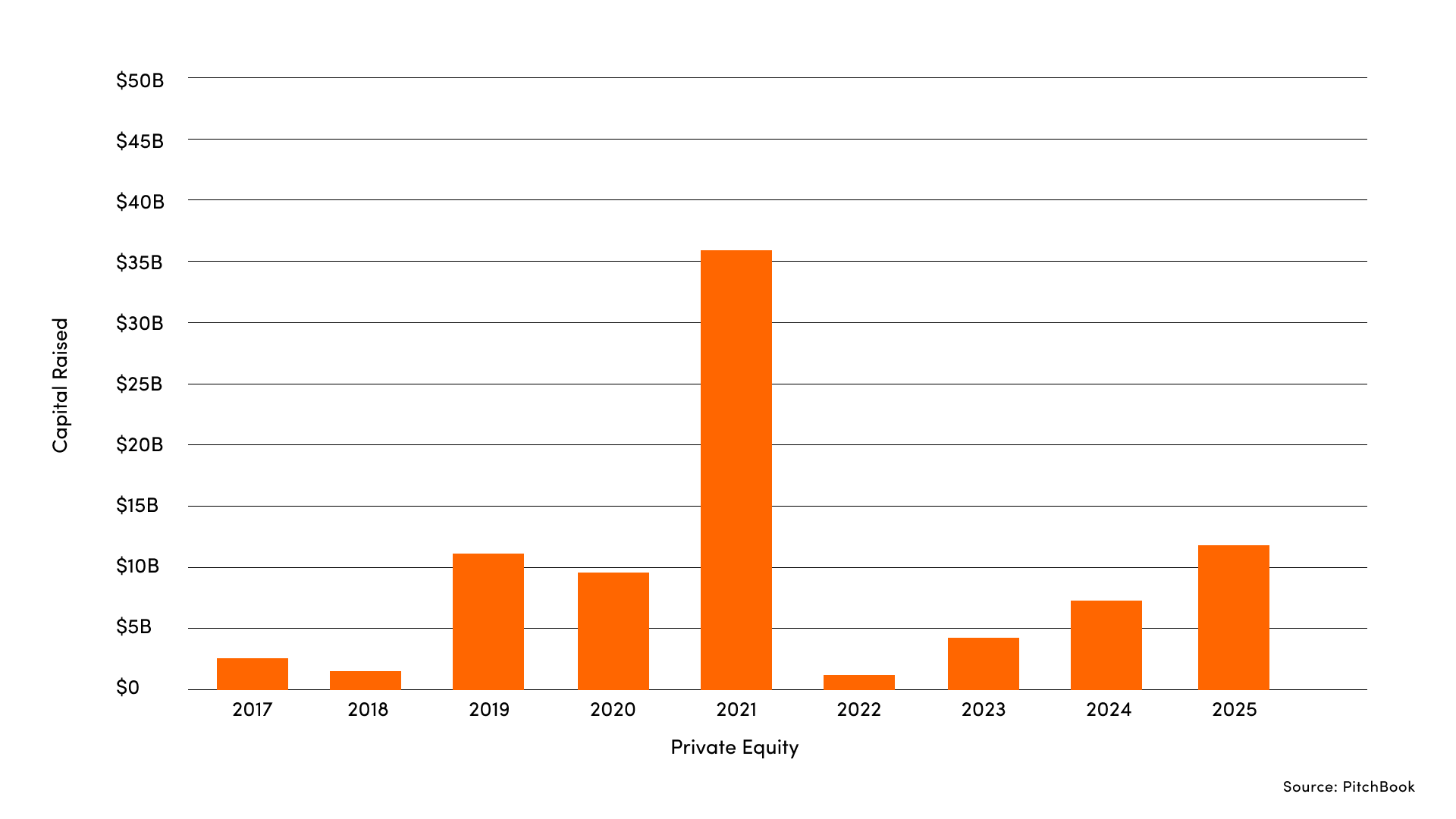
Private market firms’ interest in healthcare enterprise systems companies has resulted in $88bn in private equity-led acquisitions since 2017, according to PitchBook
Rebranded as Sagility following the 2022 carveout, the healthcare solutions provider already had operations in the U.S. servicing insurers responsible for covering the cost of medical care and providers delivering care. The firm’s strong leadership and loyal customer base stood out to the EQT team who saw an opportunity to bolster technology and analytics capabilities while aiming to drive expansion in the U.S.
Delivering the transition plan
Sagility’s long-standing relationships with large U.S. payors and providers became the foundation for its next phase of growth. These clients had been the beating heart of the business for many years. But this came with some risk, explains Gopalakrishnan. While it allowed for significant scaling, it also concentrated revenue. “When we invested, the top three customers made about 80 percent of revenue. Today it’s in the early 60s, and still coming down fast.”
Reducing revenue concentration was part of a broader effort to build Sagility from a dependable vendor into an expert in healthcare operations. In April 2023, Sagility acquired Devlin Consulting, a specialist in payment integrity that helps payors prevent improper medical payments, to strengthen its offerings and deepen its domain expertise. Sagility started off in claims processing but has since built an end-to-end service for U.S. insurance payors, covering case enrollment, claims adjudication, medical utilization, and provider network management, as well as an end-to-end Revenue Cycle Management partner for healthcare providers.
At the same time, the company strengthened its go-to-market engine by appointing a Chief Growth Officer and Head of Marketing, doubling its sales team, and forming partnerships with Deloitte, Avasant, CitiusTech, and IBM.
Sagility also undertook a significant digital transformation program. It has increased the number of technology specialists by more than 80 percent over the past four years and overhauled its data infrastructure to support data-driven decision-making for its more than 39,000 employees across five countries.
“We had a transition plan in place, which was scheduled to be for 18 months to two years. We got it done in about a year,” says Gopalakrishnan.
This speed was down to the granularity of the diligence process before making the investment, combined with a sharp focus post-deal. “Once the investment was made, we focused on creating an independent board and adding members to the board from healthcare and technology backgrounds, and accelerating investments in technology and go-to-market,” says Gopalakrishnan.
The transition also provided an opportunity for Hinduja-era employees to step into leadership roles at Sagility. “There were a lot of growth opportunities for people in the support functions,” says Sagility Group CEO and Managing Director Ramesh Gopalan.
This also meant nurturing talent and institutional knowledge sharing from within. “Rather than be a generic player, we decided to double down as a domain expert in healthcare. That brought a lot of clarity to the business decisions that we were making.”
Private equity deals in healthcare enterprise system firms
Rebuilding post-Hinduja
One of the biggest challenges Sagility faced was the carve-out itself. Gopalan recalls: “Roughly all the way from revenue to the gross profit in the business was run separately, and I already had responsibility over that, but everything below that was in a common pool.”
One hurdle was separating the general and administrative expenses, the shared costs that keep a company running, such as HR, accounting, legal, and IT, but don’t directly generate revenue. “We had to make some assumptions on the right structure and numbers of people that we needed to move to the new entity,” says Gopalan.
Another challenge was enterprise applications and IT infrastructure. The new entity, Sagility, had nothing of its own and required a transition agreement with its former parent company.
However, it wasn’t a completely blank slate. Sagility’s client infrastructure was already segregated, and the priority was ensuring uninterrupted service throughout the transition.
“In U.S. healthcare, January is the peak season when people switch insurances,” says Gopalan, referring to the so-called open enrollment period. It’s the most critical and busiest part of the year for Sagility’s clients.
Sagility closed the carve-out in January 2022 and made the switch for clients on the same day. “That was the biggest concern. But it was so seamless that the clients didn't even notice we were switching from HGS to Sagility overnight,” says Gopalan.
Taking the show on the road
With EQT’s value creation plan in motion, Sagility was now ready for its next stage: a debut in the public markets as an independent company.
“Deciding to go public in India was a shift from the earlier thinking,” says Gopalan. “We thought we’d rather do it in the U.S., because that’s our client market. But the Indian market looked a lot more attractive at that point in time.” Assets under management in the Indian capital markets system were at a record high – 68tn INR ($796bn) – at the end of 2024, having grown from just 7tn INR ($77bn) in March 2013.
That meant some restructuring to ensure the holding entity was domiciled appropriately, but it brought a key advantage: Indian investors understood Sagility’s outsourcing and offshoring model intuitively. However, Sagility still needed to make its case. An industry-specific, vertical-specific player focused solely on U.S. healthcare was a new proposition for the Indian capital markets.
“They’ve never seen a company focused on one industry,” says Gopalan. “Is that a risk? Is it big enough? What’s your future growth?” The answer lies in the fact that U.S. healthcare expenditure alone is larger than India’s entire GDP.
“We started completely from scratch, and did all of the restructuring, roadshow and IPO in about seven, eight months,” says Gopalan. “It was quite an adventure.” The listing was a major milestone for both EQT and Sagility’s employees. “All of them are very happy to see a listed company in India and feel proud about it,” says Gopalakrishnan.
EQT’s role didn’t stop there. Drawing on its experience with other Indian public companies – including CMS, Coforge, and Hexaware – the firm helped Sagility build out its investor relations infrastructure. “We appointed a dedicated IR head,” says Gopalakrishnan. “We work closely with him to increase participation of investors through increasing broker coverage.”
When this drive started, the company barely had any broker coverage. Today, there are eight brokers covering the company, with more in the pipeline. “We want to make sure that the company is on the radar of all the top investors and there is a buzz around the stock.”
In the post-IPO trading period through to end-2025, Sagility’s shares rose around 80 percent.
The next act
Since EQT invested, Sagility’s EBITDA, a core measure of a company’s operational profitability, has more than doubled. “As investors, we're proud to see how the business has performed,” says Gopalakrishnan.
This profitability comes on the back of sustained double-digit organic revenue growth – and the focus now is on maintaining that trajectory in a changing landscape.
The current AI moment represents both an opportunity and a challenge. “AI is going to partly cannibalize some parts of our business”, says Gopolan. “Future growth has to be net of that cannibalization.”
But within the U.S. healthcare market, the potential for expansion remains enormous. “While we're trying to focus on what AI brings, there’s a lot of penetration and growth headroom still left,” says Gopalakrishnan.

ThinQ by EQT: A publication where private markets meet open minds. Join the conversation – [email protected]
On the topic ofCase Studies





Exclusive News and Insights Every Month
Sign up to subscribe to the EQT newsletter.